


AI Agents Launch in Google Workspace
By Jim Lundy
AI Agents Launch in Google Workspace
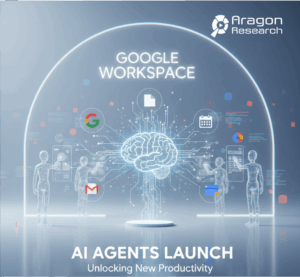
Google has announced the general availability of Google Workspace Studio, a new capability that allows users to design, manage, and share AI agents directly within the Workspace environment. This move leverages the power of Gemini 3 to enable non-technical employees to create custom agents in minutes, automating everything from simple tasks to complex, multi-step workflows. This blog overviews the Google Workspace Studio news and offers our analysis.
Why Did Google Announce Workspace Studio?
Google is positioning Workspace Studio as a necessary evolution from rigid, legacy automation tools that were too technical for the everyday user. The core motivation is to move beyond simple automation to agent-powered automation, delegating repetitive tasks to AI agents that can reason, understand context, and adapt to changing conditions. This shift is propelled by the multimodal understanding and reasoning power of the Gemini 3 model, which is used to build the agents.
The ease of creation—by simply describing the desired automation in plain language or using templates—democratizes the creation of sophisticated, intelligent workflows that can handle tasks like content generation, intelligent prioritization, sentiment analysis, and smart notifications. By deeply integrating these capabilities into the already-familiar Workspace applications, Google aims to capture more mindshare and deepen the reliance on its productivity suite.
Analysis
The announcement of Workspace Studio is Google’s preemptive strike against competitors and a clear signal that the future of enterprise productivity lies in agentic AI. This release goes beyond simply adding another AI feature; it’s an architectural shift that challenges the existing market for business process automation (BPA) and low-code/no-code application platforms. From Aragon’s perspective, this is about workplace productivity and speeding up what used to be manual processes.
Google’s unique viewpoint is that the most effective automation must be created by the people who understand the problem best—the end-users—without needing IT or specialized coding skills. This threatens traditional BPA vendors who rely on complex orchestration and IT-led deployments. Furthermore, by making agents extensible to third-party apps like Salesforce and Jira, Google is positioning Workspace as the central orchestrator for daily work, forcing other productivity suite vendors to quickly replicate a similar, easy-to-use agent creation environment or risk becoming less relevant in the automated enterprise.
What Should Enterprises Do About This News?
Enterprises should evaluate this offering deeply and understand its implications for their existing technology stack and current automation initiatives. This is not simply a feature to watch; it’s a capability that could fundamentally change how internal IT teams and business units manage automation. Note, Aragon has already been testing the email summary automation and has found it to be accurate.
Organizations should identify a few core, repeatable business processes that currently use rigid automation or are done manually—such as legal notice triage or status report generation. Pilot the creation of agents in Workspace Studio for these specific use cases to gauge the speed of deployment and the effectiveness of the Gemini-powered reasoning. Consider the cost implications of moving automation efforts away from dedicated BPA tools and into the Workspace environment.
Enterprises should also look at the cost of ownership of Workplace Productivity Suites. With Copilot still costing 30 dollars more a month on top of Microsoft 365 standard licensing, enterprises should look at the cost benefit analysis of Gemini in Workspace vs Copilot with Microsoft 355
Bottom Line
Workspace Studio is a significant step toward embedding sophisticated, reasoning AI agents into the everyday work fabric, democratizing automation across the enterprise. Aragon Research recommends that enterprises evaluate this offering now to understand how agentic AI will displace older automation paradigms. Failure to understand this shift could lead to a competitive disadvantage, as manual or overly complex processes are easily outpaced by those leveraging accessible, context-aware AI agents.
Have a Comment on this?