


Amazon Fuels AI Future with Nuclear Expansion
By Jim Lundy
Amazon Fuels AI Future with Nuclear Expansion
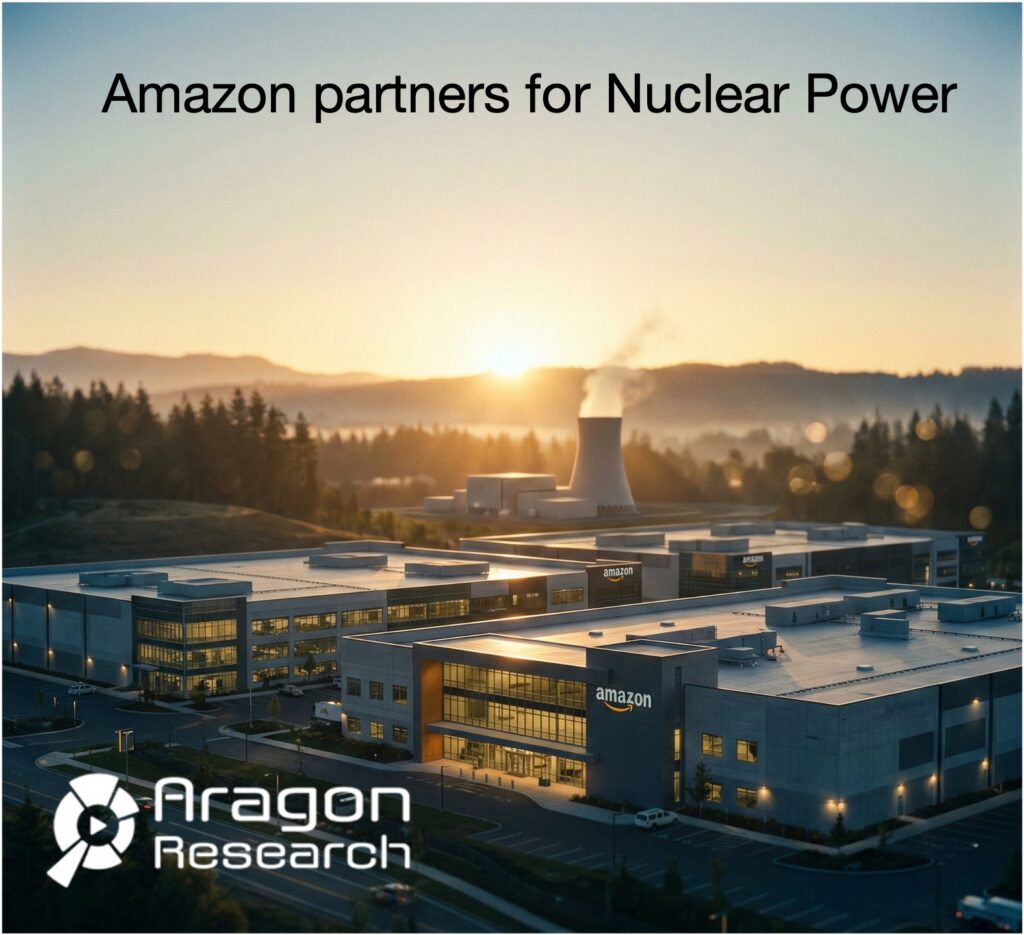
The global race to power artificial intelligence has moved from the server room to the reactor floor as hyperscalers face an unprecedented energy deficit. Amazon recently underscored this shift by unveiling significantly expanded plans for its first advanced nuclear facility in Washington state. This move signals that the path to AI market leadership now requires direct ownership of the energy supply chain. This blog overviews the Amazon nuclear power expansion and offers our analysis.
Why did Amazon announce an expanded nuclear plan?
Amazon recently tripled its commitment with Energy Northwest to potentially deploy 12 small modular reactors (SMRs) at the Cascade Advanced Energy Facility. This move targets a total capacity of 960 megawatts to support its massive data center footprint in the Pacific Northwest. By directly financing the construction of X-energy’s Xe-100 reactors, Amazon is moving beyond traditional power purchase agreements. The company aims to begin construction by the end of this decade, with carbon-free electricity flowing into the grid during the early 2030s.
Analysis
Amazon’s decision to fund construction directly represents a pivot from energy consumer to infrastructure financier. In the past, tech giants relied on utilities to manage the risk of new power generation, but the massive electrical load required for AI training has made that traditional model obsolete. By providing the capital for licensing and manufacturing, Amazon is effectively de-risking the first-of-a-kind technology hurdles that have historically stalled the nuclear industry. This news implies that the ability to scale AI will soon be restricted to firms that can bypass the public grid with private energy assets.
The partnership with X-energy also highlights a critical shift in the vendor landscape. Amazon is not just buying power; it is helping to establish a standardized, road-shippable reactor model that can be replicated globally. However, the success of this strategy depends on X-energy’s ability to deliver simultaneously on multiple large-scale projects, including its separate deployment for Dow on the Texas Gulf Coast. If these milestones are met, it will validate the modular construction approach, potentially forcing competitors to accelerate their own physical infrastructure investments or risk being priced out of high-performance computing markets.
The broader implication is a decoupling of the tech industry from public utility timelines. As hyperscalers become energy developers, they create a tiered market where those with the capital to build nuclear assets possess a significant competitive moat. This move signals that land and fiber are no longer the primary constraints for data center expansion; instead, the physical availability of power is the new ceiling. For vendors, this means that software excellence will be irrelevant if it cannot be backed by the physical infrastructure required to run it at scale.
What should enterprises do about this news?
Enterprises must evaluate the long-term infrastructure health of their cloud providers as a core component of their digital strategy. It is no longer enough to assess software features; organizations must understand if their partners have the energy runway to support the next generation of AI services. You should ask your primary technology providers for transparency on their power security strategies and consider the impact of potential energy-driven price volatility on your future cloud costs. Identifying partners that are proactively securing baseload power will be essential for ensuring business continuity as AI workloads continue to expand.
Organizations should also begin to factor energy-related risk into their vendor risk management frameworks. As the cost of power becomes a larger percentage of the total cost of ownership for cloud services, the financial stability of providers who lack a clear energy strategy may be called into question. Consider diversifying workloads across providers that demonstrate a diversified energy portfolio. This ensures that your own AI and data initiatives are not stalled by local grid constraints or the failure of a provider to secure sufficient power capacity.
Bottom Line
The expansion of Amazon’s nuclear plans confirms that energy is the new primary currency of the artificial intelligence era. By financing the development of small modular reactors, Amazon is building a specialized energy moat that will be difficult for smaller cloud providers to replicate. Enterprises should prioritize relationships with technology leaders that are moving to secure reliable, 24/7 carbon-free power. Strategic planning must now account for the physical infrastructure stability of the cloud to guarantee that your AI roadmap remains viable over the next decade.
Have a Comment on this?