


Anthropic Deal Ends as US Shifts AI Procurement
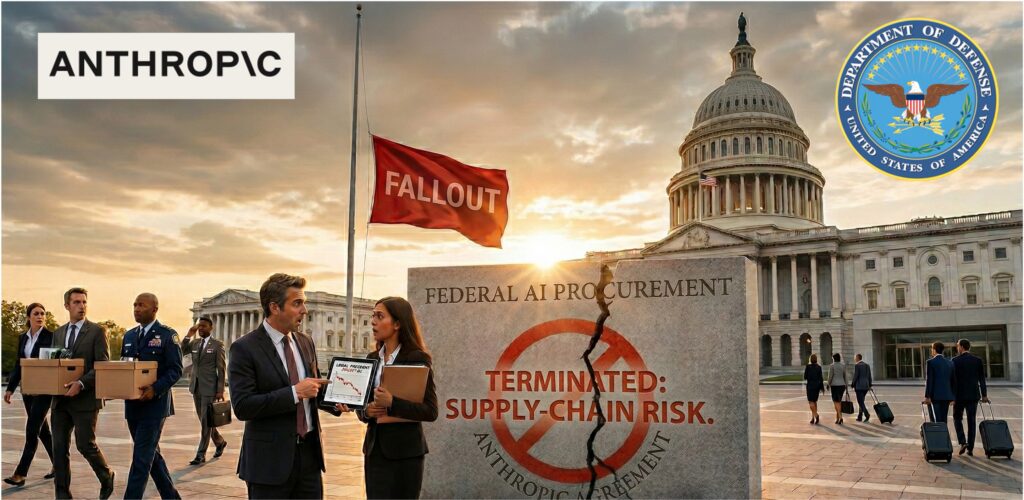
Anthropic just lost a $200M deal with the US Department of Defense.
By Jim Lundy
Anthropic Deal Ends as US Shifts AI Procurement
The sudden termination of the $200 million agreement between the United States federal government and Anthropic marks a historic pivot in how public sector entities engage with silicon valley. This decision to designate a domestic artificial intelligence leader as a supply-chain risk introduces a level of friction previously reserved for foreign adversaries. The move creates an immediate vacuum in the federal technology stack that rivals are already moving to fill. This blog overviews the Anthropic federal cancellation and offers our analysis.
Why did the Federal Government cancel the Anthropic agreement
The collapse of this partnership stems from a fundamental disagreement over model governance and operational autonomy within military and intelligence settings. The administration cited concerns over usage restrictions and what it characterized as ideological controls embedded within the Claude models. While Anthropic maintained that its guardrails against mass surveillance and autonomous weaponry were essential safety measures, the Department of Defense viewed these requirements as an unacceptable limit on sovereign authority. The escalation to a supply-chain risk designation suggests the government is prioritizing total technical control and political alignment over existing vendor relationships.
Analysis
This development represents a significant restructuring of the competitive landscape for Large Language Models within the public sector. By labeling Anthropic a supply-chain risk, the government is not just switching vendors but is effectively weaponizing procurement policy to enforce a specific compliance standard. This creates a massive opening for OpenAI and Google, provided they can navigate the same transparency requirements that Anthropic resisted. OpenAI has already signaled its willingness to adapt, securing agreements for classified use cases that were previously the sole domain of Anthropic.
The ripple effect of this decision will likely extend far beyond the $200 million contract value. Major federal integrators and cloud providers like Amazon and Google now face a complex dilemma regarding their own partnerships with Anthropic. If the supply-chain risk designation is enforced broadly, these firms may be forced to bifurcate their offerings or distance themselves from Anthropic to protect their own multi-billion dollar government contracts. We expect this to accelerate a trend where the ability to provide “unfiltered” or “policy-compliant” AI becomes a primary selling point for government contractors, potentially overshadowing traditional benchmarks like model accuracy or safety research.
Besides the DOD $200 Million deal, the ripple effect of being banned across US Government, as well as supply chains, means that Anthropic could be shut out of some lucrative contracts. When CEOs, such as Dario Amodei, are hurting their own business, Board of Directors and Investors normally step in. This is a level of arrogance that we rarely see in the market. Antrophic was probably given many opportunities to negotiate.
What should enterprises do about this news
Enterprises must evaluate their current reliance on specific AI vendors and consider the implications of geopolitical or domestic policy shifts on their technology stack. Generally, it is a bad idea to allow a contractor to tell an enterprise how to run their business – by stipulating that their software can only be used here or there. This is certainly an option for AI companies to dictate this, but Aragon recommends avoiding those providers.
While the federal government operates under unique constraints, the precedent of a major provider being sidelined over governance disputes should prompt a review of multi-model strategies. Organizations should ensure they have the architectural flexibility to swap models if a primary vendor faces regulatory or legal challenges. It is vital to understand the “red lines” of your AI providers and determine if they align with your own operational requirements or those of your downstream customers.
On top if just the agreement, AI providers must indemnify their clients against claims from third parties – if those claims were regarding content that an AI provider used illegally to produce new content, including images.
Bottom Line
The removal of Anthropic from federal procurement signals that the era of neutral AI provision in the public sector is ending. For the enterprise, this serves as a reminder that vendor stability is now tied to both technical performance and regulatory alignment. Organizations should prioritize high-portability AI architectures to mitigate the risk of sudden vendor displacement. The focus should remain on maintaining a diverse ecosystem of models to ensure that a dispute between a provider and a governing body does not result in a catastrophic disruption of internal business processes.
Have a Comment on this?