


Cisco Announces a full Agentic Security Platform
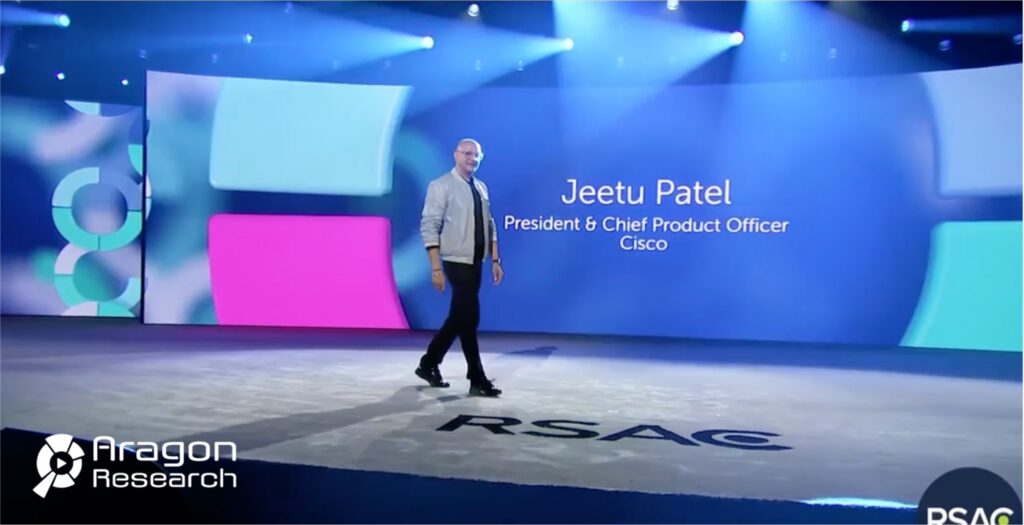
Cisco President and CPO Jeetu Patel at the RSA Conference 2026.
By Jim Lundy
Cisco Announces a full Agentic Security Platform
We attended RSAC this week and attended the Cisco Security Innovation Symposium. At the event, Cisco discussed the rapid transition from chatbots to autonomous AI agents and how tht represents a fundamental shift in how enterprise software operates and interacts with corporate data. At the RSA Conference (#RSAC), Cisco announced a suite of security innovations 6 designed to provide visibility and control over these acting entities within the enterprise ecosystem. This blog overviews the Cisco News and offers our analysis.
Why did Cisco announce Agentic Security?
Cisco is on a trajectory to become a player in AI and it is not standing still in security. At RSAC they introduced these Agentic capabilities because the industry is moving past the pilot phase of AI toward a production reality where agents perform tasks autonomously. Current security tools are designed for human users and static workloads, leaving a massive gap when an AI agent needs to access sensitive systems to complete a transaction.
The Cisco announcement focuses on three pillars: protecting the world from agents through identity management, protecting agents from the world via red-teaming tools like AI Defense: Explorer Edition, and accelerating the Security Operations Center with specialized AI agents in Splunk.
Analysis
The significance of this announcement lies in Cisco’s recognition that an AI agent is effectively a new type of employee that requires its own version of HR onboarding and behavioral monitoring. By integrating agent discovery into Cisco Identity Intelligence and mapping agents to human owners in Duo, Cisco is addressing the looming shadow AI problem where autonomous scripts could run unchecked across a network.
The move to open source the DefenseClaw framework is a strategic play to set the standard for secure agent development before proprietary silos become too entrenched. This news suggests that the perimeter has moved from the network edge to the intent of the AI model itself.
For the market, this raises the bar for competitors who must now prove they can secure not just the data used by AI, but the actions taken by it. It signals that traditional Zero Trust must evolve into Intent-Based Zero Trust where the security stack understands the context of a machine-generated request in real time.
Expected Reaction from Competitors
We expect a multi-pronged reaction from the vendor ecosystem. Major platform competitors like Palo Alto Networks and Microsoft will likely accelerate their own “agentic security” roadmaps, moving beyond large language model (LLM) firewalls to focus on transactional identity and intent. Pure-play security startups will emerge to target specific niches, such as agent red-teaming or specialized compliance logging for autonomous actions. Identity-centric vendors, in particular, must fast-track non-human identity management capabilities or risk losing relevance as agent workloads begin to outnumber human ones. This announcement has validated a new market category, and the race to dominate it has officially begun.
What should enterprises do about this news?
The Agentic Identity and Security Platform market is forming quickly. Many announcements were made at RSAC. Enterprises should evaluate these new offerings as they move AI projects from experimentation to production. It is important to realize how quickly the security landscape is evolving.
It is critical to begin auditing existing non-human identities and determining which human employees are accountable for the actions of specific AI agents. Security leaders should look at both Identity (going beyond Privileged Access Management) and look at Agentic Identity.
They also need a full Agentic Security strategy. This should include looking at integrating the Agent Runtime SDK into their development pipelines now to ensure that guardrails are embedded at the build stage rather than bolted on later. All of this means that that evaluating AI providers as well as Agentic Security providers and doing it quickly.
Bottom Line
Cisco is positioning itself as the essential governance layer for the autonomous enterprise by bridging the gap between AI development and security operations. Organizations must realize that securing an agentic workforce requires a shift from simple access control to complex identity and intent verification. The primary takeaway for the enterprise is that AI deployment cannot outpace AI governance without creating catastrophic risk.
Have a Comment on this?