

Cisco Veteran Javed Khan Appointed CEO of Neat
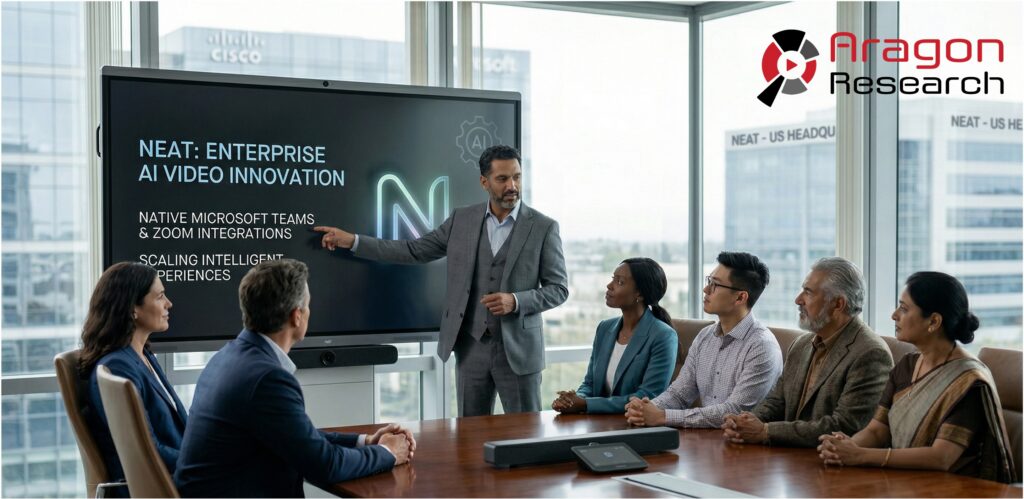
Image design by Aragon, rendered by Gemini.
By Jim Lundy
Cisco Veteran Javed Khan Appointed CEO of Neat
The video conferencing market is entering a new era of intelligent hardware, and Neat’s latest leadership move signals a shift toward aggressive enterprise scaling. This blog overviews the appointment of Javed Khan as CEO and offers our analysis.
Why Did Neat Appoint Javed Khan as CEO?
Neat announced that Javed Khan, a veteran Silicon Valley executive, will assume the CEO role on March 30. Khan joins the Norwegian video technology company following a tenure at Aptiv and a decade-long career at Cisco, where he led the Webex collaboration business. His arrival follows the departure of Janine Pelosi and comes at a time when Neat is reporting $250 million in revenue and expanding its U.S. presence in San Jose.
The company aims to leverage Khan’s experience in scaling product portfolios to move beyond its startup roots and capture a larger share of the global enterprise room system market. With a background that spans deep engineering and executive leadership, Khan possesses the specific pedigree required to transition a hardware specialist into a software-defined intelligence firm. His prior work in upscaling the entire Webex ecosystem demonstrates a capability to manage complex global supply chains while simultaneously modernizing the user experience.
Analysis
Khan’s appointment is a strategic coup for Neat, specifically because of his track record in transforming the Cisco Webex portfolio from a legacy software suite into a modern, integrated collaboration platform. His deep technical fluency in both video hardware and AI-driven software provides Neat with the leadership necessary to challenge established incumbents like Cisco and Logitech. While Neat has gained a reputation for elegant, user-centric hardware design, it now faces the challenge of moving into the complex, large-scale enterprise environments that Khan knows intimately.
This move suggests that Neat will pivot away from being a “Zoom-first” accessory brand toward becoming an independent platform powerhouse. We expect to see Neat accelerate its AI roadmap, moving processing from the cloud directly into the meeting room devices to reduce latency and improve privacy. This hire indicates that the market for intelligent room systems is far from settled, and Neat is positioning itself to lead the hardware-software convergence. The focus will likely shift from simple video connectivity to specialized meeting “outcomes” powered by computer vision and acoustic intelligence.
Khan’s First Steps to Reposition Neat
To successfully reposition Neat, Khan will likely prioritize the expansion of the company’s enterprise sales motion and its global channel partner ecosystem. For a company of Neat’s size, moving into the “large enterprise” segment requires more than just better cameras; it requires a robust management layer that allows IT teams to deploy and maintain thousands of devices across multiple geographies. Khan’s experience at Cisco gives him a blueprint for building these necessary back-end management tools which are often the deciding factor for Fortune 500 buyers.
Furthermore, we anticipate that Javed Khan will tighten the integration between Neat’s hardware and AI capabilities to create a proprietary “intelligence layer.” By focusing on in-room AI rather than cloud-based processing, Neat can offer superior voice tracking and facial framing that feels more natural than current market alternatives. This repositioning will move Neat from being a peripheral provider to a core infrastructure partner. His focus on direct customer feedback will also likely lead to a more diversified hardware lineup that addresses specific vertical needs in healthcare, education, and finance, where standard conference room setups often fall short of requirements.
What Enterprises Should Do
Enterprises should evaluate Neat’s upcoming product roadmap, particularly as it relates to AI-integrated room systems and their native support for Microsoft Teams and Zoom. Because Neat maintains deep co-engineering partnerships with both Microsoft and Zoom, it is critical for organizations to determine if Neat’s unique AI features, like Neat Symmetry, are fully optimized for their specific software platform of choice. Organizations currently locked into traditional vendor contracts should monitor Neat’s ability to provide enterprise-grade management tools at scale, which has historically been a hurdle for smaller hardware specialists.
If your organization is planning a refresh of its hybrid work infrastructure, consider Neat as a primary contender for high-end, intelligent meeting spaces that require seamless switching or multi-platform flexibility. Evaluate how Neat’s focus on the “intelligent room” aligns with your broader digital transformation goals. As AI becomes a standard requirement for meeting equity, the choice of hardware will become as critical as the choice of collaboration software. Ensure that any pilot programs with Neat devices include a rigorous test of their remote management and security features within your Microsoft Teams Admin Center or Zoom Device Management console to confirm they meet the standards required for a full-scale corporate rollout.
Bottom Line
The appointment of Javed Khan marks a transition for Neat from an innovative hardware challenger to a serious enterprise contender. His experience in scaling global collaboration businesses will likely result in more aggressive product cycles and a deeper focus on AI-driven meeting experiences. Enterprises should look for Neat to become a more prominent fixture in large-scale RFPs for hybrid work environments and expect a surge in AI-first hardware innovations that challenge the status quo.
Have a Comment on this?