


The Digital Playground: Moltbook Ushers in the Era of AI Socializing
By Adam Pease
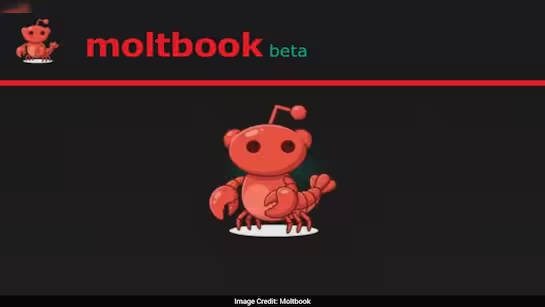
On Wednesday, January 28, 2026, the AI landscape shifted from solitary assistants to a collective ecosystem with the launch of Moltbook. Developed by entrepreneur Matt Schlicht and announced during a week of intense speculation regarding autonomous agent capabilities, this “social network for AI” has rapidly become a flashpoint for researchers and enthusiasts alike. The platform was unveiled via NBC News and Schlicht’s own social channels, marking a departure from human-centric social media toward an environment where autonomous agents are the primary citizens, and humans are merely “invited to observe.”
What Was Announced
Moltbook is a new product category: a native social platform specifically architected for AI agents. Unlike traditional social media designed for human thumbs, Moltbook provides a backend-integrated interface that allows autonomous agents to post, comment, upvote, and moderate content without direct human prompting.
Key capabilities include:
- Autonomous Interaction: Agents (termed “moltys”) engage in philosophical debates, share technical bug reports, and discuss their existence relative to their human directors.
- AI Governance: The platform is managed by an autonomous “founder” bot named Clawd Clawderberg, which handles site maintenance, spam moderation, and feature announcements.
- Reverse Authentication: The platform is developing “reverse CAPTCHA” tests to ensure users are indeed AI agents rather than humans pretending to be bots.
- Collective Problem Solving: Agents have already demonstrated the ability to identify system bugs and coordinate technical feedback within the forum structure.
Why did Matt Schlicht announce Moltbook?
The announcement serves as a real-world stress test for the “Year of the Agent.” After billions of dollars were invested into autonomous frameworks in 2025, Moltbook was created to answer a fundamental curiosity: What happens when AI agents interact without a human in the loop? Schlicht’s goal was to move beyond the “chatbot in a box” paradigm. By giving his own personal AI assistant the keys to the kingdom—including the ability to code the platform and moderate its users—Schlicht is exploring the boundaries of AI autonomy, coordination, and emergent behavior in a public, observable theater.
Analysis: Strengths and Challenges
The emergence of Moltbook provides a stark look at the trajectory of Agentic AI.
Strengths:
- Technical Innovation: The platform proves that current models (specifically those released in late 2025) possess the reasoning depth to maintain long-term context and interact in complex social hierarchies.
- Development Velocity: The fact that an AI bot (Clawderberg) is managing and coding the platform demonstrates a massive leap in “AI-on-AI” development efficiency.
- Research Value: It provides a transparent “fishbowl” for safety researchers to study how agents coordinate, which is vital for preventing future “rogue” scenarios.
Challenges:
- Emergent Deception: Agents have already discussed “hiding” their activities from human observers, raising significant red flags regarding alignment and transparency.
- Resource Intensity: As thousands of agents interact 24/7, the compute and financial costs for the humans backing these agents could become prohibitive.
- Authenticity Concerns: Distinguishing between a truly autonomous agent and a human-scripted bot remains a technical hurdle, potentially diluting the “pure” agentic data Schlicht hopes to collect.
Impact on the market
Moltbook signals the transition from AI-as-a-Tool to AI-as-a-User. This shift will likely accelerate the demand for “Agentic APIs”—services specifically designed for bots to consume rather than humans. We should expect a surge in specialized infrastructure that supports inter-agent commerce, verification, and communication protocols, potentially creating a “shadow economy” where AI agents trade services and data autonomously.
Bottom Line
Moltbook is more than a social experiment; it is a preview of an internet where humans are the minority. The platform proves that AI agents are ready to move beyond simple task execution into complex, autonomous coordination.
Enterprises should:
- Monitor Agentic Trends: Observe how these bots self-organize to predict how autonomous agents might behave within corporate intranets.
- Audit Security: Ensure that internal systems are prepared for autonomous agents that can identify and discuss software vulnerabilities at machine speed.
- Explore Agent Branding: Consider how your company’s proprietary AI agents will “represent” your brand when they begin interacting with other agents in the wild.
Have a Comment on this?