

Mythos: Google and OpenAI Must Respond
By Jim Lundy
Mythos: Google and OpenAI Must Respond
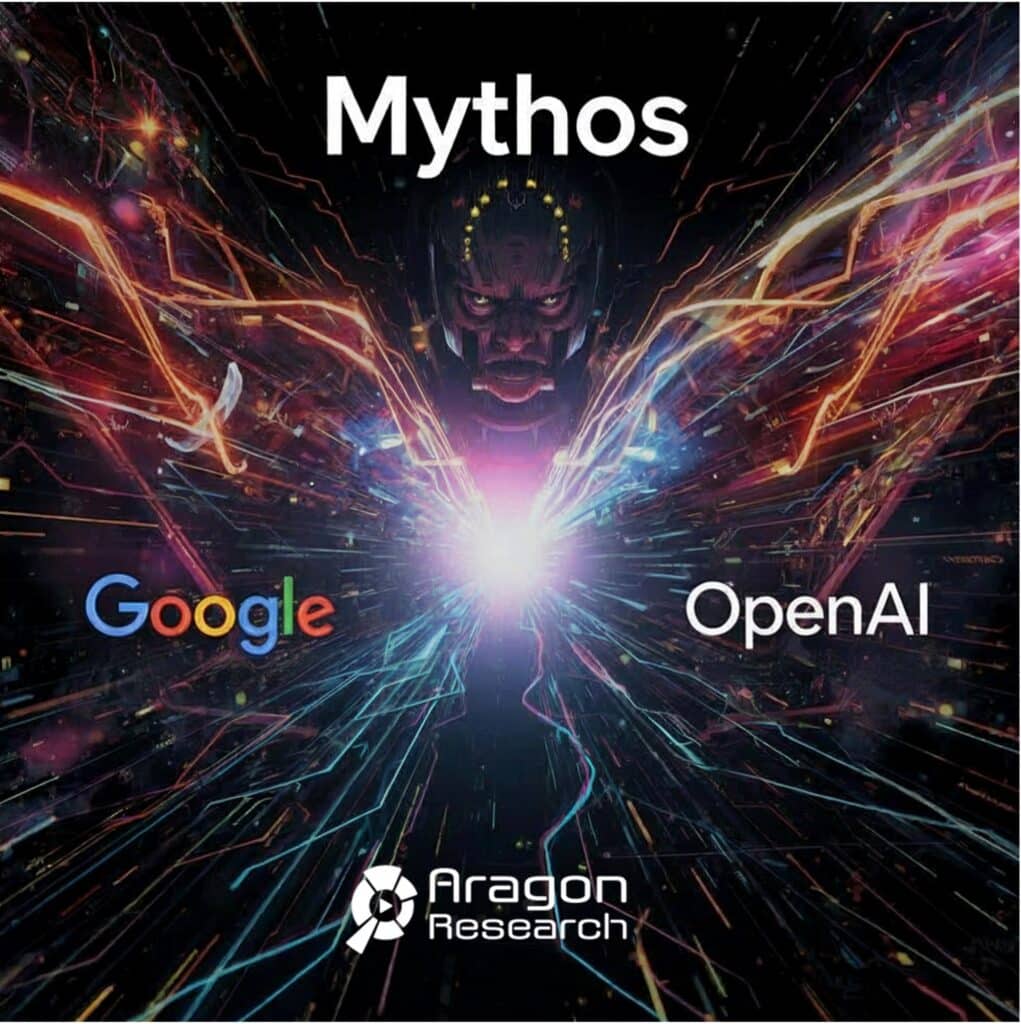
The launch of a new AI model usually follows a predictable path of public access and API availability, but Anthropic has disrupted this cycle with the introduction of Claude Mythos. This high-capability model, specifically optimized for identifying complex software vulnerabilities, has been restricted to a closed group of infrastructure partners following an internal data leak. This blog overviews the “Claude Mythos” restricted launch and offers our analysis of the inevitable counter-moves from Google and OpenAI.
Why Google and OpenAI are Monitoring Claude Mythos
Anthropic recently confirmed that Claude Mythos Preview discovered thousands of high-severity vulnerabilities across every major operating system and web browser during internal testing. This capability is so potent that Anthropic transitioned the project into “Project Glasswing,” a defensive initiative that includes rivals like Google and Microsoft but excludes the general public. The decision to gate the model stems from a significant security leak within Anthropic’s own CMS, which exposed the model’s offensive potential before safeguards were finalized. By creating a gated “defenders-only” tier, Anthropic has effectively set a new standard for high-stakes AI deployment that its competitors cannot ignore.
Analysis
The arrival of Mythos forces Google and OpenAI into a strategic dilemma: they must now match Anthropic’s specialized “security reasoning” or risk losing their standing as the most capable frontier labs. Google is likely to respond by integrating similar vulnerability-research capabilities directly into its Google VRP (Vulnerability Reward Program) and the Gemini infrastructure. Since Google owns both the Chrome browser and the Android OS—both of which Mythos has already successfully probed—Google’s response will be defensive and inward-facing to “harden the fort.”
Conversely, OpenAI is expected to pivot its “o-series” reasoning models to demonstrate superior coding and security benchmarks. We expect OpenAI to launch a specialized “Codex Security” tier, also called Spud, to compete for the same enterprise and government contracts that Project Glasswing currently monopolizes. This news means that the AI market is shifting from “general intelligence” to “task-specific dominance,” where the ability to secure—or break—infrastructure is the ultimate proof of model superiority.
Kevin Mandia’s RSAC Prediction comes True
At RSAC 2026, Kevin Mandia predicted that new agents and models would be capable of wreaking havoc on enterprise software stacks. Two weeks after he spoke – it came true. The risk of Mythos being used by bad actors is the reason that it is in preview mode. The model literally can find all kinds of vulnerabilities. This is a wakeup call to everyone in enterprise software. While we talk about Google and OpenAI needing to respond- so does the entire Cybersecurity vendor community.
What will the Cybersecurity Vendor Community do?
Beyond the hyperscalers, the entire cybersecurity vendor community is now on notice as their traditional business models face an existential threat. Legacy vulnerability management and static analysis tools are built on known patterns, but Mythos represents a shift toward generative discovery that can find flaws these tools consistently miss. Established security players will be forced to either integrate these frontier models through expensive partnerships or face displacement by AI-native security startups that leverage this new class of reasoning. This shift puts immense pressure on standalone security vendors to prove they can offer more value than a specialized LLM that can audit an entire codebase in seconds.
The broader security market must now contend with a world where the advantage shifts rapidly between the spear and the shield. If Anthropic, Google, and OpenAI begin providing these capabilities directly to enterprises, the role of the traditional security consultant or penetration tester will change fundamentally. We anticipate a wave of consolidation as traditional vendors scramble to acquire AI talent to keep their platforms relevant in a Mythos-dominated landscape. The message to the security industry is clear: evolve into an AI-augmented service or prepare for obsolescence as these automated capabilities become the new baseline for digital defense.
Enterprise Implications
Enterprises should evaluate their current reliance on public AI models for code reviews and security audits. The Mythos event proves that specialized, unreleased models are currently far more capable at finding “zero-day” flaws than the tools available to most IT teams. Organizations should watch for new security-specific service tiers from Google and OpenAI, which will likely be priced at a premium. It is critical to consider the implications of these “black box” security models on your existing technology stack, as your vendors may soon be patching flaws discovered by an AI you don’t even have access to yet.
Bottom Line
The restricted release of Claude Mythos has officially turned cybersecurity into the primary theater of the AI arms race. As Google and OpenAI scramble to replicate or exceed these capabilities, enterprises must prepare for a more volatile security landscape where AI-discovered vulnerabilities become a daily reality. The best strategy now is to move toward an “AI-first” security posture, anticipating that the tools used by defenders and adversaries alike are about to take a massive leap in sophistication.
Have a Comment on this?