

Third Party Notetaker Apps that Spy on You
By Ken Dulaney
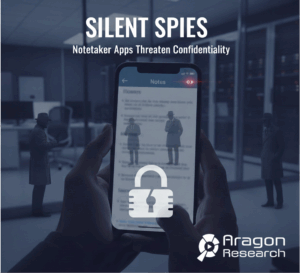
Silent Spies: Notetaker Apps Threaten Confidentiality
The explosion of AI notetaker apps—tools that automatically join virtual meetings to record, transcribe, and summarize sessions—is boosting productivity, but it has introduced a critical and unvetted risk to enterprise confidentiality. These AI attendees, often joining sessions such as product NDAs automatically without explicit host permission, can capture everything from sensitive pre-release product information and financial discussions to legally privileged communications. The danger lies in this confidential data being lifted from a company’s secure environment and stored, analyzed, or even used to train the third-party vendor’s AI models, creating an uncontrolled data leak path.
Why Did Vendors Enable Unattended Product Use?
The initial push for products like Otter.ai, Fireflies.ai, and others was all about viral growth and productivity. Vendors designed the tools to integrate seamlessly with calendar and video conferencing platforms (Zoom, Teams, Meet), often making auto-join the default setting. The rationale was simple: the easier it is for an individual user to capture a meeting, the more rapidly the product spreads across an organization (often without IT oversight—a classic case of “Shadow AI”). This “convenience-first” design, however, ignored the core security and compliance needs of large enterprises, prioritizing individual user adoption over corporate data governance and the integrity of confidential information.
Analysis: The Governance Gap That Puts IP at Risk
Aragon Research views this trend as a fundamental governance failure that demands immediate executive attention. The issue is not the Notetaker Apps themselves, but the lack of control over the resulting data asset. When an AI notetaker—especially a free, unvetted one—captures a confidential discussion, the organization effectively loses control of that data. It becomes subject to the third-party vendor’s privacy policy, which may allow the data to be stored on their servers indefinitely, transferred across borders, or utilized for model training.
This directly compromises NDAs, trade secret protections, and attorney-client privilege. The simple truth is that if a company is discussing confidential Q4 projections or a non-disclosed product feature, it is inadvertently feeding that valuable intellectual property (IP) to a third party when a rogue notetaker is present. This is a liability that can lead to regulatory fines, loss of IP, and serious litigation risk.
What Should Enterprises Do? Implement a Zero-Trust Meeting Policy
Enterprises must move past mere monitoring and implement proactive, defensive policies against unauthorized Notetaker Apps. This is not a “watch” item; it requires immediate action and an operational change in meeting security.
- Enforce the Waiting Room/Lobby Feature: This is the single most effective control. Require all participants, internal and external, to be manually admitted. Hosts must be trained to identify and decline entry to non-human entities like “OtterPilot” or “Fireflies Bot.”
- Require Authenticated Users: Configure all meeting platforms to mandate sign-in using an official company or verified external account. This prevents anonymous joiners, which is a common tactic for AI bots.
- Establish a Clear Policy on AI Notetakers: Create and circulate a corporate policy that defines approved (enterprise-licensed) AI tools and explicitly prohibits the use of unapproved, consumer-grade notetakers for all confidential, legal, HR, or strategic meetings. Train employees to remove unapproved participants immediately.
- Administer a Domain Block-List: IT administrators should block known domains associated with unsanctioned AI notetaker services at the platform level to prevent them from joining company meetings.
Impact on the Collaboration Market
This security crisis will drive a significant shift in the video conferencing and collaboration market. Platform providers like Microsoft, Zoom, and Google are under pressure to integrate robust, secure, and enterprise-grade AI summary features directly into their core applications—where the customer retains control of the data. This will cannibalize the market for third-party, standalone Notetaker App vendors, particularly those focused on the free or low-end user segment. Enterprises will gravitate towards closed AI systems offered by their main collaboration vendor, seeking contractual assurances that their meeting data will not be used for model training or stored without their explicit control. Data sovereignty and strong contractual guarantees will become primary purchase criteria, relegating productivity features to a secondary concern.
Bottom Line: Your IP is at Risk—Act Now
The convenience of AI notetakers is currently outweighed by the severe confidentiality risk they introduce. Enterprises are unknowingly outsourcing the security of their most sensitive discussions to third-party vendors with unclear data use policies. Companies must immediately mandate and enforce platform security features like Waiting Rooms and authenticated access to prevent rogue AI from capturing confidential data. Implement a zero-tolerance policy for unapproved AI meeting assistants and centralize the use of transcription to vetted, enterprise-grade tools under a strict governance framework. The price of convenience must not be the loss of your intellectual property.
Have a Comment on this?