


Vbrick Video Trust: Defeating Deepfakes
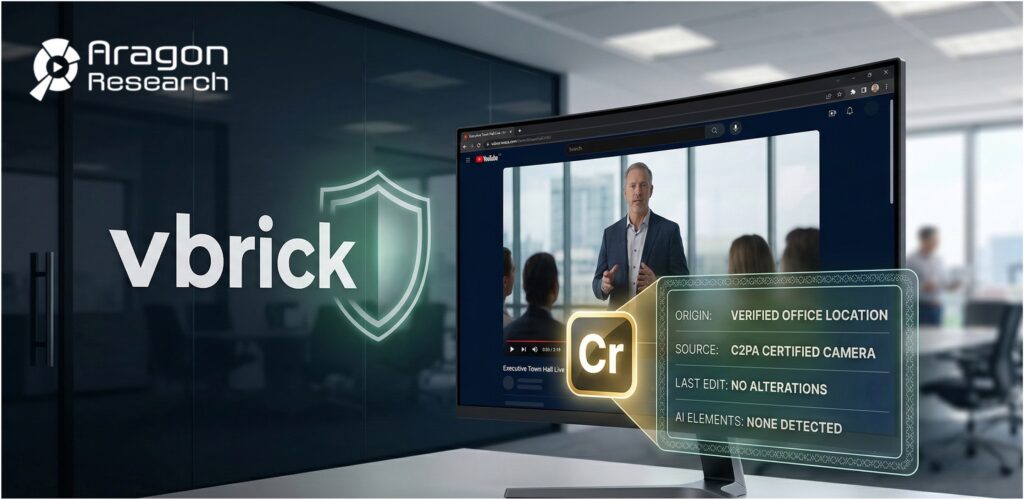
Image design by Aragon, rendered by Gemini.
By Jim Lundy
Vbrick Video Trust: Defeating Deepfakes
Vbrick recently announced its status as the first Enterprise Video Platform to achieve official conformance with the Coalition for Content Provenance and Authenticity standards. This certification allows Vbrick to act as a Content Credentials Generator, embedding metadata that acts as a digital nutrition label for video assets to verify their origin and edit history. As generative AI makes the creation of synthetic media nearly indistinguishable from reality, the ability to prove the lineage of corporate communications has moved from a technical luxury to a core security requirement. This blog overviews the Vbrick C2PA news and offers our analysis.
Why did Vbrick announce C2PA Conformance?
The announcement addresses the escalating risk of deepfakes and misinformation within the corporate environment. By meeting the rigorous security requirements of the C2PA Conformance Program, Vbrick enables organizations to attach cryptographically bound metadata to their video content. This metadata tracks the lifecycle of a file, identifying whether AI was used in its creation or if significant alterations were made after the initial recording. This move responds to a growing demand for transparency in digital assets as enterprises face increasing regulatory pressure and internal security threats related to identity fraud and corporate espionage.
Analysis
This milestone is a significant indicator of the shift toward zero-trust media architectures in the enterprise. For years, video was viewed as an unstructured data type that was inherently truthful, but the democratization of high-fidelity generative AI tools has shattered that assumption. Vbrick is positioning itself as the guardian of video integrity, moving beyond simple hosting and streaming into the realm of content authentication. By being the first in the EVP market to adopt these standards, Vbrick is creating a competitive moat that will be difficult for legacy providers to replicate quickly due to the complex cryptographic signing infrastructure required.
The impact of this news extends to the broader AI landscape. As more organizations adopt the Model Context Protocol to feed video data into AI agents, the quality and veracity of that ground truth data become paramount. If an AI agent processes a video that has been tampered with, the resulting business intelligence will be flawed. Vbrick’s conformance ensures that the data layer remains untainted, which is essential for firms looking to automate decision-making based on video analytics. We expect this to force a consolidation in the market where vendors who cannot provide verifiable provenance will be relegated to non-critical, low-security use cases.
What should enterprises do?
The need to understand deepfakes is growing. Enterprises should evaluate their current video and image workflows to identify where unverified content poses a brand or security risk. IT and security leaders need to prioritize the implementation of content credentials for high-stakes communications such as executive town halls, training certifications, and legal compliance recordings.
If your organization is currently using a standard video platform without provenance capabilities, you should consider the long-term implications of hosting dark media that cannot be verified. We recommend starting a pilot program to tag sensitive internal assets with C2PA credentials to establish a baseline for digital trust.
Bottom Line
Vbrick has set a new benchmark for the enterprise video industry by prioritizing content authenticity over simple delivery. By achieving C2PA conformance, they are providing the necessary tools for organizations to defend against the rising tide of synthetic media and misinformation. Enterprises should view content provenance as a mandatory component of their broader cybersecurity and data integrity strategy. Adopting these standards now will prepare firms for a future where the authenticity of digital communication can no longer be taken for granted.
Have a Comment on this?