


Meta & Sierra announce Personal Agent Protocol
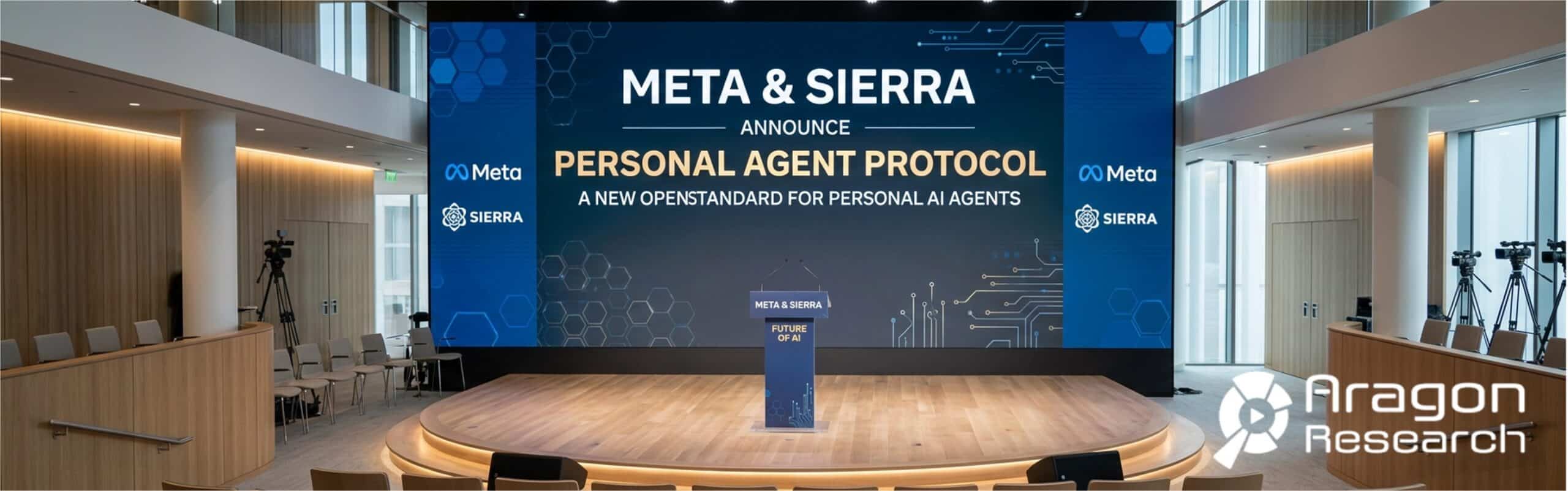
Image design by Aragon, rendered by Gemini.
By Jim Lundy and Adam Pease
Meta & Sierra announce Personal Agent Protocol
Personal artificial intelligence is swiftly evolving from simple conversational interfaces into autonomous digital assistants that execute complex tasks on behalf of users. Consumers are eagerly utilizing these tools for daily activities ranging from booking travel to purchasing retail goods. A month after the highly successful launch of the Muse agent, a consortium of technology and retail leaders announced a structured framework to manage this activity. Meta and Sierra, along with partners, are publishing the Personal Agent Protocol. This open standard dictates how artificial intelligence bots interact securely with corporate websites and enterprise infrastructure. This blog overviews the Personal Agent Protocol and offers our analysis.
Why Did Meta Announce The Personal Agent Protocol
The recent launch of Muse drove massive automated traffic to enterprise websites as users delegated routine tasks to their digital assistants. Major technology providers and e-commerce platforms subsequently blocked these bots due to severe web scraping and data privacy concerns. The unstructured nature of this automated traffic created immense operational risks for businesses unable to distinguish between legitimate customer requests and malicious data harvesting.
This new protocol aims to authenticate agents in a manner similar to traditional single sign-on mechanisms. It provides organizations with the necessary visibility and control over how these bots access their digital services. Standardization reduces the friction that causes agent tasks to fail and prevents the digital ecosystem from devolving into chaotic access wars. Establishing these technical guardrails is essential for the sustainable growth of automated commerce.
| Partner | Role |
| Meta | Co-developer and maker of the Muse agent |
| Sierra | Enterprise artificial intelligence startup and co-developer |
| Walmart | Retail and commerce partner |
| Shopify | E-commerce platform partner |
| Stripe | Payment and transaction partner |
| Rocket | Platform and technology partner |
| Genesys | Contact center and customer experience partner |
| Instinct | Personal agent platform partner |
| NiCE | Contact center and enterprise software partner |
| Decagon | Artificial intelligence customer service platform partner |
Analysis
The introduction of this protocol represents a critical shift from defensive bot mitigation to proactive machine commerce. Organizations can no longer afford to perpetually block artificial intelligence traffic without eventually alienating their own customer base. By creating an authenticated communication pathway, Meta and Sierra are forcing a structural change in how consumer inquiries and transactions are processed. The market is transitioning from human-driven web browsing to application-driven task execution.
The absence of OpenAI and Anthropic in this initial consortium highlights an impending protocol war within the generative technology sector. This fragmentation suggests that competing routing standards will emerge as dominant platforms vie for ecosystem control. The underlying tension revolves around which technology giant will control the authentication layer of the next generation internet.
Firms that adopt this initial standard will likely gain a distinct advantage in capturing early agent-driven revenue streams. Legacy digital properties relying exclusively on human-centric navigation will experience degraded conversion rates. Consumers will increasingly delegate daily tasks to their digital representatives, bypassing platforms that cannot support automated execution.
What Should Enterprises Do
Organizations must stop treating automated bots as hostile web scrapers and begin viewing them as a distinct class of prioritized customer. Digital strategy leaders should evaluate this specific protocol immediately. Consider its technical implications on your existing technology stack, particularly within customer identity and access management systems.
Customer service and electronic commerce workflows will require significant optimization to support these machine-to-machine interactions. Companies need to audit their web properties and application programming interfaces to ensure they can interface cleanly with authenticated agents. Legacy security protocols that automatically block bot traffic will need careful reconfiguration.
Preparing your digital infrastructure today will prevent costly service disruptions as consumer adoption of these tools accelerates globally. Vendor management teams should also monitor how their current software providers intend to support this emerging standard.
Bottom Line
The Personal Agent Protocol establishes the necessary digital plumbing for the incoming wave of autonomous consumer tools. It replaces the current friction of blocked web access with a structured framework for secure digital transactions.
Enterprises should proactively evaluate this standard and prepare their digital properties to accommodate authenticated automated traffic. Adapting to this machine-driven commerce model is critical for maintaining customer engagement and protecting future revenue generation channels.
Related Blogs:
Amazon Blocks Meta’s Muse Agent from Shopping
Gemini 3.8 Sets a New Bar for Agentic AI
How Anthropic won the PR Narrative but Google kept the Volume
Google Nano Banana: Free AI Image Tools for All
Important Research related to this Blog:
Also – Check out all our Podcasts HERE
Have a Comment on this?