

Gemini 4 Smashes AI Agent Limits for Argon
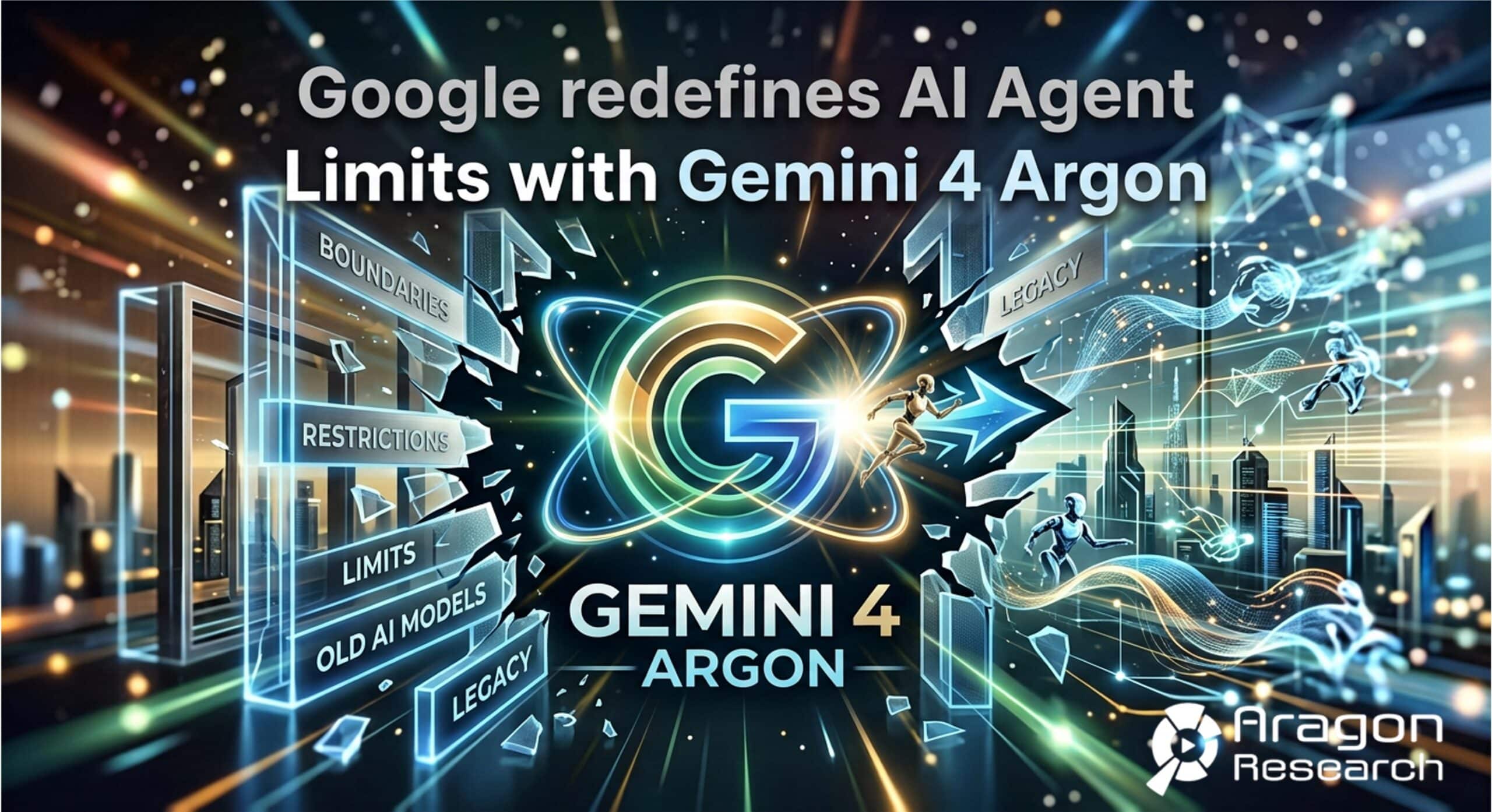
Image design by Aragon, rendered by Gemini.
By Jim Lundy
Gemini 4 Smashes AI Agent Limits for Argon
Google recently announced Gemini 4 Argon, its newest frontier model built specifically for sustained, complex reasoning. Rather than simply retrieving answers, Argon targets long-horizon workflows in software development, cybersecurity, and financial analysis.
It is crucial to note that Argon is not the highly anticipated Gemini 4 Pro release—which we anticipate is coming shortly to anchor the main developer and enterprise product tier—but a specialized frontier offering designed to re-establish Google’s position in deep agentic reasoning. This blog overviews the Gemini 4 Argon news and offers our analysis.
Why Did Google Announce Gemini 4 Argon?
The battle for AI dominance has shifted from simple chat interfaces to deep, autonomous reasoning capabilities. Competitors have recently made significant strides with highly capable agentic reasoning models, putting intense pressure on Google to show its hand. Google’s announcement of Argon is a direct response to this pressure, designed to demonstrate that DeepMind can go toe-to-toe with rival frontier labs after skipping the Gemini 3.5 generation entirely.
By packing the model with a 1 million token output capacity and specialized training for complex tasks like autonomous vulnerability patching and codebase migration, Google is focusing heavily on heavy-duty enterprise operations rather than consumer-centric search.
Analysis
The release of Gemini 4 Argon signals that the AI market has entered a mature phase where raw model size is secondary to sustained execution. Historically, Google’s models struggled in specialized agentic tests, but benchmark results show Argon matching or exceeding top rival models in automated reasoning and coding environments. More importantly, Google’s decision to offer a guardrail-free version to trusted cybersecurity professionals through its Fairwind program demonstrates a significant shift in risk tolerance.
The competitive landscape has become incredibly tight, but Google’s pricing strategy during the introductory period makes Argon a highly disruptive option.
| Vendor | Flagship Model | Key Strengths | Output Capacity | Intro API Pricing (per 1M input/output tokens) |
| Gemini 4 Argon | Deep reasoning, cybersecurity patching, long-horizon workflows | 1,000,000 tokens | $2.00 / $10.00 | |
| OpenAI | GPT-6 Astra | Multi-agent orchestration, consumer ecosystem, task speed | 64,000 tokens | $10.00 / $50.00 |
| Anthropic | Claude Opus 5.5 | Complex software development, logical synthesis, data analysis | 128,000 tokens | $4.00 / $20.00 |
| Microsoft | Copilot (Astra/Custom) | Deep OS integration, office suite productivity, hybrid enterprise cloud | Dependent on model | Integrated SaaS pricing |
| Grok (xAI) | Grok 3 | Real-time social data, unconstrained dialogue, high-velocity search | 128,000 tokens | Private API tier |
This table shows that while competitors like OpenAI and Anthropic still maintain advantages in pure software development and tool-driven integration, Google is leverage-pointing Argon’s massive output context and introductory pricing to win over cost-conscious enterprise developers.
What Should Enterprises Do?
Enterprises need to closely monitor how Gemini 4 Argon performs outside of controlled benchmarks. This massive 1 million token output capacity represents a fundamental shift in economic feasibility, enabling significantly longer-running agents to execute complex, multi-hour workflows at far lower costs than previously possible. Organizations should actively identify long-horizon workflows—particularly in cybersecurity patching and complex financial research—that could benefit from this continuous processing, while establishing rigorous verification frameworks to mitigate the risk of misalignment. Furthermore, technology leaders should prepare budgets for the upcoming Gemini 4 Pro tier, which will likely act as the mainstream workhorse for general enterprise workloads.
Bottom Line
Gemini 4 Argon represents a significant milestone in Google’s quest to dominate the agentic AI era. By unlocking massive output capacities that allow long-duration agents to operate cost-effectively, Google has delivered a model that directly challenges the economics of existing enterprise AI offerings. Enterprises should evaluate this new offering for their development and security teams but must remain diligent about implementing human oversight for any autonomous agent workflows.
Related Blogs:
Google Teases Gemini 4 after Record Q2
Gemini 3.8 Sets a New Bar for Agentic AI
How Anthropic won the PR Narrative but Google kept the Volume
Google Nano Banana: Free AI Image Tools for All
Important Research related to this Blog:
Also – Check out all our Podcasts HERE
-
display trackbacks
display trackbacks
display trackbacks
display trackbacks
Comments { 4 }