

Google Search: Pivoting from Web to Gemini
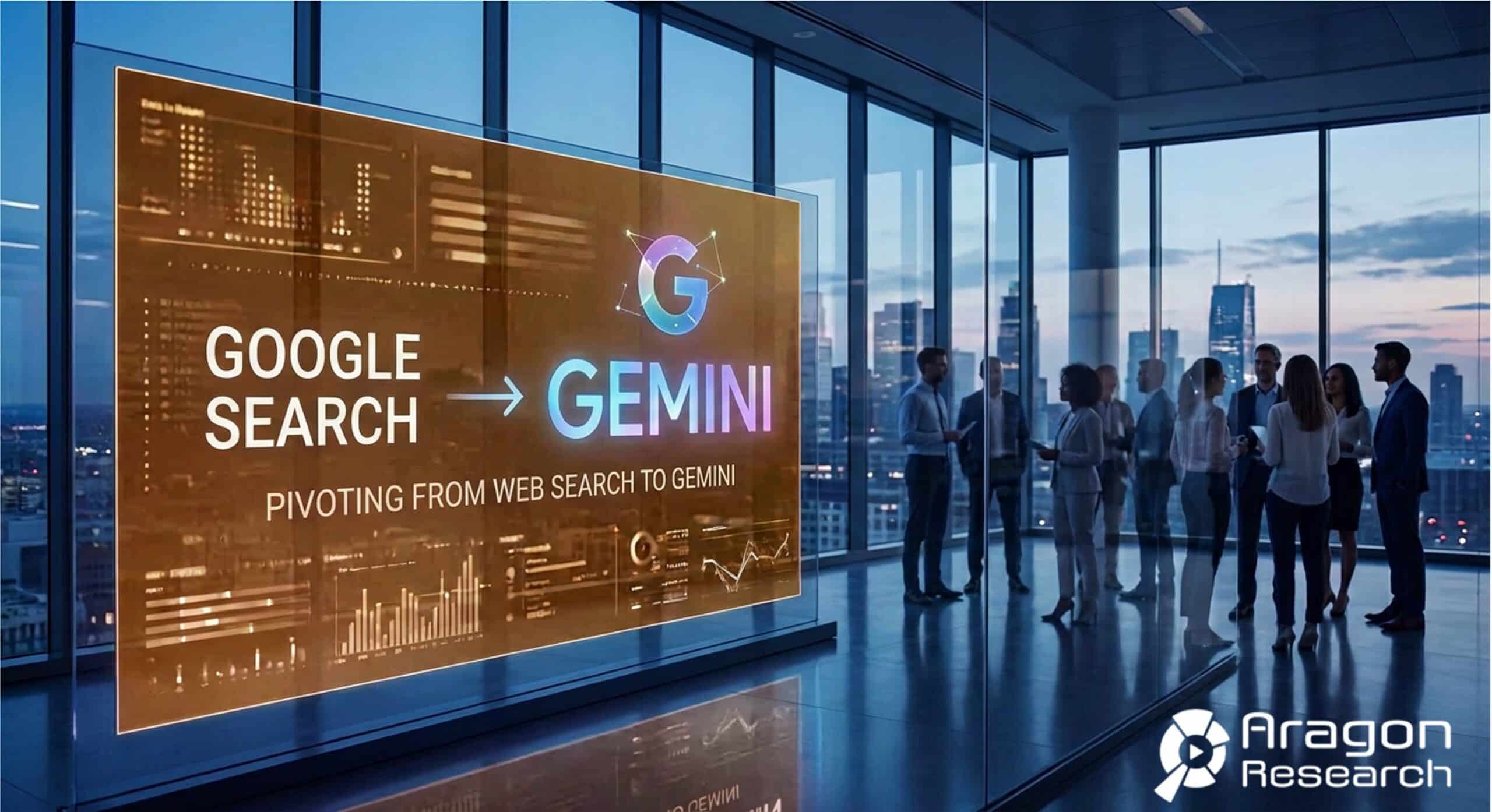
Image design by Aragon, rendered by Gemini.
By Ken Dulaney
Google Search: Pivoting from Web Search to Gemini
This blog overviews Alphabet’s recent market sell-off triggered by slowing search ad monetization growth and offers our analysis of how Google intends to re-engineer its commercial model as user journeys shift to Gemini and AI-synthesized responses.
Why Did the Market Sell Off Alphabet Over Search Advertising?
Wall Street reacted sharply to signs that conversational search and direct AI answers compress traditional click-based advertising real estate. When a user queries Gemini or Google’s AI Overviews for product evaluations—such as identifying the best commercial dishwasher or evaluating ERP software—they seek synthesized conclusions rather than a page of paid links.
For twenty-five years, Google’s primary profit engine rested on auctioning high-intent keyword inventory on the Search Engine Results Page (SERP). In an AI-synthesized interface, users receive complete answers directly on the platform, drastically reducing click-through volumes to advertiser sites. The market sell-off reflects investor anxiety that this zero-click dynamic shrinks the total pool of monetizable real estate faster than Google can replace it.
Analysis
The market’s immediate reaction assumes Google is passive in the face of its own disruption. It is not. Aragon Research has tracked technology platform shifts for over three decades, and this transition mirrors Google’s historic pivot from desktop to mobile.
Google’s plan does not rely on degrading conversational trust by forcing pay-to-play results into objective answers. Gemini’s core answer synthesis must remain uncompromised, or users will migrate to competing engines. Instead, Google is executing a three-part commercial architecture:
- Contextual Follow-Up and Downstream Ad Units: Google is placing native sponsored units below or alongside AI syntheses, triggered only when commercial intent peaks in multi-turn dialogues. High-funnel research remains objective; the downstream purchase action is monetized.
- Merchant Center and Agentic Checkout Integration: Rather than charging solely for page traffic, Google is embedding structured catalog feeds (Google Merchant Center) and agentic checkout capabilities directly into Gemini. Monetization shifts from cost-per-click (CPC) toward transaction-facilitation and native shopping modules.
- Diversified Compute Monetization: Google is subsidizing consumer-facing answer generation by charging enterprises directly for Gemini infrastructure, Google Cloud Vertex AI integrations, and premium subscription tiers like Google One AI.
The critical takeaway for digital strategists: traditional Search Engine Optimization (SEO) ranking metrics and keyword bidding are decoupling from enterprise pipeline generation. The battleground is no longer winning position one on a search page; it is ensuring your brand is cited and ingested by the underlying model.
What Should Enterprises Do About This Shift?
Enterprises must evaluate and consider their entire go-to-market and brand-delivery strategy through Google immediately.
- Audit Keyword Spend: Review your digital marketing portfolio. Strip away high bids on top-of-funnel informational keywords that AI synthesizers now answer without delivering clicks. Reallocate those funds toward high-intent conversion terms and direct buyer channels.
- Transition from SEO to Generative Engine Optimization (GEO): Your content must be optimized for ingestion by large language models. This requires authoritative third-party reviews, structured technical schema, direct Q&A formats, and authoritative technical documentation rather than keyword-dense landing pages.
- Clean and Standardize Product Feeds: Ensure all technical specifications, pricing, inventory levels, and certifications are synced across structured repositories (such as Merchant Center feeds) where AI agents retrieve real-time factual data. If the model cannot verify your specifications, it will omit your product from its synthesis.
Impact on the Market
This shift resets digital media economics. The programmatic display ecosystem and ad-supported publishers that rely on organic Google referral traffic face structural contraction. B2B and consumer brands that relied on brute-force advertising budgets to outbid competitors for top SERP slots will lose their built-in advantage. When conversational engines prioritize factual authority and verified attributes over ad spend, market share will flow toward brands that dominate digital word-of-mouth, third-party benchmarks, and clean machine-readable data.
Bottom Line
The market sell-off in Alphabet reflects a real economic transition, but enterprises must not confuse revenue model friction with channel decline. Google will remain a dominant customer touchpoint by embedding transactions, downstream sponsored placements, and structured catalog data into Gemini. Enterprise leaders should evaluate their reliance on legacy SEO immediately and pivot their teams toward Generative Engine Optimization and authoritative content structuring to ensure their message reaches the AI-driven buyer.