

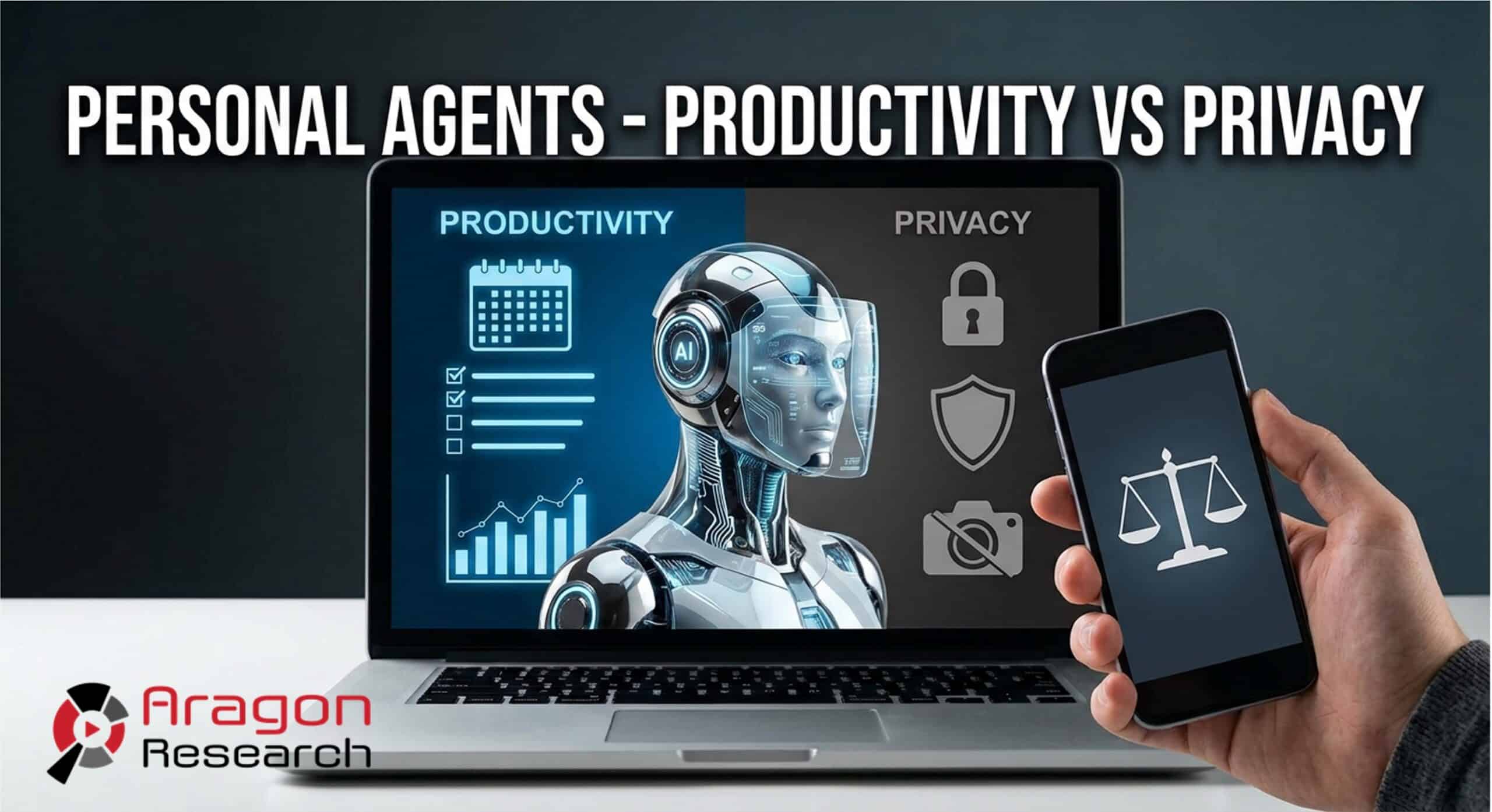
Personal Agents – Productivity vs Privacy
By Jim Lundy
Personal Agents – Productivity vs Privacy
Knowledge workers spend too much of their week managing mundane digital chores across disconnected applications. The rapid arrival of always-on personal agents—including Meta Muse, OpenAI Dots, Anthropic Claude Duet, xAI Grokbot, and Instinct—promises to eliminate this operational friction.
While these tools offer substantial individual productivity gains, they also introduce critical security vulnerabilities when employees link them to corporate credentials. This blog overviews the rise of personal agents and offers our analysis.
Why Did Tech Vendors Launch Always-On Personal Agents
Between August and October 2026, five distinct personal agents transitioned from development labs onto employee devices. xAI released Grokbot in August alongside the invite-only launch of a new provider called Instinct. Meta followed in September with Muse, OpenAI introduced Dots at its developer conference, and Anthropic opened its Claude Duet preview in October.
Unlike traditional chatbots that wait for a prompt, these personal agents operate continuously on dedicated cloud virtual machines. They maintain persistent memory, control their own web browsers, and execute multi-step workflows even when the user turns off their laptop.
The core driver behind this release wave is the shift from conversational assistance to autonomous task execution. Vendors recognize that true productivity requires software that can read emails, navigate user interfaces, and complete transactions independently. However, because employees adopt these tools via personal subscriptions and connect their workplace logins, these agents bypass standard enterprise security reviews.
| Agent Name | Vendor | Core Architecture | Primary Productivity Promise | Enterprise Permission Risk |
| Muse | Meta | Cloud virtual machine with browser control | Autonomous background task completion | Copies corporate credentials to external cloud |
| Dots | OpenAI | Multi-app connector across 4,000+ tools | Automated cross-application workflows | Inherits full human user access rights |
| Claude Duet | Anthropic | Persistent workspace research agent | Continuous document and code synthesis | Caches plain-text enterprise data externally |
| Grokbot | xAI | Always-on autonomous execution engine | Real-time information gathering and action | Bypasses endpoint security monitoring |
| Instinct | Instinct | Invite-only dedicated personal runtime | End-to-end calendar and email management | Operates invisibly inside corporate audit logs |
Analysis
At Aragon Research, we view the arrival of personal agents as a direct collision between individual productivity and enterprise identity governance. Giving every employee a persistent digital worker removes hours of administrative overhead, creating an undeniable operational opportunity. Yet the architecture of these personal agents creates an urgent security crisis that traditional access controls cannot solve.
When an employee connects a personal agent like Dots, Grokbot, or Instinct to their corporate workspace, the agent inherits the exact permissions of that human user. In system audit logs, every file export, database query, or email sent by the agent appears as a legitimate action taken by the employee.
Furthermore, user credentials and corporate data are copied to vendor clouds where internal security teams have zero visibility. Even disconnecting the agent fails to erase cached plain-text data that the system already ingested.
This dynamic will force a mandatory overhaul of enterprise identity and access management. Static role-based permissions are now obsolete because they assume a human is sitting at the keyboard making rational decisions.
Identity vendors that fail to build runtime authorization and separate non-human agent identities will lose market relevance within twenty-four months. Simultaneously, model providers will be forced to build strict enterprise sandboxes if they want corporate buyers to approve tools like Claude Duet or Muse for official use.
What Enterprises Should Do
Enterprise IT and security leaders must immediately audit their network traffic to discover unapproved personal agents operating as shadow AI. Organizations cannot rely on policy memos to stop employees from connecting Muse, Grokbot, or Dots to corporate applications. Instead, security teams must deploy local guardrails that block personal accounts from authenticating into enterprise software ecosystems.
Next, architectures must evolve to tune enterprise permissions around the principle of least privilege and dynamic runtime verification. Enterprises should strip excessive standing privileges from human accounts so that an attached personal agent cannot automatically access sensitive customer records or source code. Evaluating dedicated agent governance platforms is now essential to separate human identities from autonomous machine actions.
Bottom Line
Personal agents such as Muse, Dots, Claude Duet, Grokbot, and Instinct represent a major leap forward for workforce productivity. However, allowing these always-on systems to piggyback on human logins exposes the enterprise to silent data exfiltration and credential theft. Leaders must capture the productivity upside of autonomous agents by tuning enterprise permissions, enforcing strict identity boundaries, and requiring dynamic authorization for every automated action.
Related Blogs:
Gemini 4 Smashes AI Agent Limits for Argon
Google Teases Gemini 4 after Record Q2
Gemini 3.8 Sets a New Bar for Agentic AI
How Anthropic won the PR Narrative but Google kept the Volume
Google Nano Banana: Free AI Image Tools for All
Important Research related to this Blog:
Also – Check out all our Podcasts HERE
Have a Comment on this?