


Nvidia in Crisis: Jensen Huang Resigns
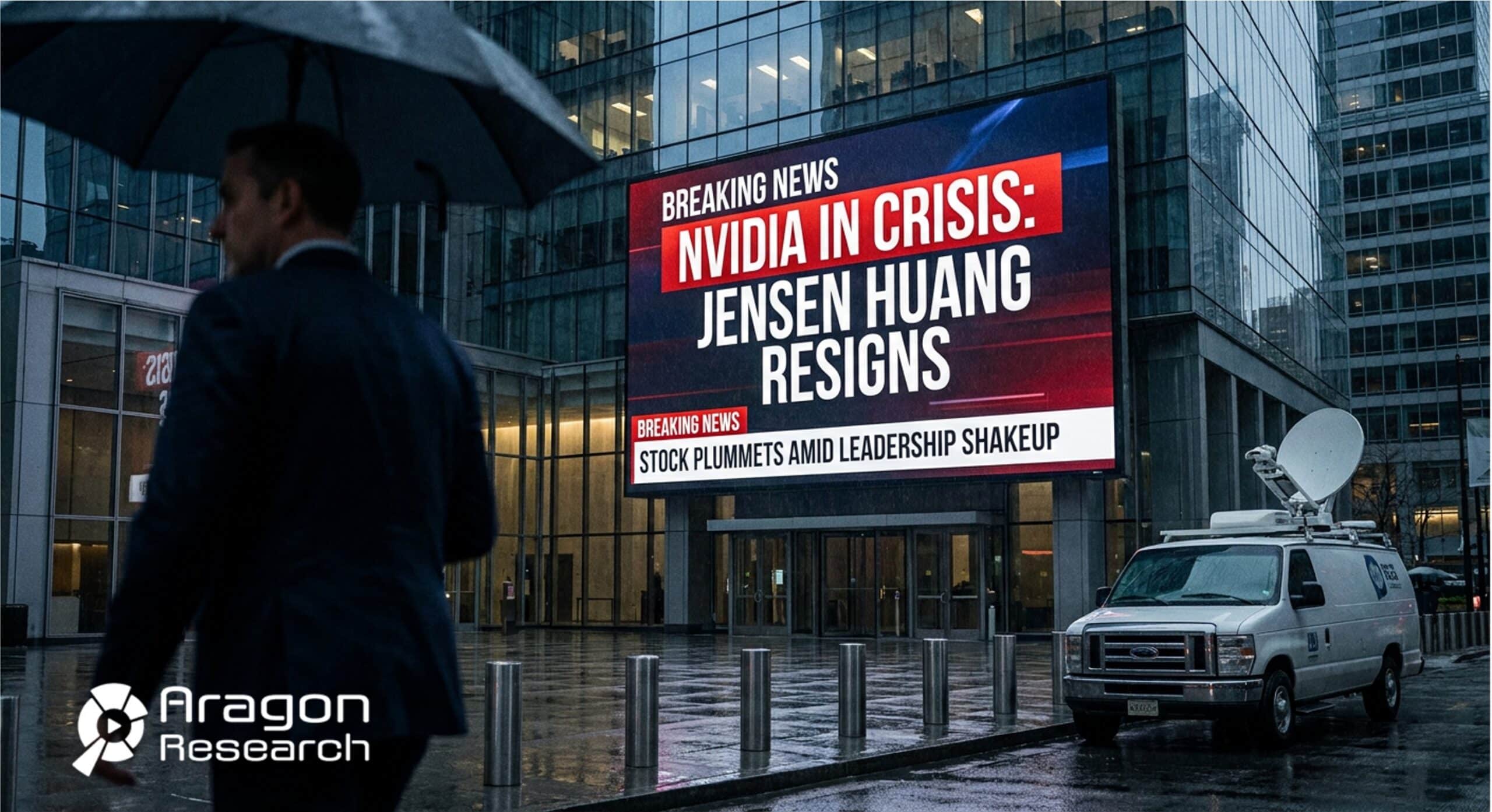
Image design by Aragon, rendered by Gemini.
By Jim Lundy
Nvidia in Crisis: Jensen Huang Resigns
Leadership transitions at dominant technology vendors rarely happen overnight, yet sudden departures can reshape an entire industry. The artificial intelligence market now faces its biggest leadership test to date following a sudden executive change at its most prominent hardware supplier. When a founder who controls every major strategic decision departs under regulatory and national security scrutiny, the shockwaves extend far beyond the boardroom. This blog overviews the resignation of Nvidia CEO Jensen Huang and offers our analysis.
Why Did Jensen Huang Resign from Nvidia?
Nvidia announced on Thursday that its board of directors accepted the resignation of president and chief executive Jensen Huang. The sudden exit follows the revelation of a second workplace relationship involving an Nvidia vice president, coming just days after Huang admitted to an affair with an alleged Chinese spy. That initial admission triggered a United States national security crisis, and the second revelation made his continued tenure untenable. Because Huang held only 3.5 percent of company shares and lacked supervoting rights, the board had the authority to remove the founder who had led the company since 1993.
To stabilize operations, the board appointed Chief Financial Officer Colette Kress as interim CEO while she retains her financial duties. Longtime board member and former Synopsys CEO Harvey C. Jones was named the company’s first-ever chair of the board to lead the search for a permanent successor. The financial reaction was immediate. Nvidia shares fell nearly 19 percent since Friday, erasing more than 855 billion dollars in market capitalization and dragging down the stock values of partner firms across the sector.
Analysis – Nvidia will weather this storm
Nvidia has closed ranks and will weather the storm – but Jensen’s huge involvement in the overall AI market means that Nvidia must answer many questions, particularly involving its business dealings with Cloud Partners, many of whom may have been agents for China.
Under Huang, Nvidia did far more than design graphics processing units and the CUDA software architecture. The company acted as a central bank for the AI ecosystem, holding 99 billion dollars in investments, 25 billion dollars in commitments, and 36 billion dollars in cloud service arrangements.
By funding neoclouds like CoreWeave and Nebius, backing model builders like OpenAI and Anthropic, and offering up to 105 billion dollars in credit guarantees for data center projects, Nvidia effectively financed its own customer base.
CFO Takes over as Interim CEO
With CFO Colette Kress at the helm and Washington scrutinizing the firm due to the national security dimensions of Huang’s departure, this circular financing model will face an immediate freeze. A chief financial officer navigating a federal crisis and an 855 billion dollar market loss will prioritize balance sheet protection over aggressive venture capital bets and massive credit guarantees. Consequently, neocloud operators and AI startups that relied on Nvidia to guarantee their debt or buy back compute capacity will face a severe liquidity crunch, forcing several undercapitalized providers to consolidate or exit the market.
Furthermore, Nvidia faces an internal operational bottleneck that will slow its product roadmap. Huang operated a notoriously flat organizational structure with roughly 60 direct reports and no heir apparent. Transitioning from a founder-led command structure to a traditional hierarchy while under federal investigation will delay strategic decisions, giving rivals like AMD and custom silicon providers a rare window to capture market share.
What Should Enterprises Do About This News?
Enterprise technology leaders must immediately evaluate their exposure to Nvidia and its extended ecosystem of cloud partners. While Nvidia hardware and the CUDA software stack remain the industry standard for training and running neural networks, the financial stability of secondary cloud providers is now in question. Organizations that rely on neoclouds like CoreWeave, Nebius, or Nscale for GPU capacity should audit their service level agreements and assess the financial viability of those vendors if Nvidia pulls back its credit support.
Chief information officers should also accelerate multi-silicon strategies to mitigate vendor lock-in and potential supply chain disruptions. Enterprises planning multi-year AI deployments should evaluate alternative hardware ecosystems from AMD, Intel, and hyperscaler custom silicon programs to ensure their infrastructure roadmaps are insulated from executive and regulatory turmoil at Nvidia.
Bottom Line
Jensen Huang’s resignation marks the end of an era for Nvidia and introduces significant financial and operational risk into the global AI supply chain. The combination of a national security inquiry, a leaderless flat management structure, and a likely pullback in ecosystem financing will slow the pace of data center expansion. Enterprises must look beyond the immediate stock market drop, audit the financial health of their AI cloud providers, and diversify their hardware architectures to protect long-term AI initiatives.
Related Blogs:
Gemini 4 Smashes AI Agent Limits for Argon
Google Teases Gemini 4 after Record Q2
Gemini 3.8 Sets a New Bar for Agentic AI
How Anthropic won the PR Narrative but Google kept the Volume
Google Nano Banana: Free AI Image Tools for All
Important Research related to this Blog:
Also – Check out all our Podcasts HERE
Have a Comment on this?