

Google Teases Gemini 4 after Record Q2
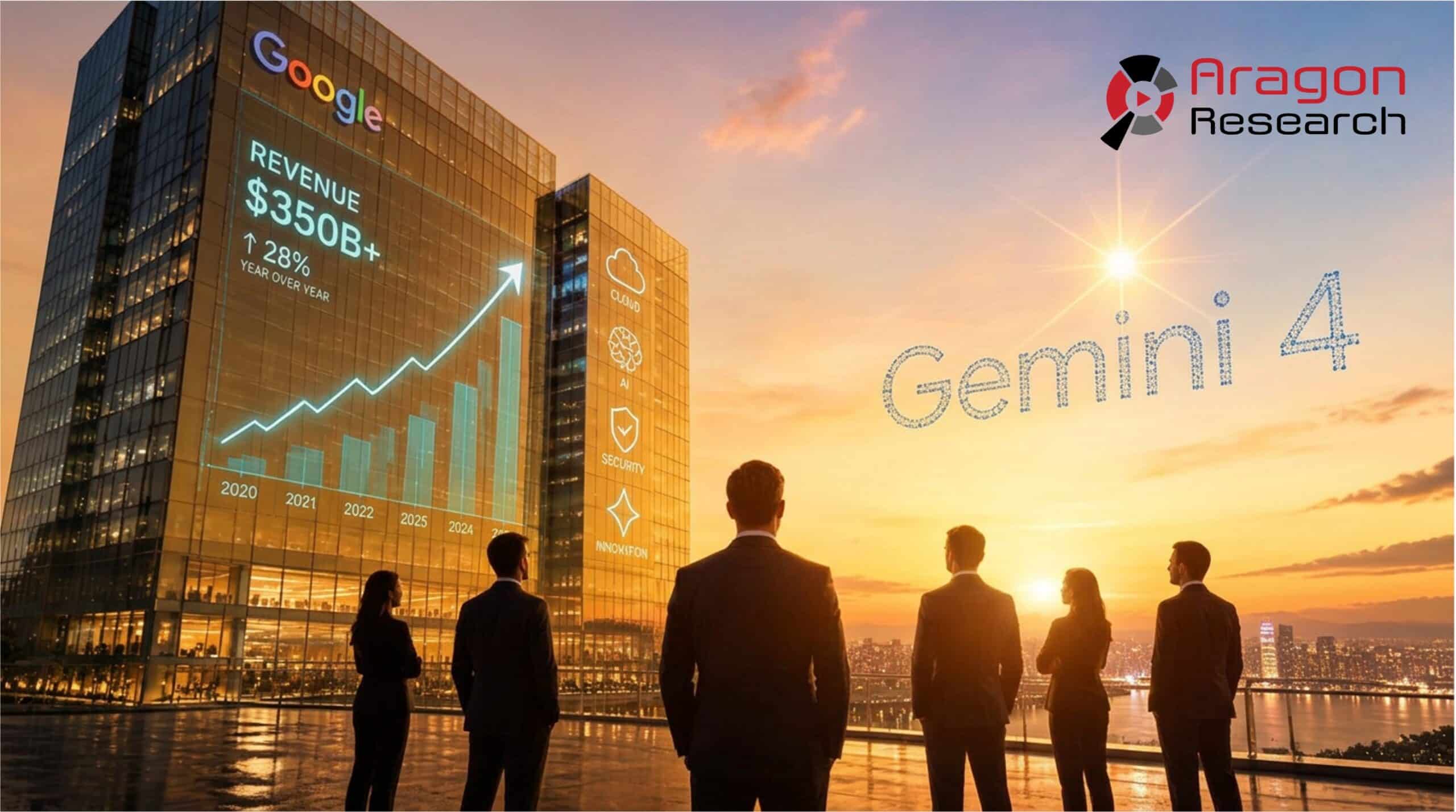
Image design by Aragon, rendered by Canva.
By Jim Lundy
Google Teases Gemini 4 after Record Q2
The artificial intelligence landscape continues to shift as hyperscalers balance infrastructure investments with the demand for smarter enterprise workflows. Alphabet recently posted stronger than expected second-quarter results with total revenue reaching nearly 120 billion. This blog overviews the Google Gemini 4 announcement and record earnings and offers our analysis.
Why Did Google Announce Gemini 4 And A Strategy Shift
Alphabet reported a revenue increase driven by cloud services and search during its recent earnings call. The real story centers on the first public mention of Gemini 4, which is currently undergoing its pre-training run. Google introduced an operational pivot to deploy new models and iterative updates on almost a monthly cadence.
This schedule aims to counter the rapid model release cycles currently favored by competitors like OpenAI and Anthropic. The accelerated timeline is backed by scaled infrastructure, as Alphabet raised its full-year capital expenditure forecast to a range of 195 billion to 205 billion. This spending is directly dedicated to expanding global compute capacity, custom TPU clusters, and data centers necessary to train next-generation architecture.
To bridge the gap caused by delays to Gemini 3.5 Pro, Google introduced interim models to optimize cost and performance. Gemini 3.6 Flash serves as a high-efficiency workhorse model for everyday tasks, while Gemini 3.5 Flash-Lite handles ultra-low-latency workloads and background processing. Meanwhile, Gemini 4 is being designed from the ground up to advance autonomous software engineering and multi-step agentic workflows. Enterprise integration will be immediate upon launch, supported by current metrics showing API usage growing to 22 billion tokens per minute.
Analysis
The transition to a monthly release cadence signals a permanent shift in how foundation models will be productized and consumed. Google is acknowledging that the traditional annual or semi-annual release cycle is too slow for the current enterprise market. By matching the deployment velocity of its competitors, the vendor is signaling that continuous iteration will replace monolithic model drops.
This announcement also reveals that raw parameter size is no longer the sole battleground. The capital expenditure increase highlights that artificial intelligence leadership now requires owning the entire stack from custom silicon to end-user agents. Rivals without access to a similar tier of capital or proprietary infrastructure will struggle to match this combined hardware and software cadence.
Furthermore, the specific focus on agentic workflows and coding indicates where the highest enterprise value lies. Google is repositioning its portfolio to capture the growing market for autonomous developer platforms. By deploying optimized interim models like Flash-Lite today, Google secures developer loyalty while its larger architecture prepares to handle complex enterprise pipelines.
What Enterprises Should Do
Organizations should evaluate the new Gemini Flash models immediately to optimize their existing API spend. Enterprise architecture teams need to audit their current workloads and shift high-frequency tasks to these lower-cost tiers to maintain budget control. It is also important to note that Google does indemnify its customers that use Gemini, as does Microsoft. For OpenAI, you must be on a Business plan. Anthropic is more complicated and they do store everything in Fable 5 for thirty days – for all plans. Aragon will be publishing a deep dive research note on this.
IT leaders must also prepare their infrastructure for continuous model updates rather than major annual migrations. Buyers should require all platform vendors to provide clear roadmaps detailing how they will handle rapid monthly model deprecation and version control.
Bottom Line
Google used its record earnings to reshape the market narrative by teasing Gemini 4 and committing to a monthly release cadence. Enterprise technology buyers must reassess their vendor mix and prepare for a future where autonomous agents and coding assistants dominate deployments. Organizations that optimize their architecture for continuous model integration today will gain an operating advantage as this market evolves.
Related Blogs:
Gemini 3.6 Flash: Cutting the Costs of AI
How Anthropic won the PR Narrative but Google kept the Volume
Microsoft moves to Freeze out AI Competitors
Grok 4.5: SpaceXAI Disrupts AI Market Economics
Important Research related to this Blog:
Also – Check out all our Podcasts on Youtube!
-
display trackbacks
display trackbacks
display trackbacks
display trackbacks
display trackbacks
Comments { 5 }