


Vonage Powers AI Agents With Unified Email API
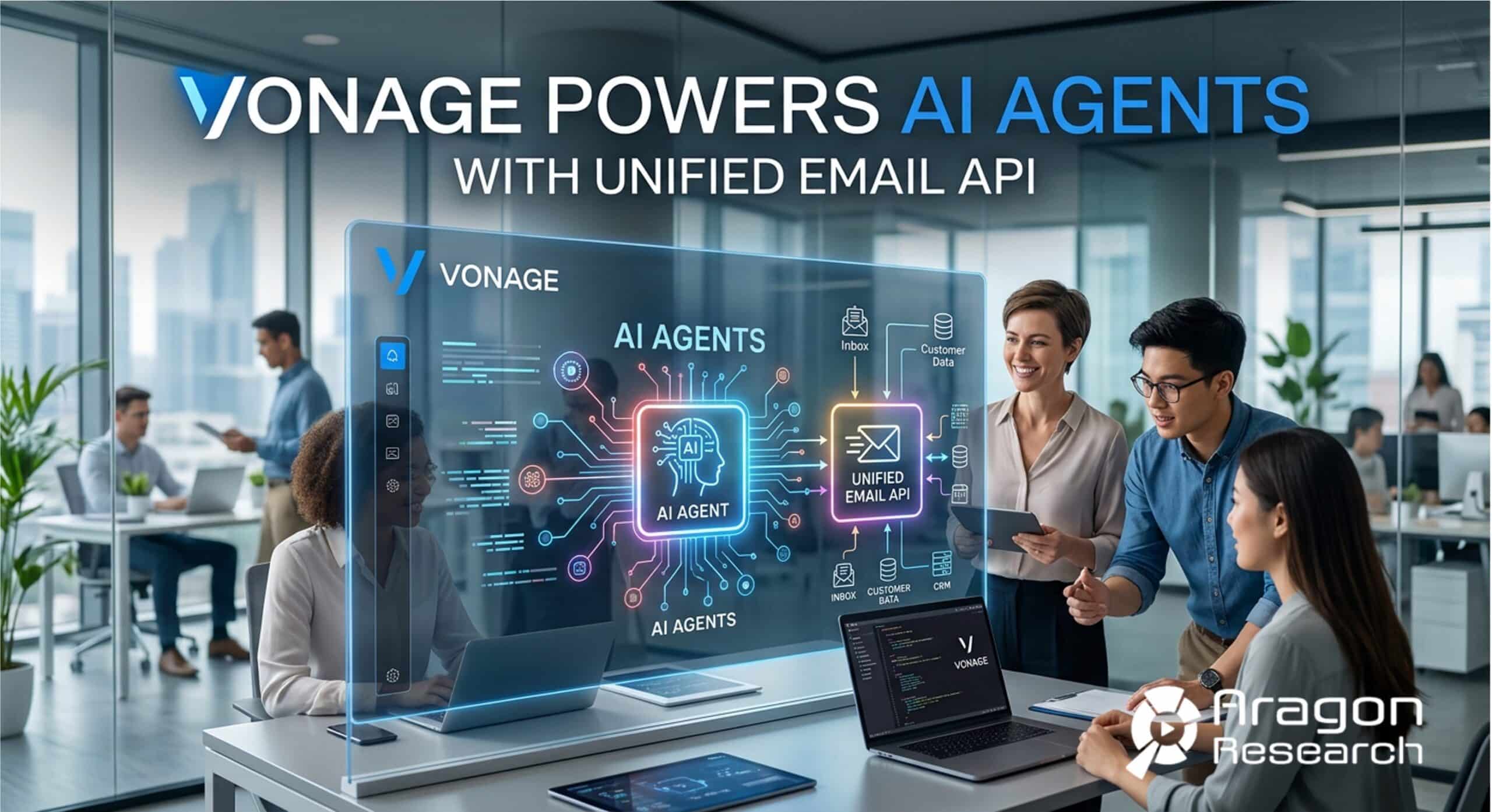
Image design by Aragon, rendered by Gemini.
By Jim Lundy
Vonage Powers AI Agents With Unified Email API
Enterprise communication strategies often fail because critical channels operate in disconnected technical silos. While mobile messaging formats capture market attention, email remains the foundational backbone for digital business records and identity verification. Recently, the Ericsson subsidiary addressed this architecture gap by adding native email capabilities to its core communications platform. This blog overviews the Vonage Email API launch and offers our analysis.
Why Did Vonage Announce the Email API?
Vonage introduced the Email API within the existing Vonage Messages API to unify transactional messaging under a single interface. Previously, developers using the Vonage platform for SMS, MMS, RCS, and WhatsApp maintained separate codebases to manage email. By integrating email into the same endpoint, Vonage lets organizations trigger password resets, order confirmations, and alerts without new integrations.
The new capability includes built-in authentication to verify every sent message and protect brand reputation. It also provides real-time webhook notifications that track delivery, opens, and engagement within existing customer dashboards. Most importantly, the update enables native cross-channel failover for enterprise communication workflows. If an urgent SMS or RCS message fails to reach a customer, the platform routes that message to email automatically.
Analysis
Adding email to a Communications Platform as a Service portfolio looks like a routine catch-up move against established rivals. However, viewing this solely through the lens of basic customer notifications misses a broader architectural shift in enterprise software. From an Aragon Research perspective, the primary driver here is the rapid proliferation of autonomous AI agents and composite applications.
Modern enterprise applications and AI agents cannot function exclusively inside ephemeral chat windows. When an AI agent executes a complex workflow, it needs programmatic email access to send formal documentation and verify identities. By embedding email into the same API as RCS and WhatsApp, Vonage positions itself as a hub for agentic workflows.
Furthermore, building this capability natively rather than bolting on a standalone email marketing acquisition gives Vonage an architectural advantage. Competitors often struggle for years to merge acquired email infrastructure into their core messaging APIs. This leaves developers dealing with fragmented dashboards and separate billing models.
Because Vonage engineered this specifically for transactional utility within its existing messaging architecture, software teams gain immediate channel orchestration. This move forces competing CPaaS vendors to accelerate the true unification of their own API endpoints. Rivals that fail to offer single-call failover across mobile and email risk losing developer mindshare as multi-channel AI agents scale.
This native integration puts direct architectural pressure on market leader Twilio and rivals such as Sinch, Infobip, and Bird. While Twilio acquired SendGrid years ago and Sinch bought Mailgun, those email platforms often operate as distinct product silos with separate APIs and authentication structures. Developers using those competitors frequently have to stitch together mobile messaging and email workflows manually across different consoles. Because Vonage built transactional email directly into its core Messages API endpoint, it bypasses that legacy integration debt and forces Twilio and others to accelerate the true backend unification of their acquired email assets.
What Should Enterprises Do About This News?
Enterprise architecture and application development leaders should evaluate this offering as an opportunity to consolidate their communication stacks. Organizations currently paying separate point-solution providers for transactional email and mobile messaging should audit their integration maintenance costs. You should also examine how fragmented webhook architectures slow down your application deployment cycles.
If your teams build customer-facing AI agents or automated applications that require email access, consider testing the Vonage Messages API. Evaluate whether single-call channel failover reduces your operational overhead and improves message deliverability for critical customer transactions.
Bottom Line
Vonage has closed a notable gap in its CPaaS portfolio by embedding transactional email directly into its unified Messages API. Beyond simplifying customer alerts, this architecture provides the programmatic email access that modern enterprise applications and AI agents demand. Chief Information Officers and development leaders should review their current messaging vendor contracts and pilot unified API orchestration to eliminate communication silos.
Have a Comment on this?