


Dropbox Navigates the Content Intelligence Race
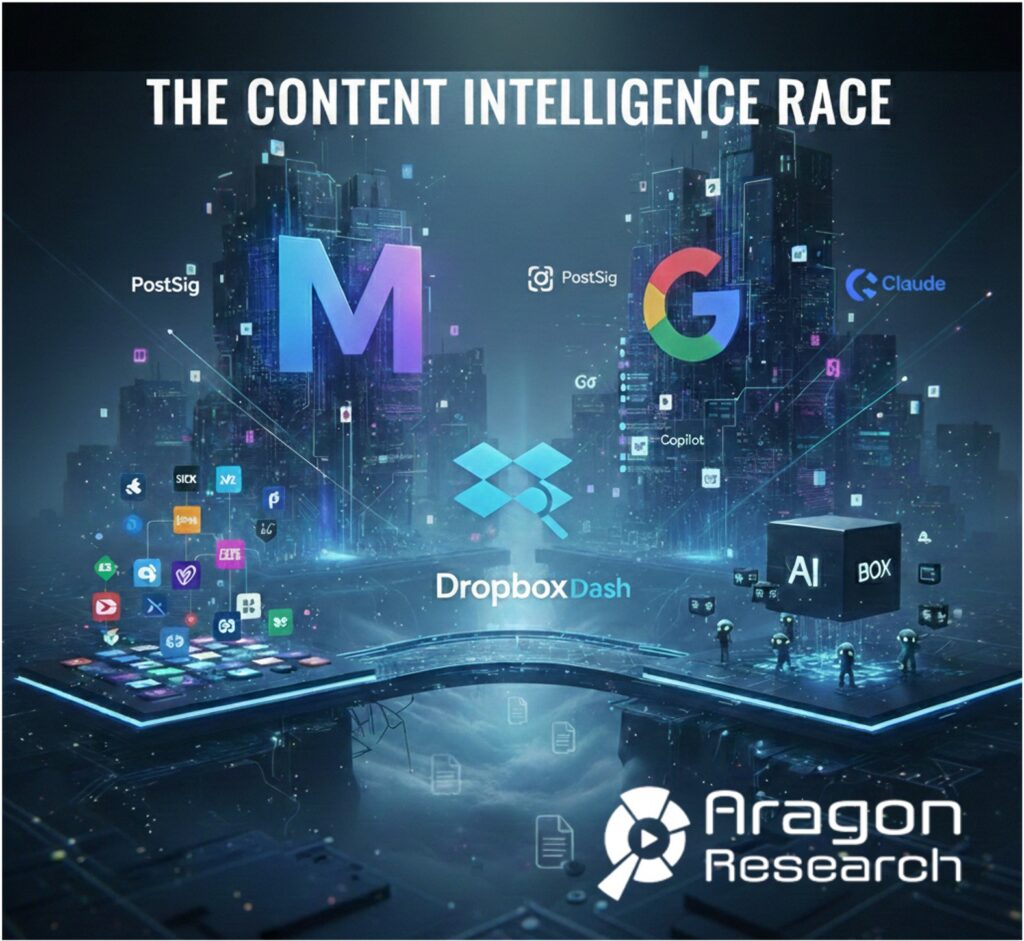
Dropbox faces increased competition in Content Intelligence.
By Jim Lundy
Dropbox Navigates the Competitive Content Intelligence Race
Dropbox recently reported its fourth-quarter earnings for 2025, revealing a slight revenue decline of 1.1% year-over-year to $636.2 million. While the company managed to beat analyst expectations on profit, the stock faced immediate pressure as investors reacted to slowing growth and a cautious outlook for 2026. This financial dip highlights the mounting pressure on legacy cloud storage providers to pivot toward intelligence-driven services. This blog overviews the Dropbox earnings and discusses the state of the growing Content Intelligence market.
Why did Dropbox report declining revenue in Q4 2025
The decline in revenue stems primarily from the saturation of the core file-sync-and-share market and a shift in enterprise IT spending toward generative AI platforms. As organizations consolidate their software stacks, many are opting for the bundled AI capabilities found in Microsoft 365 or Google Workspace rather than maintaining a standalone storage tier.
Dropbox is attempting to counter this trend by positioning Dash, its universal AI search tool, as a productivity layer that sits above fragmented application environments. However, the transition from a storage utility to an AI-powered work companion is proving to be a slow climb that has yet to offset the churn in its legacy subscriber base.
The Proliferation of Intelligent Content Assistants and Agents
A primary driver of the Content Intelligence market is the rapid maturation of Intelligent Content Assistants (ICAs) and the emergence of specialized Content Agents. These tools are moving from novel features to fundamental components of the modern content platform. Intelligent Content Assistants are AI-powered tools designed to help users interact with, summarize, and generate content.
Foundational capabilities like document summarization and generation are becoming standard, addressing information overload and accelerating decision-making. Leading providers have integrated ICAs into their platforms, allowing users to distill lengthy reports into concise summaries or easily draft effective communications.
Beyond assistants, the market is now seeing the arrival of Content Agents designed to perform specific, autonomous tasks within a document lifecycle. When multiple agents work in concert—for example, one agent drafts a contract, a second sends it for review, and a third monitors for signatures—they form an Agentic System. This represents a significant leap in automation, moving beyond simple, linear workflows to complex, dynamic, and intelligent processes.
Analysis
The struggle for Dropbox is no longer about who has the most reliable sync engine; it is about who owns the connective tissue of the digital workplace. While Dropbox Dash offers impressive multimodal search capabilities, it is entering a market already dominated by giants and specialized innovators. Microsoft and Google are natively embedding AI into the creation layer, while Box, Hyland, IBM and Opentext are aggressively moving into deep content services.
Notably, new entrant PostSig is redefining the space by focusing on the post-signature phase, turning static contracts into active systems of intelligence. This highlights a shift where “intelligence” is no longer just about finding a file, but about the AI understanding the obligations and data within that file to drive business outcomes.
Aragon Research believes that for Dropbox, Dash currently feels like a bridge to a future that is not yet fully built. The challenge is that a universal search tool is a feature, not necessarily a platform. To survive the content intelligence race, Dropbox must prove its neutrality—the ability to search across all ecosystems—is more valuable than the deep vertical integration offered by firms like Box or the specialized lifecycle automation of PostSig. If Dash remains perceived as a work in progress rather than a mission-critical automation engine, Dropbox risks being relegated to a niche provider for creative professionals rather than an essential enterprise partner in the agentic era.
What should enterprises do about this news
Enterprises currently using Dropbox should evaluate the roadmap for Dash specifically regarding how it handles cross-platform data governance and sensitive information. It is important to compare the search accuracy and connector depth of Dash against existing investments in Microsoft Copilot or Google Gemini for Workspace to see if the cross-ecosystem search justifies the additional cost. Furthermore, organizations with high-stakes document lifecycles should investigate specialized providers like Box for agentic workflows or PostSig for contract performance management to see where autonomous agents can replace manual administrative tasks.
Bottom Line
The latest financial results from Dropbox serve as a warning that the storage only era is officially over, and the race for content intelligence is the new battlefield. While Dash represents a solid technical effort to unify the digital workspace, it faces an uphill battle against the distribution power of Microsoft and Google and the specialized agentic capabilities of Box and PostSig. Enterprises need to decide if they value a neutral third-party search layer enough to justify the overhead of another AI license in an increasingly crowded software environment.
Have a Comment on this?