


Meta Acquires Manus to Accelerate AI Agents
By Jim Lundy
 Meta Acquires Manus to Accelerate AI Agents

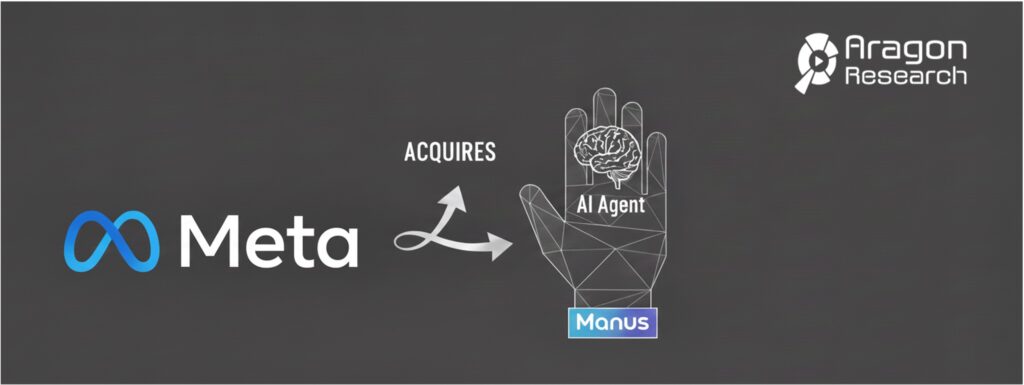
The global race for artificial intelligence dominance reached a significant milestone this week with Meta Platforms announcing its acquisition of Manus. This move follows a period of intense speculation regarding the ability of the social media giant to keep pace with rapid innovation from agile startups and entrenched rivals like OpenAI. Manus has gained notoriety for its “general-purpose” AI agent which reportedly outperforms existing research models by executing complex, multi-stage workflows autonomously. This blog overviews the Meta acquisition of Manus and offers our analysis.
Why did Meta announce the Manus acquisition?
Meta is under immense pressure to prove that its massive capital expenditure on AI infrastructure can translate into tangible products and revenue. While the Llama series of models has established Meta as a leader in the open-weights movement, the company has lacked a consumer-facing “execution layer” that moves beyond simple chat. Manus provides this missing link by offering technology that does not just answer questions but performs tasks such as travel planning, stock analysis, and recruitment screening. By acquiring a firm already generating over $100 million in annual recurring revenue, Meta is signaling to investors that it can successfully commercialize AI at scale.
Analysis
The acquisition of Manus is less about the startup’s existing user base and more about Meta’s need to secure a defensive position in the emerging agentic AI market. In the current landscape, the value of AI is shifting from “knowledge retrieval” to “autonomous action.” If Meta remained focused solely on large language models, it risked becoming the plumbing for other companies’ intelligent agents. By integrating Manus into WhatsApp and Instagram, Meta effectively turns its messaging platforms into the primary interface for the “AI economy.”
This deal also reveals a strategic pivot in how Meta handles geopolitical risks. By mandating that Manus sever all ties to Chinese investors and shutter its mainland operations, Meta is attempting to preempt the regulatory friction that often plagues cross-border tech deals. However, the move suggests a deeper concern: Meta may have realized that its internal development of autonomous agents was not progressing fast enough to counter OpenAI’s Deep Research or Google’s specialized agents. Buying Manus is a shortcut to technical parity, but it also highlights a potential “innovation gap” within Meta’s own labs that required a $2 billion external fix.
China to Investigate
It was announced this week that China’s Ministry of Commerce is going to review export laws to see if this deal violates them. If China blocks this deal, it could sour investments in Chinese AI startups if there is no possible exit strategy.
What should enterprises do?
Enterprises should evaluate this acquisition as a sign that the era of the “AI agent” has officially arrived for the mass market. If your organization is currently building simple chatbots, it is time to reconsider your roadmap in favor of autonomous agents that can execute workflows. Given the Chinese investigation, this deal is basically on hold. All that said, consider how these autonomous capabilities might impact your existing technology stack, particularly if you rely on manual processes for data analysis or research that these agents can now handle.
Bottom Line
Meta’s purchase of Manus is a high-stakes bet that autonomous agents will be the next major computing platform. If the deal is approved, then this move helps Meta bridge the gap in the “AI Wars”. However, given Western tensions with China over AI technology, dont expect other deals to be considered for the time being. Enterprises must move beyond the hype of generative AI and begin testing autonomous agents for specific business outcomes. The focus should now shift from what an AI can say to what an AI can actually do for your business operations.
Have a Comment on this?