

Superhuman – the new name for Grammarly
By Ken Dulaney
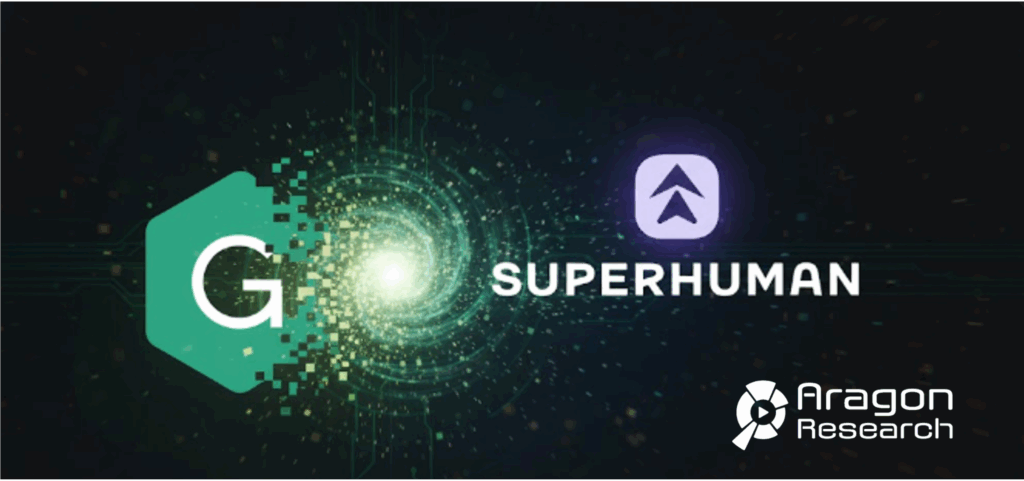
Grammerly is changing its name to Superhuman. This blog overviews the Grammarly rebranding and its strategic pivot to AI agents, offering an analysis of what this means for the company, its competitors, and the enterprise market.
Why Did Superhuman Announce the Pivot to Agents?
The decision by Grammarly—now Superhuman—to transition from a premium writing assistant to a comprehensive AI agent-driven productivity suite is a direct and necessary response to the evolving market. The primary catalyst is the aggressive integration of AI editing and writing functions into popular productivity ecosystems like Microsoft Copilot and Google Gemini.
When your core, market-leading functionality (AI writing and correction) becomes a native, “good enough” feature within the platforms where knowledge workers spend their entire day, your business model is critically undermined. The move to agents, catalyzed by the acquisitions of the Superhuman email client and the Coda collaboration platform, signifies a bid for survival and expansion. Superhuman is moving up the value chain, shifting from being an AI feature to being an AI fabric that automates entire, multi-modal workflows—a shift that makes it indispensable, not redundant.
Analysis: Aragon Research Perspective
The pivot to agent technology by Superhuman is a notable strategic adjustment by a secondary vendor in the productivity market over the past year. It matters because it validates a key Aragon Research tenet: the future of work is not just generative AI, but agentic AI.
For Superhuman, the impact is a high-risk, high-reward proposition. The rebrand sheds the historical limitation of “grammar,” opening the door to a much broader market opportunity, specifically the $100 billion-plus market for enterprise productivity software. By focusing on agents that execute downstream actions—such as triaging an inbox, scheduling a meeting, or pulling data from a CRM while drafting an email—Superhuman aims to create a deeply integrated, collaborative AI experience.
The key risk is integration friction. Blending Grammarly’s writing intelligence with Superhuman’s speed-focused email workflow and Coda’s structured collaboration capabilities will be an enormous technical and user experience challenge. If the integration is clunky, the powerful brand equity of the original tools could be lost.
This move also highlights a broader trend: narrowly focused agent deployment as a formula for success for application vendors. While mega-vendors like Microsoft and Google build generalized, platform-wide AI, smaller, agile firms like Superhuman are targeting specific, high-friction application areas (e.g., email and document flow). By mastering an immediate, measurable productivity gain in a critical vertical, they can build a defensible product against the broad, horizontal AI offerings of the giants.
What Enterprises Should Do: Evaluate and Consider
This announcement is not merely something for enterprises to “watch”; it is a strong signal that AI Agents are maturing from concept to deployable technology.
Enterprises should evaluate and consider Superhuman’s new suite. Specifically, organizations should look at the unified platform’s ability to automate complex, cross-application workflows (e.g., sales, marketing, and support communication cycles). The appeal lies in a solution that offers multi-modal application automation—a system that can simultaneously engage with email, documents, and external data sources to complete a task.
For CIOs and IT leaders, the due diligence must focus on:
- Security and Governance: How does Superhuman ensure its agents only access data within defined enterprise permissions?
- Workflow Customization: Can the agents be customized to adhere to specific brand tones, compliance rules, and internal procedures?
- ROI Measurement: Can Superhuman clearly articulate the time-savings and productivity gains beyond basic grammar checks?
Impact on the Market: The Agent Arms Race
The shift accelerates the Agent Arms Race and redefines the competitive landscape for all players in the productivity space.
- Specialization over Generalization: This move validates that niche, vertical expertise for agents will be a successful counter-strategy to the large, general-purpose models. We will see an acceleration of specialized agent development from vendors across CRM, ERP, and HR application categories.
- Productivity Suite Consolidation: Superhuman is now squarely positioned as an orthagonal competitor to Microsoft 365 and Google Workspace, creating a premium third option that prioritizes AI-driven workflow efficiency across all applications, not just those within a single-vendor ecosystem.
- The New Application Standard: The expectation for all business applications will evolve. Users will no longer tolerate simple, reactive AI features; they will demand proactive, context-aware agents that execute multi-step processes autonomously. This raises the bar for every vendor building a tool for knowledge workers.
Bottom Line: The Survival Strategy
Superhuman’s pivot to agents is a necessary and well-executed survival strategy that transforms the company from a feature threatened by hyperscalers into a platform competing for enterprise workflow ownership. The core message is clear: AI is moving beyond content generation to action-oriented, process automation, what we call agentic computing. Enterprises should understand this shift and actively evaluate how Superhuman’s specific, integrated, agent-driven workflow solution compares with the broader AI platforms being offered by the productivity giants. The right choice will come down to which solution provides the most measurable, high-impact automation for their most critical, repetitive communication workflows.
Have a Comment on this?