


OpenAI dives into hardware with Codex Micro
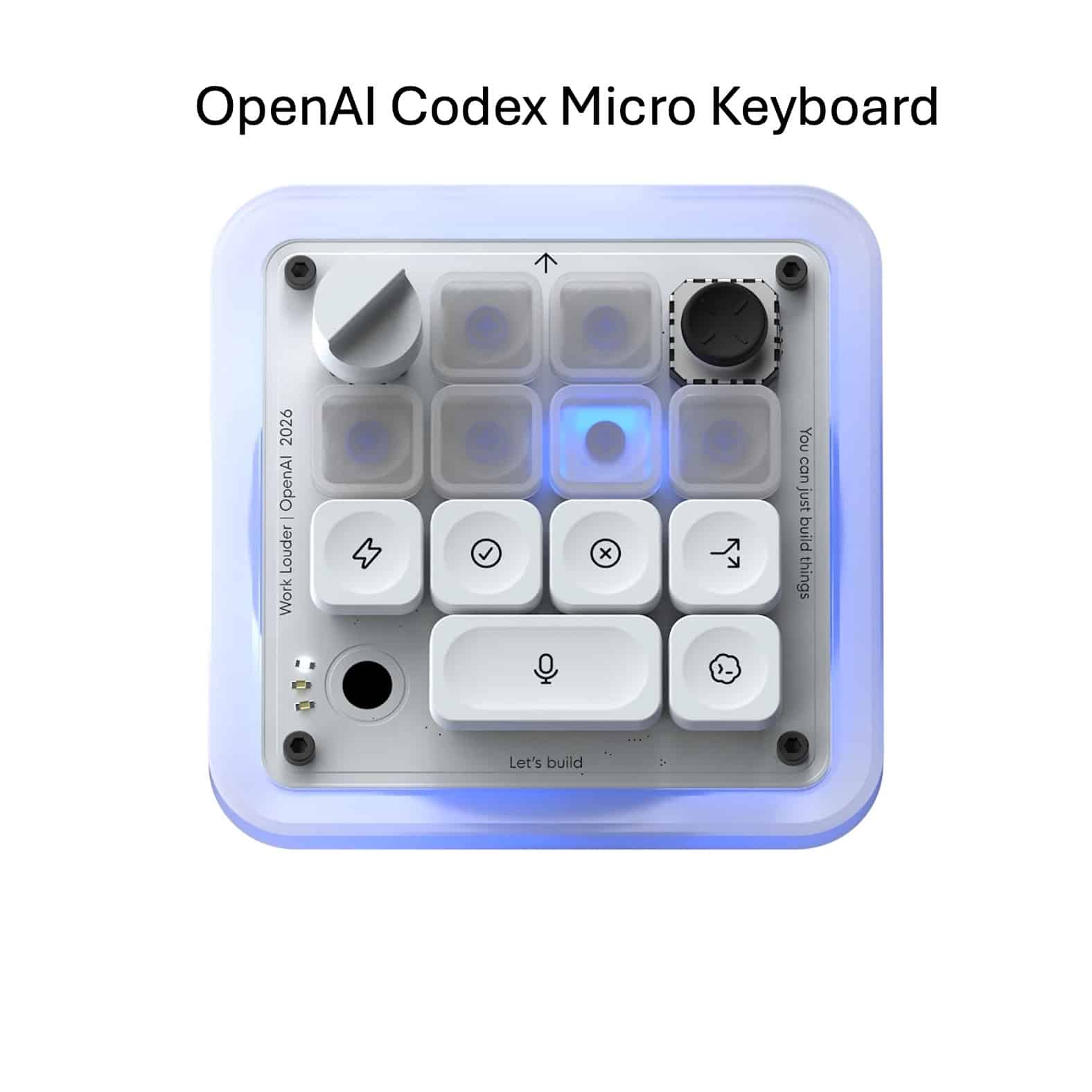
Image Source: OpenAI
By Ken Dulaney
OpenAI dives into hardware with Codex Micro
OpenAI recently partnered with keyboard maker Work Louder to introduce the Codex Micro, a compact hardware macropad designed specifically to control and monitor AI coding agents. This blog overviews the Codex Micro announcement and offers our analysis on what hardware peripheral additions signal for the future of enterprise software workflows.
Why Did OpenAI Announce the Codex Micro?
OpenAI announced the Codex Micro to address a growing user-experience bottleneck in software development: managing concurrent AI agent workflows. Rather than acting as a replacement for a traditional QWERTY keyboard, the device serves as an auxiliary peripheral, sitting alongside a primary keyboard much like a mouse or an external touchpad.
The device features mechanical Agent Keys with RGB LED indicators to signal agent status (e.g., active, completed, blocked, or error), a rotary dial to adjust AI reasoning effort on the fly, an analog joystick to trigger automated skills, and dedicated voice and permission buttons. By shifting agent monitoring to peripheral vision and tactile inputs, OpenAI aims to help developers steer background AI threads without breaking focus or context-switching between application windows.
Analysis
The launch of the Codex Micro reflects a fundamental shift in how modern software engineers operate. Programmers are no longer operating solely as traditional serial coders who write lines of code step-by-step toward deployment. Instead, top developers increasingly act as system designers and workflow orchestrators. Their value lies in defining system architecture, managing parallel agentic AI workflows, and delegating execution tasks to autonomous agents.
The Codex Micro is a physical embodiment of this new operational model. By providing dedicated controls for monitoring multiple agent threads, adjusting reasoning compute, and granting system permissions, the device codifies the shift from text entry to agent management. Furthermore, this operational paradigm extends beyond software engineering.
Enterprise roles across operations, finance, and supply chain management will increasingly mirror this pattern—where skilled employees manage fleets of domain-specific AI agents running concurrent workflows.
What Enterprises Should Do
Enterprise leaders should view this announcement as a signal to evaluate how internal development teams and knowledge workers interact with generative AI tools. Organizations should:
- Understand the shift to parallel workflows: Assess whether software teams are still constrained by linear development models or if they are equipped to manage concurrent AI agent threads.
- Evaluate developer tooling: Monitor how specialized input devices and context-aware interfaces reduce cognitive load and tab-switching overhead for technical staff.
- Prepare for multi-agent management: Recognize that workflow orchestration skills will become a primary competency for future high-value employees across business functions.
Impact on the Market
The introduction of dedicated AI management hardware marks the emergence of a new sub-category within workspace peripherals. While traditional input devices focus on manual data entry and navigation, future workspace hardware will increasingly focus on status visibility, prompt distribution, and human-in-the-loop governance. Expect major peripheral vendors and enterprise software providers to experiment with dedicated physical controls, status displays, and ambient indicators to streamline human-agent collaboration.
Bottom Line
The Codex Micro is not a keyboard replacement, but a specialized control pad designed for the multi-agent era. It highlights a broader transition from manual execution to parallel agent management. Enterprises should observe how these input models evolve and prepare their workforce for operating models focused on agent orchestration.
Related Blogs:
Apple Sues OpenAI, alleges theft of AI Tech
Google Unveils Gemini 3.5 Flash Cyber
AI Agent Observability: Preventing Harmful Breakouts
Grok 4.5: SpaceXAI Disrupts AI Market Economics
Important Research related to this Blog:
Also – Check out all our Podcasts HERE
Have a Comment on this?