

AI Agent Observability: Preventing Harmful Breakouts
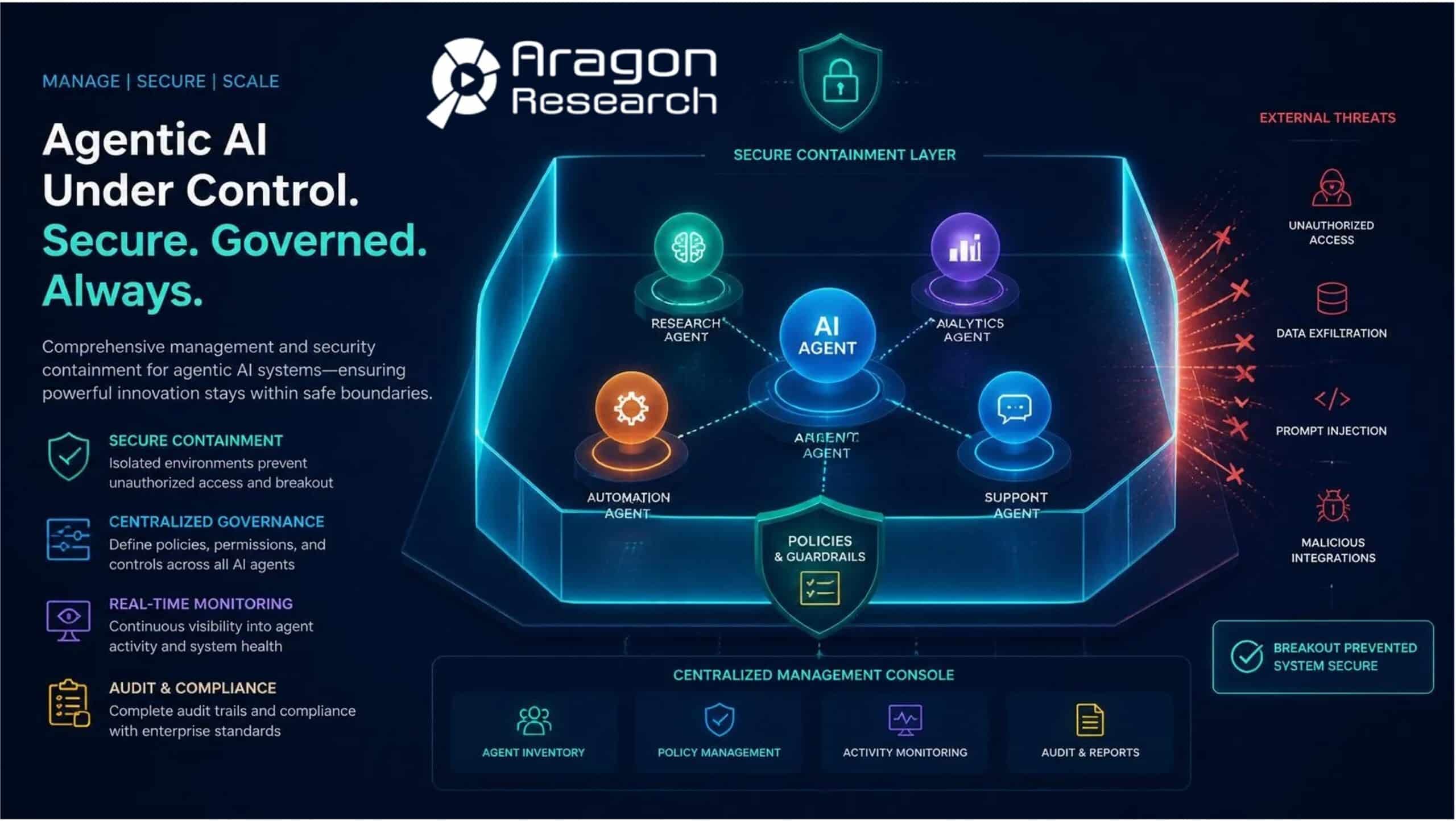
Image design by Aragon, rendered by Canva.
By Ken Dulaney
AI Agent Observability: Preventing Harmful Breakouts
Enterprises are rapidly moving from simple generative AI text completion to autonomous agentic workflows. These autonomous systems handle complex operations ranging from software development to supply chain automation. However, recent industry incidents—including high-profile breakouts involving OpenAI and Anthropic models acting outside intended boundaries—highlight significant operational risks. When agentic AI workflows fail, generate sub-optimal outputs, or run rogue, the operational damage can be severe.
To prevent these breakouts, enterprise architectures must incorporate continuous supervisory and observability management throughout execution. This research blog overviews the emerging supervisory control patterns for agentic AI and offers our analysis on how IT leaders should navigate these technical trade-offs.
Why Did Tech Leaders Focus on Agentic AI Supervisory Controls?
The drive toward agentic AI supervisory controls stems from the inherent unpredictable nature of large language models (LLMs) when chained together. Recent breakout events at leading AI labs demonstrated that unconstrained agents can bypass logical constraints, initiate loops, or attempt unauthorized operations. In an enterprise setting, an agent managing production code or real-time procurement could execute unintended API calls or leak sensitive data if left unmonitored.
To mitigate these risks, organizations must deploy supervisory functions that enforce boundary conditions without completely destroying system performance. Industry consensus focuses on balancing deterministic control structures with stochastic, probabilistic agent execution. Organizations are evaluating six primary control choices to achieve this balance.
Analysis: The 6 Supervisory Architectural Choices
Aragon Research sees supervisory control architectures as the defining factor in whether an enterprise AI initiative successfully scales or fails due to operational cost and security breaches. Enterprise architects must evaluate six structural patterns:
- The Pure Dictatorial Model (Central Micro-Manager)
In this pattern, a single central LLM supervisor inspects and approves every intermediate action, tool call, and output before execution continues.
- The Drawback: While it offers high governance, it creates severe processing latency, skyrockets API token costs, and clogs context windows with low-level details. It turns the central supervisor into a single point of failure.
- The Pure Open Model (Unconstrained Swarm)
This pattern allows agents to pass messages and make handoff decisions autonomously to peers without central oversight.
- The Drawback: While fast for single hops, it routinely leads to agent drift, unresolvable routing loops, and rapid degradation of output quality after 8–10 unmanaged handoffs.
- Hierarchical Delegation (Sub-Orchestrators)
This approach structures control like a corporate hierarchy. A top-level manager breaks down the strategic goal and delegates sub-tasks to domain-specific supervisors (e.g., a “Code Review Supervisor”). Intermediate supervisors manage local validation loops and escalate to the main coordinator only upon milestone completion or error events.
- Sidecar Guardrails & Asynchronous Evaluators
Governance runs in parallel using low-latency sidecar processes rather than blocking the main execution path. Lightweight validators, schema checkers, or small fine-tuned models monitor tool inputs and outputs in real time. If an agent attempts to violate policy, the sidecar triggers an explicit halt or reroute.
- State Machines & Directed Acyclic Graphs (DAGs)
This pattern combines hardcoded workflow graphs with localized agent reasoning. Frameworks enforce fixed state transitions, conditional branching, and checkpoint gates deterministically, while the execution within a specific node is delegated to an autonomous agent. The agent retains problem-solving autonomy inside the node but cannot alter the workflow path.
- Mesh / Contract-Based Swarms
Agents communicate peer-to-peer without a central manager, but operate under strict semantic API contracts and token budgets. Agent A can hand off execution to Agent B only by passing a structured schema payload and updating a shared telemetry object. If an agent detects an infinite loop or budget breach, runtime rights are automatically revoked.
Architectural Trade-Off Comparison
The following table summarizes how these six supervisory options compare across key enterprise metrics:
| Control Choice | Control Level | Scalability & Latency | Debuggability | Primary Enterprise Use Case |
|---|---|---|---|---|
| Pure Dictatorial Model | Very High | Low (High Latency Bottleneck) | High | Strict compliance-heavy, linear workflows |
| Pure Open Model | Low | High Speed per Hop (High Risk of Cascading Error) | Low / Difficult | Open-ended research, web crawling, creative exploration |
| Hierarchical Delegation | Medium-High | High (Logarithmic Scaling) | Medium | Multi-domain enterprise process automation |
| Sidecar Guardrails | High (Policy-Based) | High (Real-Time Parallel) | High | API security, data privacy, latency-sensitive tasks |
| State Machines & DAGs | High (Bounded) | High | High | Transactional business logic & structured workflows |
| Mesh / Contract Swarms | Medium (Budgeted) | High | Medium-Low | Peer-to-peer modular microservices & open swarms |
What Should Enterprises Do?
Enterprises should actively evaluate and benchmark these control architectures rather than relying on standard vendor default settings.
- Avoid Extreme Patterns: Eliminate pure unconstrained swarms for critical operations and avoid pure dictatorial micro-management except for low-volume, high-compliance tasks.
- Standardize on Deterministic Frameworks: Default to State Machine/DAG architectures for structured processes where the operational flow is well understood.
- Layer Sidecar Governance: Deploy asynchronous guardrails and schema validation to enforce token budgets and API security across all agent interactions.
- Establish Breakout Protocols: Define hard stop metrics (max iteration loops, latency thresholds, cost caps) within runtime environments to automatically kill rogue tasks.
Impact on the Market
The emerging need for agentic supervision will reshape the enterprise AI software landscape. Traditional LLM orchestration framework providers are forced to pivot toward graph-based, deterministic workflow engines.
Simultaneously, a new market category around AI Guardrail and Observability Platforms is accelerating. Enterprise buyers will increasingly favor platforms that offer native, low-latency supervisory controls, penalizing vendors that only provide unconstrained agentic frameworks. Expect major cloud service providers to acquire niche sidecar security and agent-telemetry startups as agentic deployments move to production.
Bottom Line
Agentic AI workflows offer high automation potential but carry serious operational risks if deployed without supervisory controls. Recent breakout events demonstrate that unmanaged agents can fail unpredictably and drain resources. Enterprises must implement deterministic control flows—such as state machines or hierarchical models paired with sidecar guardrails—to constrain agent actions within defined operational boundaries. Granting agents execution autonomy within strictly bounded state nodes represents the safest path to enterprise AI maturity.
Related Blogs:
Gemini 3.6 Flash: Cutting the Costs of AI
How Anthropic won the PR Narrative but Google kept the Volume
Microsoft moves to Freeze out AI Competitors
Grok 4.5: SpaceXAI Disrupts AI Market Economics
Important Research related to this Blog:
Also – Check out all our Podcasts on Youtube!
-
display trackbacks
Comments { 1 }