


Cisco Webex Strategy: Driven by Agentic AI
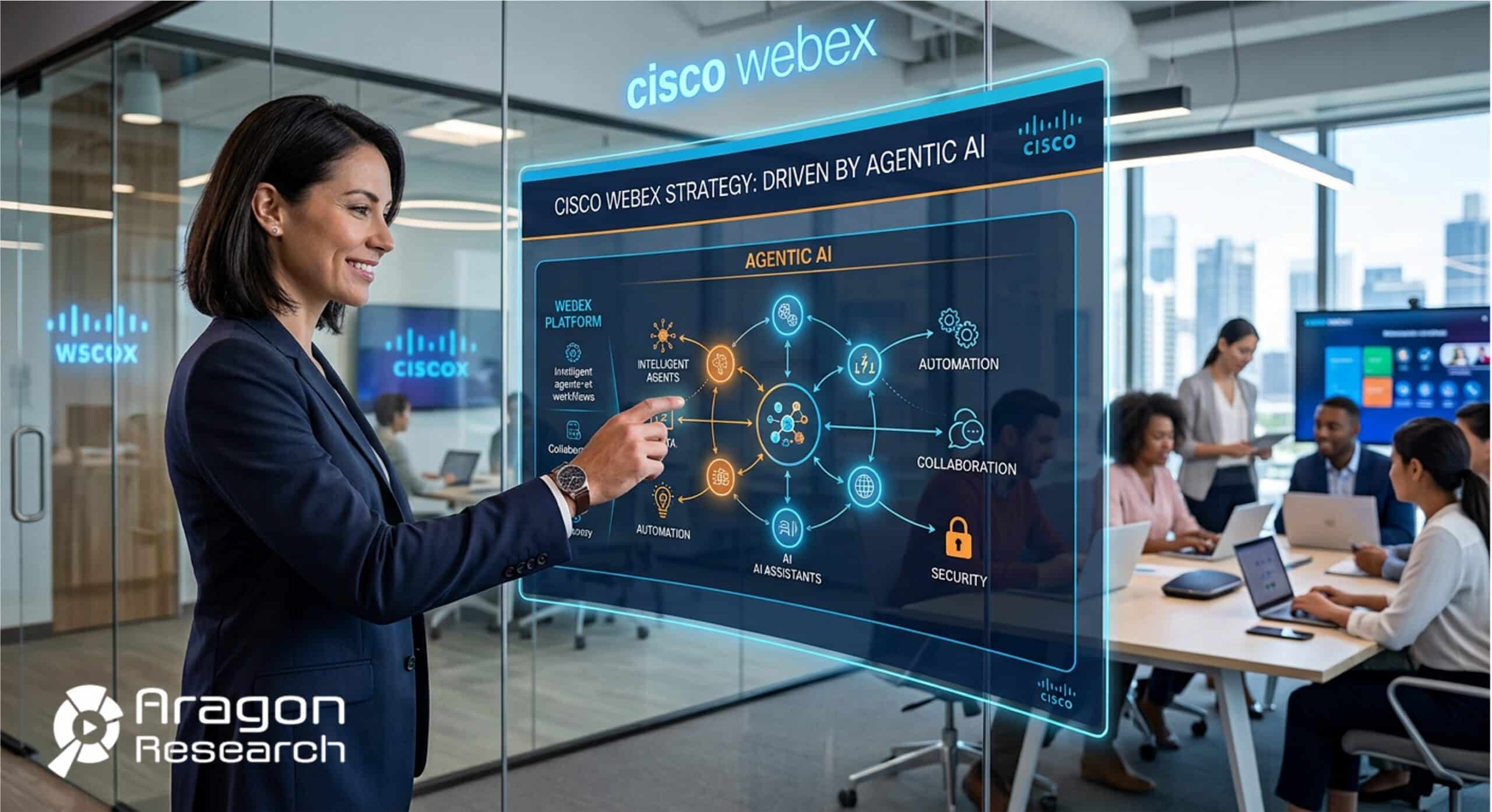
Image design by Aragon, rendered by Gemini.
By Jim Lundy and Adam Pease
Cisco Webex Strategy: Driven by Agentic AI
The enterprise collaboration market is experiencing a massive architectural shift as basic digital assistants give way to proactive digital teammates. Organizations are rapidly moving away from reactive tools and demanding solutions that actively manage complex workflows across all departments. This transition requires technology that bridges human communication with automated task execution seamlessly. This blog overviews the Cisco WebexOne news and offers our analysis.
Why Did Cisco Announce Webex Agentic Architecture
Cisco introduced these innovations to bridge the operational gap between human employees and artificial intelligence. The primary goal is to move beyond simple prompt-based interfaces and embed intelligence directly into the collaborative process.
The updated platform handles deep data analysis and coordinates strategic actions across different applications without requiring users to switch software interfaces. Team members can now bring collaborative agents directly into meetings to execute multi-step tasks.
Cisco also launched a dedicated agentic harness for its customer experience ecosystem. This tool is engineered to manage continuous customer relationships rather than treating interactions as isolated events. The release additionally includes hardware and environmental integrations. This ecosystem allows facility managers to optimize physical meeting spaces using advanced metrics and capacity planning tools.
Here is a breakdown of the core products announced:
| Product | Function |
| Claude Managed Agents | Multi-step actions and deep data analysis within Webex spaces |
| Dialog | Agentic harness for continuous customer relationship management |
| Intelligent Workplace Experiences | Unification of secure networking and physical space optimization |
| RoomOS 27 | Collaboration device operating system featuring advanced AI at the edge |
| Cisco Ceiling Speaker Pro | IP-connected audio system utilizing AI to adapt room acoustics |
Analysis
This announcement shifts the competitive landscape from passive AI co-pilots to fully autonomous execution engines. Cisco is fundamentally changing how digital work is completed by allowing agents to operate persistently in the background. We view this as a crucial evolution for the enterprise communications market. The deployment of the new agentic harness means that automated systems can now perform complex long-horizon execution tasks.
These systems will keep working on a customer problem long after the initial communication channel closes. This capability creates a persistent relationship context that competitors will be forced to address. Other vendors in the unified communications and contact center markets will need to replicate this persistent agent architecture to remain relevant. The deep integration of the updated operating system with these cloud-based agents creates a significant competitive moat.
Cisco is heavily leveraging its established endpoint hardware footprint to create highly intelligent physical spaces. Competitors lacking a strong hardware portfolio will find it increasingly difficult to offer this level of holistic environmental management. To ensure scale and trust these AI operations run within active safety guardrails backed by live telemetry. This observability integration allows administrators to continuously monitor agent performance and enforce strict corporate policy adherence.
What Enterprises Should Do
Business leaders must start mapping their operational readiness for autonomous digital teammates. Evaluate this offering and consider its implications on your existing technology stack. Introducing agentic workflows requires a highly robust approach to data governance and security controls. IT departments should immediately review their current identity management protocols to ensure automated systems operate safely.
Organizations need to prepare for a paradigm where software agents are treated similarly to new human hires. This transition involves carefully indexing corporate knowledge bases and standard operating procedures so these tools can be effectively onboarded.
Technology buyers should plan to run tightly controlled pilot programs using these new capabilities to understand their true impact on daily productivity. Focus initially on specific operational bottlenecks before expanding the tools into broader team collaboration scenarios.
Bottom Line
The rollout of an agentic architecture at WebexOne signals a profound maturation in how artificial intelligence is applied to enterprise tasks. Cisco is effectively merging automated digital workflows with physical office environments and extended customer journeys.
Enterprises should closely monitor these emerging developments and begin updating their internal readiness for highly autonomous operational tools. Preparing your technical infrastructure today will ensure a smoother transition to a fully integrated workforce comprised of both human employees and digital teammates.
Related Blogs:
Cisco innovates with its Antares AI Models
Cisco AI Pivot Pays Off as Demand Surges
Cisco Agentic Security expands with Astrix Deal
Important Research related to this Blog:
Also – Check out all our Podcasts HERE
Have a Comment on this?