


CES 2026: The AI Genome and Robot realities
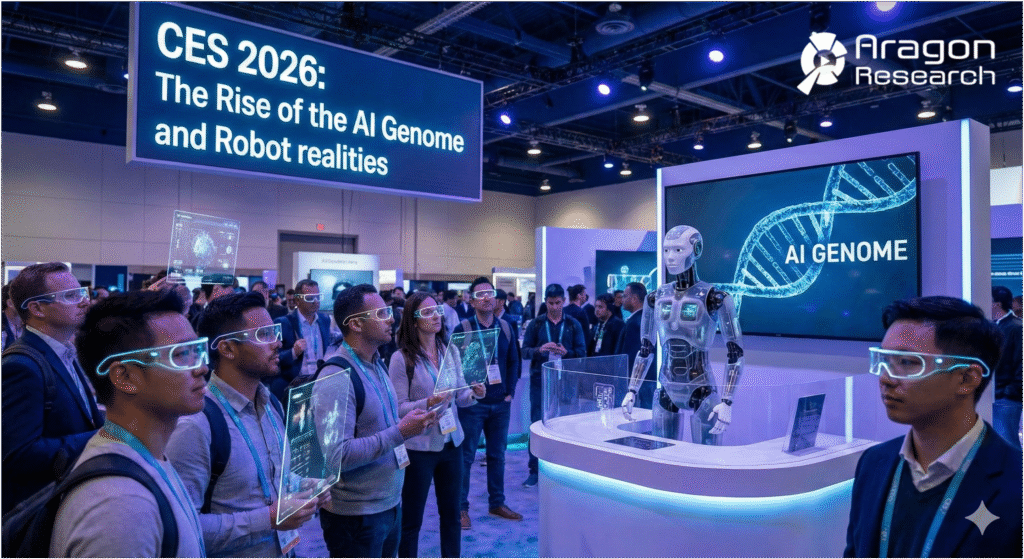
Wearables showed increasing maturity at CES 2026.
By Ken Dulaney
CES 2026: The AI Genome and Robot realities
CES 2026 has concluded, and the sheer scale of the event remains undeniable. Attendance held strong at approximately 140,000 visitors, with a notably large contingent of attendees from Asian markets, reflecting the shifting center of gravity in consumer electronics manufacturing and innovation. However, a walk through the main halls revealed a distinct bifurcation in the show’s energy.
The show floor itself felt lighter on major mainstream company announcements, many of which appeared to have migrated to the quieter, controlled environments of private hotel suites. Instead, the main convention center floor was dominated by a mix of lower-level consumer goods—ranging from advanced hairdryers to an abundance of component manufacturers—creating a bazaar-like atmosphere that contrasted with the strategic deal-making happening off-site.
Why Did OEMs Announce AI-Native Operating Architectures?
The most significant trend at CES 2026 was not a single product, but a fundamental shift in how Artificial Intelligence is deployed. Vendors across the board announced a transition of AI from an “add-on” feature to a core interface mechanism integrated directly at the operating level. This shift is being driven by necessity; we have previously reported on the “complexity wall” facing modern devices, where the sheer volume of features renders traditional tree-structure menus obsolete.
Users simply ignore features they cannot easily find. The industry’s response at CES was clear: AI is no longer just a chatbot, but the primary navigation layer intended to replace legacy UI entirely, dynamically surfacing capabilities as users need them.
Analysis: AI as the New Product Genome
From an Aragon Research analyst perspective, this move that we saw at CES 2026 represents the emergence of the “AI Genome.” Just as the human genome determines biological expression, AI at the operating level will now define the inherent behavior and utility of technology products. This is a critical evolution from the “app-based” era to an “intent-based” era. This AI genome is essential for solving the discovery problem that plagues complex software and hardware.
However, like biological expression, this genome will manifest uniquely depending on the environment—or tasks—it is exposed to. A product’s value will no longer be defined by its static feature list, but by how effectively its AI genome adapts to and executes the specific workflows of its user.
What Should Enterprises Do?
For enterprise buyers, this shift requires a new evaluation framework. It is not enough to ask if a product “has AI”; one must assess the maturity of its AI genome. Is the AI integrated deep enough to automate complex workflows, or is it merely a superficial interface layer? Enterprises should closely monitor this “operating level” integration, as it promises to unlock productivity by surfacing unused features and automating routine navigation.
However, caution is advised. As we observed with the “neural” silicon announcements from major chip providers, the hardware foundation is ready, but the software expression of this genome is still in its early stages. Enterprises should pilot these AI-native devices to understand their specific “expression” of value before committing to large-scale deployments.
Impact on the Market: Robots, Glasses, and the Physical World
The impact of this “AI Genome” was visibly extending into physical markets. Robots were a larger presence than in previous years, moving beyond static displays to demonstrate complex tasks like dealing cards, playing ping-pong, and operating in simulated manufacturing environments. While their human-like motion was impressive, our analysis notes they still failed to match the speed and dexterity of human workers for these specific tasks. However, dedicated robots for lawn mowing and pool cleaning showed immediate market viability. Similarly, “virtual robots”—visualized as life-size human agents on large screens—demonstrated agentic capabilities that could deliver real productivity in service roles.
Smart Glasses Mature
In the wearables market, smart glasses showed maturity but remain in a transitional phase. Screen resolutions were adequate, though we observed better immersive experiences in models with extensions protruding beyond the traditional frame or utilizing wrap-around designs to accommodate eyeglass wearers.
These devices are becoming productive for navigation, alerts, and capture, but the market largely remains in a holding pattern, awaiting a definitive entrant from Apple to kickstart widespread adoption. Other notable innovations included continuous improvements in digital health monitoring and the software-defined vehicle, both of which are steadily integrating the same neural silicon foundations seen elsewhere.
Bottom Line
CES 2026 confirmed that AI has graduated from a feature to an operating standard. The “AI Genome” is now the defining characteristic of future tech investments, promising to solve the complexity crisis in user interfaces. While robots and smart glasses are inching toward utility, they highlight the gap between “impressive” and “essential.” Enterprises should focus their immediate attention on software and devices where this AI integration offers a measurable reduction in workflow friction, while keeping a watchful eye on the maturing physical AI market.
Have a Comment on this?