


Google launches Gemini Agentic CX for ecommerce
By Jim Lundy
Google launches Gemini Agentic CX for ecommerce
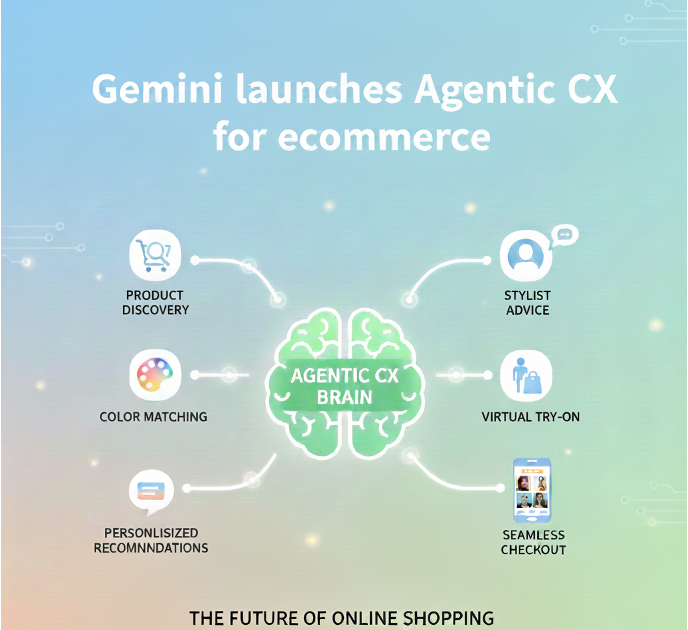
Retailers are rapidly moving beyond basic chatbots to embrace autonomous digital assistants that can actually execute tasks. At NRF 2026, Google Cloud launched Gemini Enterprise for Customer Experience (CX), a platform designed to unify shopping and service through agentic AI. This move represents a significant evolution in how enterprises manage the customer lifecycle by connecting discovery, purchase, and support into a single continuous thread. This blog overviews the Gemini Enterprise for CX news and offers our analysis.
Why Did Google Announce Gemini Enterprise for CX?
Google announced this solution to address the fragmentation that defines modern digital commerce. Most businesses currently operate with disconnected systems where a shopping bot knows nothing about a customer’s previous support tickets, leading to high friction and repeated information. By leveraging the multimodal reasoning of Gemini 3, Google is providing a way for retailers to deploy agents that can see images, understand voice, and execute complex multi-step workflows like shade-matching for cosmetics or processing real-time refunds. The introduction of the Customer Experience Agent Studio further enables brands to build these custom agents in days rather than months, effectively democratizing high-end AI orchestration for the mass market.
Analysis
The launch of Gemini Enterprise for CX is more than a product update; it is an architectural challenge to the established CRM and contact center markets. For years, the industry has focused on “omnichannel” support, which largely meant being present on every channel. Google is shifting the goalpost to “contextual continuity,” where the AI agent maintains the state of a transaction regardless of the interface. This news means that traditional customer service vendors must move quickly to transition from “assistants” that help humans to “agents” that act on behalf of the business.
From an Aragon Research perspective, Google’s strategy is to leverage its massive consumer search footprint and connect it directly to enterprise backend systems through the new Universal Commerce Protocol. By doing this, Google is positioning itself as the primary interface for the entire commerce journey. Competitors like Salesforce and Microsoft will likely need to accelerate their own agentic frameworks to prevent Google from becoming the de facto operating system for retail interactions. The impact of this will be a rapid decline in the relevance of static, decision-tree chatbots which simply cannot compete with the reasoning capabilities shown by agentic models.
Countering ChatGPT
This move clearly is a snapback at OpenAI ChatGPT which announced the ability to do checkout inside of ChatGPT. That simplifies shopping – but what Google just did is to change the entire shopping experience. It puts the market on notice and means that Agents now can actually help humans while they are on their shopping journey – not after it is over. For the online shopping (eCommerce) market- expect this type of Agentic CX shopping agents to become common place by the end of 2026.
What Should Enterprises Do?
Enterprises should evaluate Gemini Enterprise for CX as a replacement for legacy conversational AI tools that lack reasoning and execution capabilities. It is no longer enough for a bot to answer questions; it must be able to solve the underlying problem to drive real ROI. We recommend that CIOs and CX leaders pilot these agentic solutions in high-friction areas like returns or complex product discovery to measure the impact on customer satisfaction and operational costs. Organizations should also audit their current data architecture to ensure it can support the deep grounding required for these agents to perform accurately.
Bottom Line
Gemini Enterprise for CX marks a turning point where AI moves from conversation to active problem solving in the retail sector. Google is effectively raising the bar for what constitutes a digital customer experience by unifying commerce and support under a single intelligent layer. Enterprises must move beyond watching this trend and begin integrating agentic capabilities into their technology stack to meet the rising expectations for seamless, autonomous service
Have a Comment on this?