


Intel Foundry Becomes Its Strategic Asset
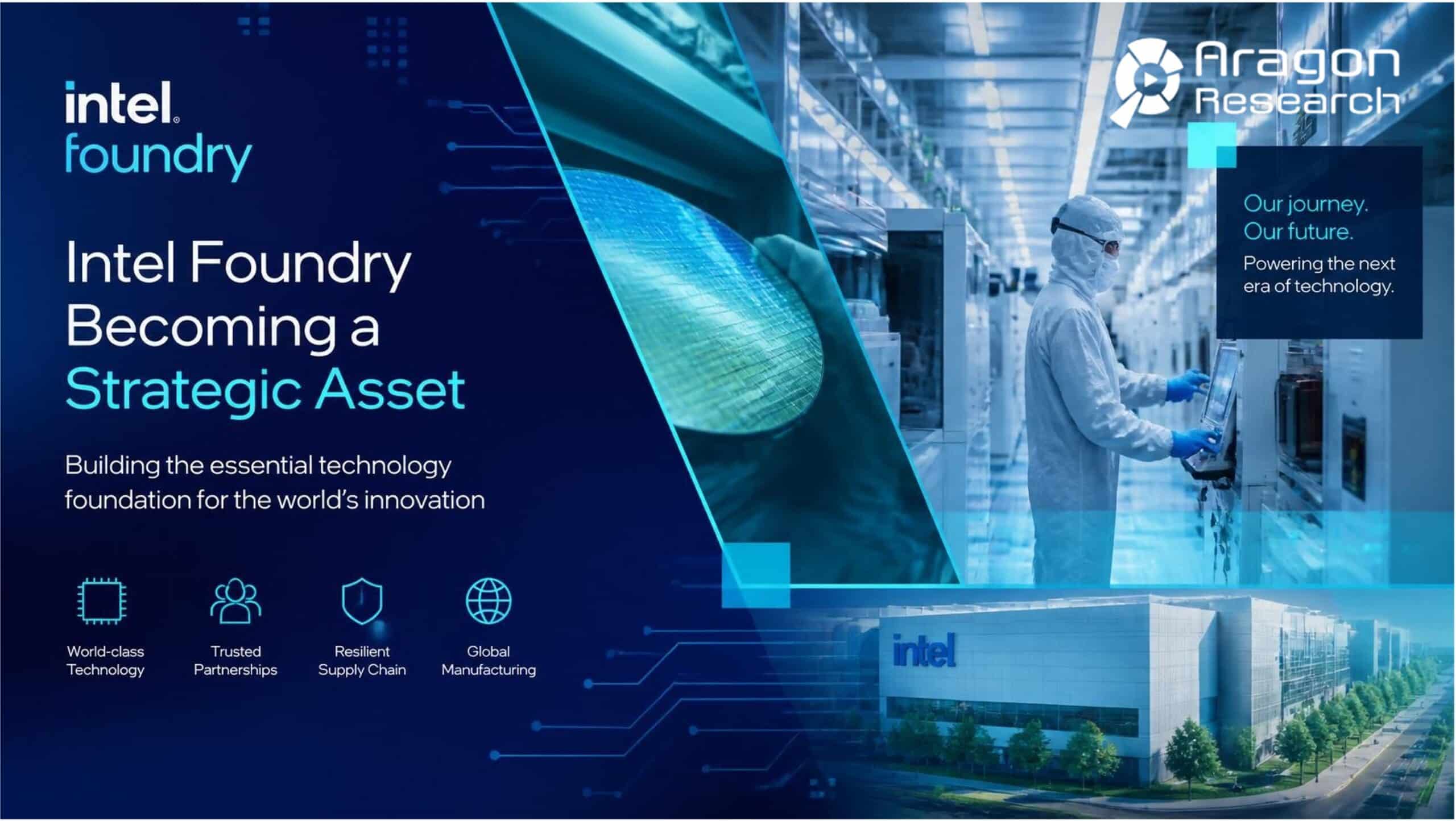
Image design by Aragon, rendered by Canva.
By Ken Dulaney
Intel Foundry Becomes Its Strategic Asset
This blog overviews the recent momentum building within Intel Foundry and offers our analysis. Despite historical setbacks and a prolonged period where we maintained a negative outlook on Intel’s manufacturing division, recent market and supply chain indicators suggest the company is establishing a viable, technology-driven foundation to challenge TSMC.
Why Did Intel Announce Its Pivot Toward an Independent Foundry Model?
Intel shifted its corporate focus toward a dedicated foundry model to capture the soaring global demand for artificial intelligence processing and custom silicon accelerators. Historically, Intel focused on protecting and milk-producing its legacy complex instruction set computer (CISC) architecture, which served as the foundation of the personal computer market. However, modern computing has shifted toward reduced instruction set computer (RISC) architectures and highly parallelized AI frameworks. Realizing that proprietary architecture is no longer a guaranteed moat, Intel recognized that its manufacturing infrastructure—the foundry itself—represents its most scalable and valuable asset. Supply chain reports indicate that equipment orders have surged 50% year-over-year, driven by initial orders and product evaluations from major technology hyperscalers, including Google and Nvidia.
Analysis
From the Aragon Research perspective, this development indicates that Intel is successfully executing a high-stakes architectural leapfrog. While marketing labels like “18A” (1.8-nanometer class) and TSMC’s “N2” (2-nanometer class) do not represent physical dimensions, they reflect performance equivalents. Currently, Intel does not match TSMC’s raw physical density; Intel 18A operates at a more relaxed pitch strategy yielding roughly 190 million transistors per square millimeter (MT/mm2), compared to TSMC’s tightly packed 260 MT/mm2.
However, Intel has offset this density gap by altering the structural architecture of the silicon. By introducing PowerVia—a backside power delivery network that moves electrical routing to the reverse side of the wafer—Intel cleared front-side congestion and optimized performance. TSMC will not implement its version of backside power (Super Power Rail) until its N16 node scales.
Furthermore, Intel’s next-generation 14A node relies heavily on High-Numerical Aperture (High-NA) EUV lithography, which is projected to tighten physical line widths and boost transistor density by 30%, closing the metric gap with TSMC’s sub-2nm nodes by 2029. This architectural focus allows Intel to deliver competitive performance and attract custom AI silicon clients despite trailing in current spatial density.
What Should Enterprises Do?
Enterprises should actively monitor Intel Foundry’s progression over the next 12 to 18 months rather than dismissing it based on past manufacturing delays. This news moves Intel from a vendor to watch to one that should be understood more deeply, particularly for organizations developing custom ASIC architectures or cloud-native AI infrastructure. For large enterprises planning multi-year infrastructure investments, evaluating Intel’s 18A and upcoming 14A roadmaps alongside TSMC’s pipeline is necessary to ensure supply chain diversification and cost leverage.
Impact on the Market
This shift introduces a viable secondary option into the consolidated leading-edge semiconductor manufacturing market. Currently, TSMC operates under severe capacity constraints due to intense booking from global AI hyperscalers. Intel Foundry’s emergence as a technologically distinct competitor provides a critical safety valve for the industry. By competing on architectural innovations like backside power rather than raw lithographic shrinking, Intel creates an alternative design ecosystem. This pressure will likely accelerate the development timelines of competitors and stabilize pricing structures for advanced node processing.
Bottom Line
Intel’s strategic decision to prioritize its Foundry over its legacy CISC architectures was the correct path to long-term market viability. By leveraging early architectural advancements like PowerVia, Intel has built a foundation capable of competing with TSMC on performance class, even before matching its raw transistor density. Enterprises must recognize that the semiconductor landscape is shifting toward structural innovation, making Intel Foundry a credible participant in the future of AI and custom silicon execution.
Related Blogs:
Gemini 3.6 Flash: Cutting the Costs of AI
How Anthropic won the PR Narrative but Google kept the Volume
Important Research related to this Blog:
Also – Check out all our Podcasts on Youtube!
-
display trackbacks
Comments { 1 }