


Nvidia Rubin Reshapes the AI Factory
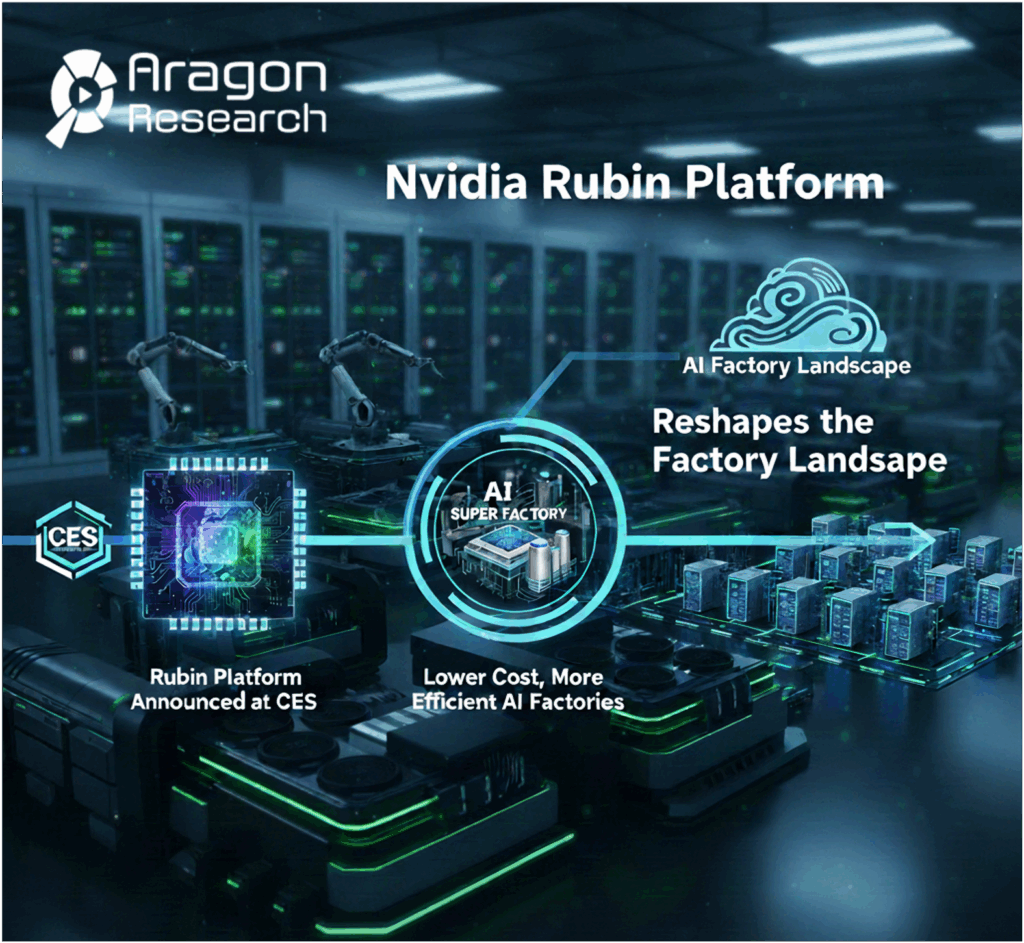
Nvidia Rubin processors are expected to lower AI processing costs by 10%.
By Jim Lundy
Nvidia Rubin Reshapes the AI Factory
The unveiling of the NVIDIA Rubin platform at CES 2026 marks a structural shift in the delivery of artificial intelligence. By moving beyond a single-chip focus to an “extreme codesign” of six distinct chips, Nvidia is repositioning itself from a component provider to the primary architect of the “AI Factory.” This platform is specifically engineered to solve the scaling bottlenecks of agentic AI and Mixture-of-Experts (MoE) models, which require massive memory bandwidth and high-speed data movement to function effectively in real-time environments. This blog overviews the “NVIDIA Rubin platform launch” and offers our analysis.
Why did NVIDIA announce the Rubin platform?
Nvidia is addressing a critical ceiling in AI infrastructure where the cost of inference is threatening to outpace the value of the intelligence generated. The Rubin platform delivers a 10x reduction in inference token cost compared to the current Blackwell architecture, a move designed to make “agentic AI”—AI that can reason and act over long sequences—economically viable for mainstream adoption. By integrating the Vera CPU with the Rubin GPU via NVLink-C2C, Nvidia is eliminating the traditional latency bottlenecks between processing units. This allows enterprises to train trillion-parameter models with 4x fewer GPUs, significantly lowering the barrier to entry for proprietary model development.
Analysis
The Rubin platform represents Nvidia’s definitive move into the ASIC-competitive landscape. While the industry has debated whether specialized ASICs might eventually displace general-purpose GPUs due to cost and power efficiency, Nvidia has effectively “ASIC-ified” its own stack. By designing the Vera CPU, BlueField-4 DPU, and Rubin GPU as a unified system, Nvidia is achieving the power efficiency and deterministic performance typically associated with custom silicon, while maintaining the flexibility of a programmable platform.
A standout innovation is the BlueField-4 DPU, which powers the new “Inference Context Memory Storage Platform.” In the era of multi-turn agentic reasoning, the ability to store and share “context” (the KV cache) is as important as the raw FLOPS of the GPU. By moving this context storage to the DPU layer, Nvidia is enabling 5x higher tokens per second and reducing the “time-to-first-token,” which is the critical metric for user experience in real-time applications. This architecture suggests that future AI data centers will be configured as massive, interconnected memory pools rather than isolated compute nodes. The collaboration with Microsoft on “Fairwater” superfactories underscores that the unit of compute has officially shifted from the server to the entire data center rack.
What should enterprises do?
Enterprises should begin planning for a transition to “rack-scale” infrastructure as the primary deployment model for production AI. If your organization is currently managing a fragmented collection of GPU servers, you should evaluate the TCO benefits of moving toward a unified platform like the Vera Rubin NVL72, which offers significantly better energy efficiency and serviceability. You should specifically monitor the development of the Inference Context Memory Storage Platform, as this will likely become the foundation for how your proprietary agents retain long-term memory and context across sessions. It is time to assess your cooling and power infrastructure, as these “AI superfactories” require significantly different environmental controls than traditional data center setups.
Bottom Line
The NVIDIA Rubin platform is a strategic response to the demand for efficient, high-speed AI reasoning at a global scale. By slashing the cost of tokens by an order of magnitude, Nvidia is ensuring that the “AI Factory” is not just a high-end luxury for research labs, but a cost-effective utility for the enterprise. Organizations must look beyond raw GPU counts and focus on the “extreme codesign” of their entire AI stack—from networking to storage processors—to fully capitalize on the next wave of agentic intelligence.
Have a Comment on this?