


Salesforce Targets CCaaS Rivals with Agentforce
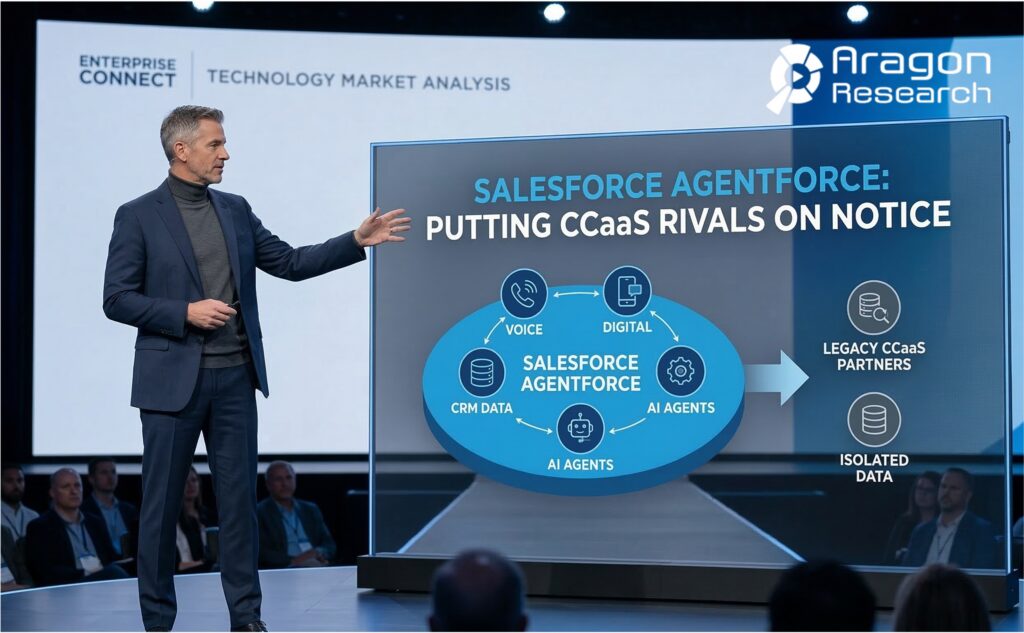
Image design by Aragon, rendering by Gemini.
By Jim Lundy
Salesforce Targets CCaaS Rivals with Agentforce
You could say that today is the day that Salesforce ended its partnerships with some partners. That is because Salesforce is officially entering the standalone intelligent contact center market (also referred to as CCaaS) with the launch of Agentforce Contact Center at Enterprise Connect in Las Vegas. This move represents a pivot from a strategy of partnership to one of direct competition with long-time allies. This blog overviews the Salesforce news and offers our analysis.
Why did Salesforce announce Agentforce Contact Center?
The announcement centers on the need to eliminate the data silos that traditionally hamper customer service efficiency. Salesforce claims that legacy systems require expensive custom integrations to connect CRM data with AI and communication channels. By launching a native solution, Salesforce aims to provide a single platform where voice, digital messaging, and AI agents share a unified data foundation.
This native integration allows administrators to provision phone numbers and manage complex routing logic directly within the Salesforce Service Cloud interface. Every interaction, whether handled by a human or an AI agent, is grounded in the same organizational data and business logic. By removing the “integration tax” of connecting third-party telephony to the CRM, Salesforce is positioning itself to own the entire service “nervous system.”
Analysis
This launch signals a fundamental shift in the contact center ecosystem as Salesforce moves from being the primary CRM partner for vendors like Amazon Connect, Five9 and Genesys to becoming their direct competitor. For years, Salesforce provided the desktop while others provided the plumbing, but that era is ending. The primary value proposition here is not just the “agentic” AI capability, but the removal of the integration tax that has plagued enterprise CX departments for decades. However, the costs for Agentforce and forced upgrades that come with that may give enterprises pause when it comes to adding AI Agents to the mix.
We believe this move will force existing Intelligent Contact Center leaders to accelerate their own platform consolidations or risk being relegated to providing commoditized connectivity. The impact on the market will be a rapid bifurcation between those who own the “system of record” and those who only own the “system of engagement.”
Salesforce is betting that enterprises will prioritize data continuity over best-of-breed telephony features. However, enterprises must be wary of the pricing complexity associated with the base packages and the additional costs of Agentforce 360, which could lead to significant budget creep if not managed strictly.
What should enterprises do about this news?
Enterprises currently using Salesforce for CRM while maintaining a separate legacy contact center should evaluate this offering as a potential path toward architectural simplification. It is critical to understand that while Salesforce provides the interface, the underlying omni channel capabilities like voice are often powered by strategic global carriers. You must verify that these underlying suppliers meet your specific enterprise security and residency requirements, particularly in highly regulated industries.
Enterprises should conduct a rigorous cost-benefit analysis that compares the reduction in integration maintenance against the potential for vendor lock-in and the premium pricing of Agentforce. This includes evaluating the new Flex Credit model, which shifts spending from fixed seats to consumption-based actions. It is time to move beyond watching this trend and begin a formal pilot to determine if the native AI handoffs actually improve first-touch resolution in your specific environment before committing to a full-stack migration.
Bottom Line
The launch of Agentforce Contact Center establishes Salesforce as a full-stack player in the customer experience market, directly challenging the Intelligent Contact Center status quo. While the promise of a unified “service nervous system” is compelling for reducing operational friction, the economic reality of the licensing model requires careful scrutiny. Enterprises should weigh the benefits of a single-vendor stack against the risks of increased costs and the shifting competitive landscape of their current technology partners.
Have a Comment on this?