


X-Games Expands the Use of Owl AI to Predict Outcomes
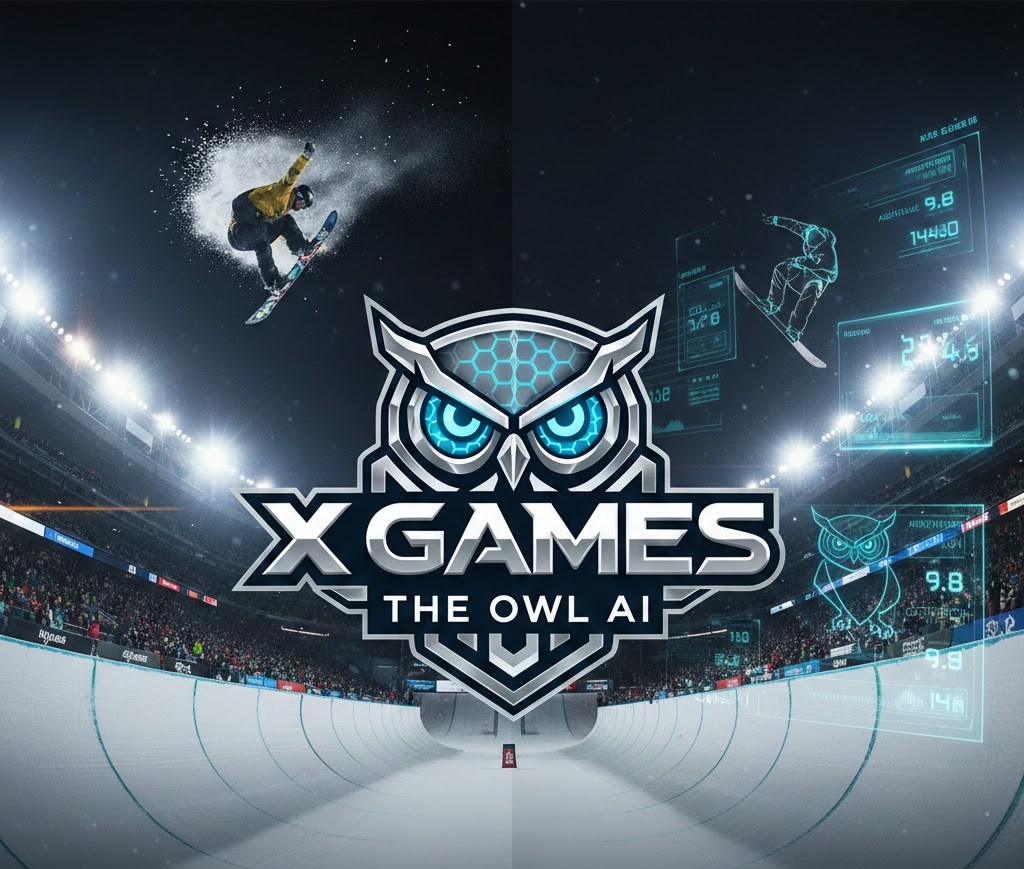
X Games introduced a artificial intelligence platform, The Owl AI, during the Winter X Games in Aspen, marking a significant test of AI in subjective sports judging and prediction.
I am increasingly seeing AI being used in sports, particularly professional sporting events. Tennis competitions and baseball games regularly use AI to determine if a ball is in or out of play, or, in the case of baseball, if a pitch is a ball or strike. In gymnastics, AI is being used to aid judges with making point deductions, and helping coaches reduce injuries.
However, the X-Games is really pushing the envelope with AI.
The X-Games initially deployed in the men’s snowboard superpipe competition to provide an objective score for judges and then expanded to showcase its ability to analyze and predict outcomes.
Following this high-profile test, X Games CEO Jeremy Bloom announced, the launch of a dedicated, standalone technology company, also named Owl AI, to commercialize the platform for other judged and refereed sports.
X-Games Initial Use of Owl
The Owl AI is a specialized AI platform built in partnership with Google Cloud, leveraging the capabilities of Google Cloud’s Vertex AI LLM and a custom-built model using the reasoning and direction-following capabilities of Gemini.
The core capability of the Owl AI is the real-time, objective analysis of athletic performance in complex, subjective sports. The system was trained on a proprietary, multimodal dataset that includes:
- Decades of X Games video archives and competition runs.
- Detailed judging criteria for categories like amplitude, difficulty, and technicality.
- Contextual information on an athlete’s “economy of motion” during trick sequences.
This data injection allows the system to generate a score by factoring in dynamic variables that are often difficult for human judges to process instantly.
X-Games Expands the Use of Owl
After initial tests using Owl to aid judging, the X-Games expanded it use to predict podium finishes after analyzing athlete practice runs, which it did successfully for the men’s half pipe. And it has been utilized to inform commentators with sophisticated real-time insights and to generate multilingual, localized commentary, extending its utility beyond simple scoring.
The model’s expansion into prediction was a natural leap, leveraging the same foundational data and analysis tools. The Owl’s predictive engine uses multimodal analysis that incorporates the actual quality of the performance.
The shift was executed through a distinct and widely publicized trial:
- Instead of using just historical data, The Owl was fed the live practice runs for the Men’s Snowboard SuperPipe final, a crucial data set human analysts rarely utilize fully.
- It combined the athletes’ historical performance trends with its real-time assessment of their current form (trick difficulty, landing consistency, and overall flow in practice). The model then ran a complex calculation to generate a probabilistic ranking of the finalists.
- The prediction was announced live on air, and when the final competition concluded, The Owl AI had correctly predicted the gold, silver, and bronze medalists.
This success demonstrated that the AI, trained to understand the science and art of a perfect run, could transform from a scoring aid into an intelligent forecasting engine.
Owl AI Benefits
Technologically, its use of an LLM trained on multimodal data is a sophisticated solution for analyzing high-speed, complex human movement, moving beyond simple measurement tools. This provides a more consistent, granular analysis of performance metrics like trick difficulty and execution quality than human-only judging typically allows.
From a business perspective, the platform’s ability to offer real-time insights and multilingual commentary creates a distinct competitive advantage in broadcasting, deepening fan engagement globally and offering a richer product for media rights holders.
The commercial launch of the spin-off company diversifies the X Games’ revenue streams and positions it as a key technology vendor in the burgeoning sports tech market.
Owl AI Challenges
The core technical challenge lies in maintaining accuracy and nuance across the diverse, rapidly evolving landscape of action sports, where style and creativity are highly valued.
While Owl AI is trained on historical data, new, unforeseen tricks may test the limits of its programming and could risk penalizing innovation if the model is too rigid. The question is what would Owl have done during Shaun White’s famous 2009 performance when he shocked the world with a Double McTwist 1260
The most significant issues revolve around human acceptance and the displacement of subjective judgment. As one fan commented on social media during the initial test, human judges are seen as “as important as the athletes,” suggesting resistance to full automation.
Furthermore, there is a risk that an over-reliance on quantifiable metrics could inadvertently shift the focus of the competition away from the creative, “artistic” elements of the sport, potentially making runs more formulaic in the pursuit of the AI’s highest score.
Owl AI Impact on the Human Element of Sports
Having participated and watched a lot of action sports, I do wonder about the impact of AI on the excitement, spontaneity and thrill of the human endeavor.
I remember the 1980 Miracle on Ice when the US beat the Soviet National team in hockey. The US team was not even close to being favored to win, but they pulled out a 4-3 victory. If there is an AI engine predicting the outcome, would talented, scrappy, and inspired athletes push themselves as much as they could.
Also, as a fan, if I know an AI engine had already come up with a predicted outcome, am I going to want to watch the competition For me, it would certainly diminish the enjoyment. Even if they announce the predictions after the competition, as they did at the x-Games. I would likely feel the game was fixed.
I am also less interested in the commentators if they are just reading some AI commentary. Phil Liggett and Paul Sherwen have been commenting on the Tour De France for 52 and 33 years respectively. Their experience and history adds significant value and entertainment to watching the race.
Bottom Line
It is interesting to see AI being used to aid in judging. It is also important to see how AI is being used by coaches to increase performance and reduce injuries.
However, what makes action sports so exciting is the human element, the players, the coaches, commentators and judges.
Yes they are imperfect, and may make a bad call here and there, but it is that human dynamic that we remember.
Think about it….if there were AI judges, who John McEnroe yell at? Or LeBron James haggle with?
We would surely miss the drama and antics of the human interaction!
Have a Comment on this?