

Microsoft Unveils Seven New MAI LLM Models
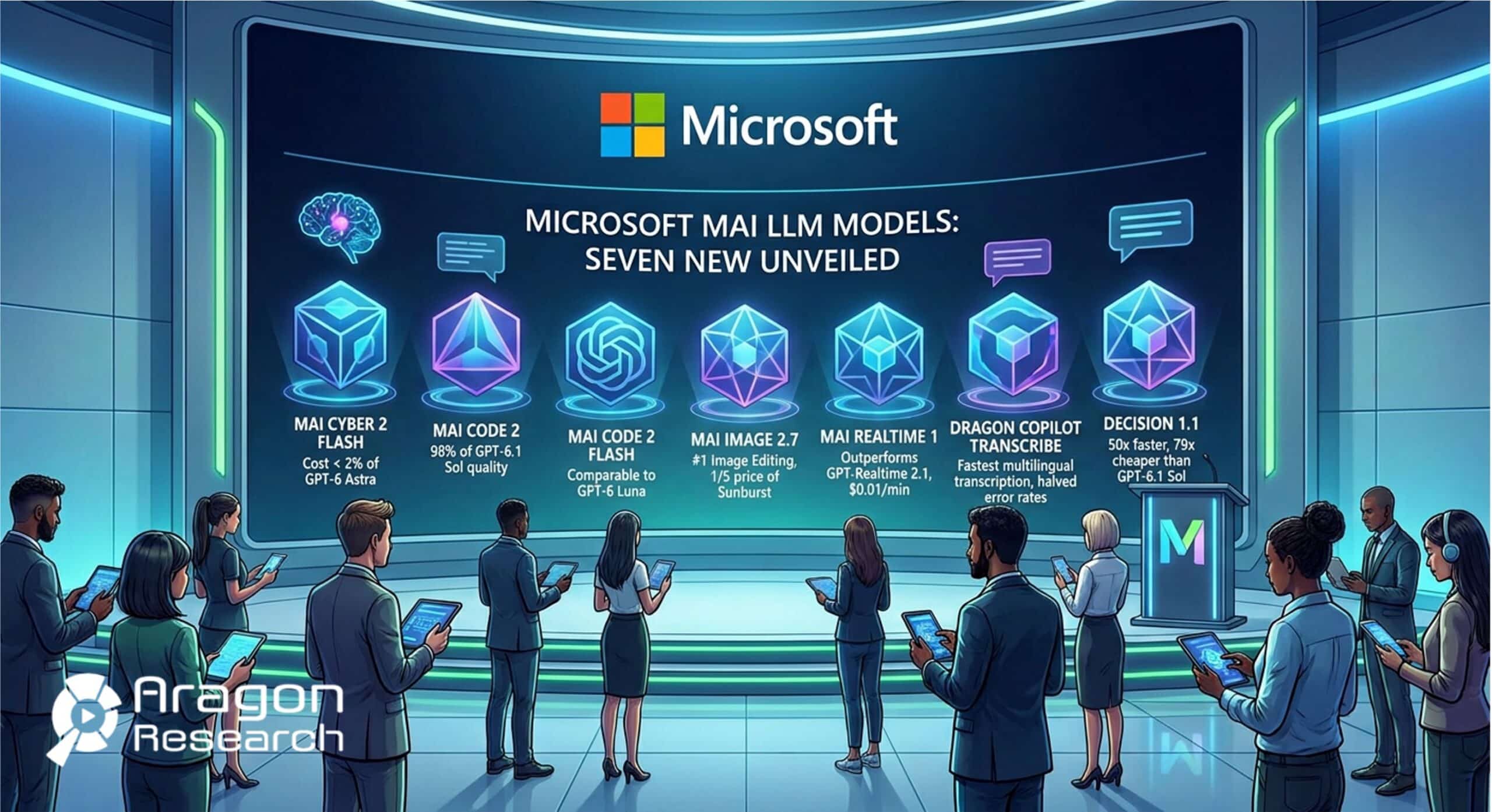
Image design by Aragon, rendered by Gemini.
By Jim Lundy
Microsoft Unveils Seven New MAI LLM Models
Enterprise token budgets are escalating rapidly as autonomous agents transition from pilot tests into continuous production. Microsoft just intervened with a major architectural shift aimed directly at the bottom line of IT leaders. This blog overviews the Microsoft MAI model launch along with its MAI silicon and offers our analysis.
Why did Microsoft announce the MAI model family?
At Microsoft Ignite on November 17, 2026, Microsoft AI introduced seven specialized foundation models engineered for high-volume price-performance. Rather than chasing theoretical reasoning benchmarks, Microsoft built these models to handle continuous enterprise workloads at a fraction of prevailing API rates. The lineup spans MAI Code 2 and Code 2 Flash for everyday software engineering, alongside MAI Cyber 2 Flash for continuous security monitoring.
The portfolio also introduces MAI Image 2.7 and Image 2.7 Flash for visual generation, MAI Realtime 1 for low-latency voice agents at one cent per audio minute, and MAI Transcribe 2, which powers Dragon Copilot across ten million monthly patient encounters. Tying the architecture together is Decision 1.1, a routing engine that directs routine tasks away from expensive frontier systems. Powered by second-generation Maia 200 silicon, these releases arrive alongside MAI Licensed Weights, enabling organizations to customize and isolate proprietary models inside their own Azure environments.
| Microsoft Model | Primary Domain | OpenAI Comparison | Anthropic Comparison | Google Gemini Comparison |
| MAI Cyber 2 Flash | 24/7 Cyber Defense | GPT-6 Astra / GPT-6 Cyber | Claude Sonnet / Fable Security | Gemini 4 Neon (Cyber) / 3.8 Flash Cyber |
| MAI Code 2 | Everyday Coding & UI | GPT-6.1 Sol / GPT-6 Sol | Claude Opus 5.5 | Gemini 4 Hydrogen / Gemini 4 Neon |
| MAI Code 2 Flash | High-Volume Routine Code | GPT-6 Luna | Claude Haiku 5.5 | Gemini 3.8 Flash / 3.5 Flash-Lite |
| MAI Image 2.7 & Flash | Image Editing & Generation | GPT Image 2.6 Sunburst | N/A (Text/Multimodal Input Only) | Nano Banana Pro / Nano Banana 2 |
| MAI Realtime 1 | Live Speech-to-Speech | GPT-Realtime 2.1 | N/A (No Native Speech-to-Speech) | Gemini 3.8 Live |
| MAI Transcribe 2 | Multilingual Transcription | Whisper Enterprise / GPT Audio | N/A (No Dedicated ASR Model) | Gemini 3.5 Transcribe |
| Decision 1.1 | Model Routing & Decisions | OpenAI Routing Layer | Claude Haiku 5.5 (Routing) | Gemini 3.1 Flash-Lite (Built on Gemma 4) |
Analysis
This launch signals a structural turning point for Microsoft in the enterprise AI market. For the past three years, foundation model vendors competed primarily on raw intelligence, driving compute costs to unsustainable levels for production deployments. Not only has Microsoft launched competitive LLM Models, with its new Silicon, it is positioned to lower costs compared to the frontier providers.By benchmarking MAI Code 2 and Cyber 2 Flash against GPT-6 and Claude Opus 5.5 at five to forty percent of the cost, Microsoft is actively commoditizing high-utility intelligence.
From an Aragon Research perspective, pairing custom Maia 200 silicon with Decision 1.1 routing exposes a major vulnerability for pure-play model providers. Competitors lacking proprietary hardware and integrated cloud infrastructure cannot easily match this margin compression without subsidizing compute losses. Furthermore, Microsoft is systematically reducing its dependency on external partners like OpenAI for core internal workloads such as GitHub Copilot, Microsoft 365, and Dragon Copilot. Owning the silicon, the routing layer, and the specialized models allows Microsoft to control the entire economic stack of enterprise AI.
The introduction of MAI Licensed Weights also disrupts the open-weight ecosystem. Many regulated enterprises avoid open-source weights due to provenance, compliance, and governance risks. Microsoft now offers a middle ground: proprietary, indemnified weights that enterprises can fine-tune and govern within their own tenants. Competing vendors will soon be forced to slash enterprise API pricing or offer comparable licensed-weight options to prevent customer attrition.
What Should Enterprises Do?
IT and AI leaders must treat this release as an immediate catalyst to audit their current token consumption. Organizations relying on monolithic frontier models for routine coding, transcription, or security scanning are overpaying for capabilities they rarely utilize. Engineering teams should benchmark MAI Code 2 and Code 2 Flash inside GitHub Copilot and Microsoft Foundry against existing production workflows.
Enterprise architects must also prioritize intelligent model routing. Deploying routing engines like Decision 1.1 should become a standard architectural pattern so expensive reasoning models are reserved strictly for complex edge cases. Finally, data governance teams should evaluate MAI Licensed Weights if intellectual property and security concerns have stalled custom model initiatives.
Bottom Line
Microsoft has shifted the enterprise AI conversation from peak theoretical capability to sustainable unit economics. By combining Maia 200 hardware with seven task-specific models and automated routing, the vendor established a new baseline for price-performance. Enterprises must eliminate single-model dependencies, adopt intelligent routing architectures, and aggressively benchmark these lower-cost alternatives to protect their 2027 IT budgets.
Related Blogs:
Microsoft Cloud Up 27% on Copilot Demand
Microsoft Copilot Cyber updates will be costly
How Anthropic won the PR Narrative but Google kept the Volume
Important Research related to this Blog:
Also – Check out all our Podcasts HERE
Have a Comment on this?