


AgentExchange: Salesforce Unifies Apps & Agents
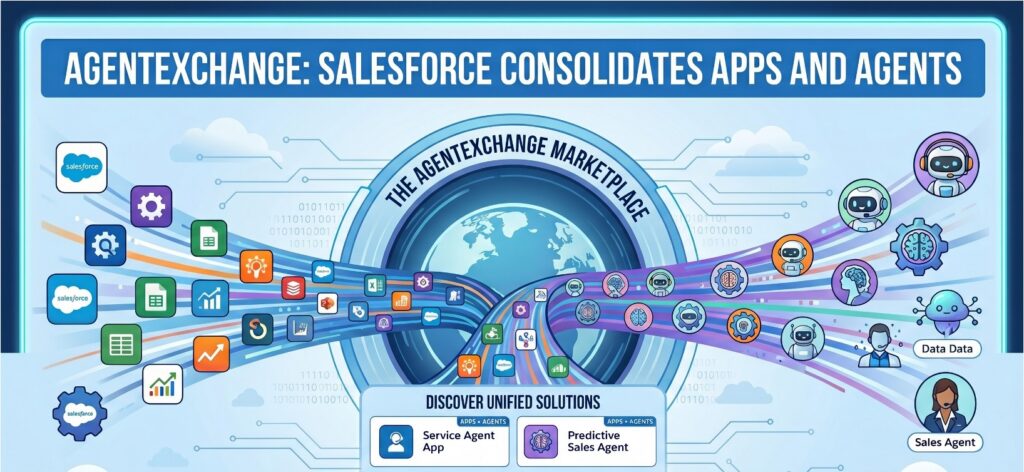
Image design by Aragon, rendered by Gemini.
By Jim Lundy
AgentExchange: Salesforce Unifies Apps & Agents
The rapid proliferation of AI agents has created a discovery problem for the modern enterprise. As organizations move beyond experimental chatbots toward autonomous workflows, the need for a central repository of trusted tools has become paramount. This blog overviews the AgentExchange news and offers our analysis.
Why did Salesforce announce AgentExchange
Salesforce introduced AgentExchange to unify its disparate marketplaces—AppExchange, Slack Marketplace, and the Agentforce ecosystem—into a single storefront. In the emerging agentic enterprise, a single business process often spans multiple environments, such as a sales agent requiring a data connector in CRM and a workflow trigger in Slack. By consolidating over 10,000 apps and 1,000 pre-built agents into one interface, Salesforce aims to eliminate the friction of navigating different platforms to find AI solutions. The announcement includes new semantic search capabilities and a 50 million dollar builders fund to incentivize partners to develop agentic tools that are immediately deployable and governed by enterprise security standards.
Analysis
This move signals that Salesforce is attempting to replicate the “AppExchange effect” that fueled its growth a decade ago, but for the autonomous era. While the original AppExchange allowed Salesforce to outsource innovation to third-party developers, AgentExchange is designed to provide the glue for the agentic enterprise. It addresses a critical market gap: the lack of coherence in AI deployment. Most enterprises currently struggle with fragmented AI pilots that do not talk to one another. By consolidating these capabilities, Salesforce is moving to own the orchestration layer of the enterprise, ensuring that AI agents are not just isolated tools but integrated participants in complex business workflows.
By providing a unified commerce layer with private offers and automated provisioning, Salesforce is positioning itself as the primary gatekeeper for enterprise AI transactions. This strategy forces other platform vendors to either integrate with Salesforce’s Model Context Protocol or risk being left out of the most lucrative enterprise workflows. This shift effectively commoditizes the underlying Large Language Models and places the premium on the platform that controls the data and the action.
The success of this marketplace will depend on whether Salesforce can convince customers that these agents are truly plug-and-play rather than requiring extensive professional services to implement. If successful, AgentExchange will define the standard for how businesses discover and deploy the specialized intelligence required to remain competitive in an automated economy.
What should enterprises do about this news
Enterprises should evaluate AgentExchange as a means to accelerate their AI time-to-value by utilizing pre-built agents instead of building from scratch. It is important to consider its implications on your existing technology stack, particularly how unified billing and security reviews can simplify the procurement of AI tools. IT leaders should task their teams with exploring the semantic search tools to identify subagents that can automate high-volume tasks in Slack or Sales Cloud.
While the convenience of a unified marketplace is high, organizations must maintain rigorous internal governance to ensure that the third-party agents they click to install align with their specific data privacy requirements and operational guardrails. Prioritize testing agents that demonstrate clear integration with your existing Data 360 or Slack workflows to ensure immediate ROI.
Bottom Line
AgentExchange represents the next evolution of the enterprise software ecosystem by bringing apps and autonomous agents under one roof. This unified marketplace simplifies the discovery and procurement of AI tools, potentially providing the same growth engine for the agentic era that the AppExchange provided for the cloud era. Enterprises should leverage this resource to move from fragmented AI experiments to a more governed, scalable automation strategy. Success in the next three years will likely depend on how effectively an organization can orchestrate these third-party agents to drive measurable business outcomes.
-
display trackbacks
display trackbacks
display trackbacks
display trackbacks
display trackbacks
display trackbacks
display trackbacks
Comments { 7 }