

Canvas Breach Payment Emboldens Cybercriminals
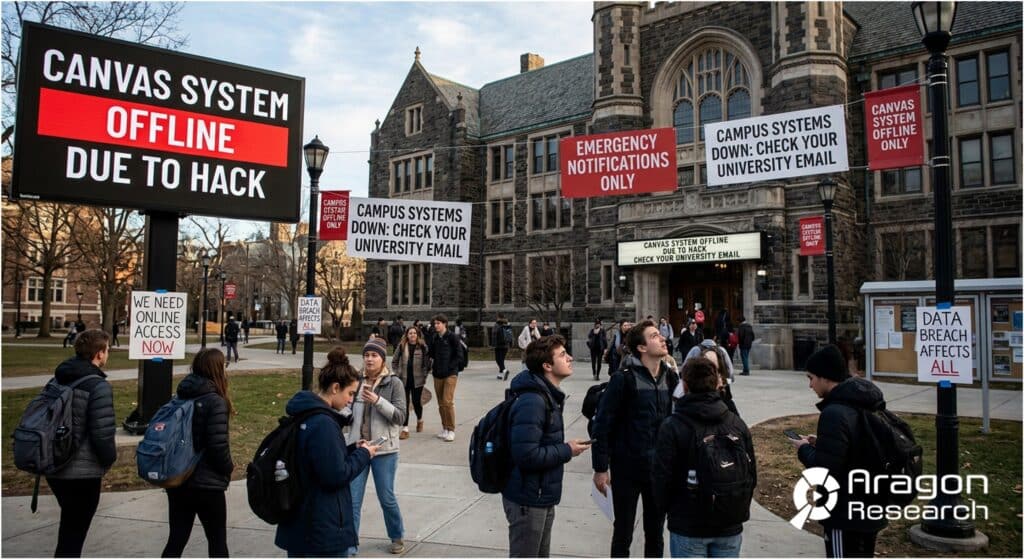
Image design by Aragon, rendered by Gemini.
By Jim Lundy
Canvas Breach Payment Emboldens Cybercriminals
Cybersecurity incidents are rapidly transforming from isolated technology headaches into systemic operational crises. Educational institutions across the country are currently learning a harsh lesson about digital dependency as a major platform succumbs to a malicious network breach.
The recent compromise of a vital academic tool has brought coursework, communication, and final exams to a sudden halt for millions of students. This disruption affects basic daily routines and highlights the fragile nature of modern academic infrastructure. This blog overviews the Canvas hack and offers our analysis.
Why did Instructure announce the Canvas breach
Instructure recently confirmed that its widely adopted Canvas learning management system suffered a severe data breach orchestrated by the ShinyHunters cybercrime group. This web-based platform serves as the central hub for daily academic activities at thousands of schools and major universities, including the University of Pennsylvania, Rutgers, and Rowan.
The hackers successfully infiltrated the system and accessed a massive trove of user information. Exposed data includes names, school-based email addresses, student identification numbers, and billions of private messages exchanged between students and faculty.
While highly sensitive financial records and Social Security numbers appear unaffected, the compromised information provides ample material for targeted phishing attacks. The threat actors defaced university portal pages and issued a ransom deadline of May 12.
The timing of this breach intentionally coincided with the end of the academic year and final exam schedules. This malicious scheduling maximized operational disruption and significantly increased the pressure on educational institutions to negotiate. Students were left locked out of their coursework, highlighting the severe consequences of this infrastructure failure.
It is also important to note that Instructure was sold by Thoma Bravo to KKR in July 2024. There is evidence to show that software firms owned by Private Equity firms are increasingly being targetted by groups such as ShinyHunters – as they are often easier targets due to incomplete or lax security procedures.
Analysis
The breach of the Canvas system exposes a critical vulnerability in the current operational model of higher education. Institutions have centralized their academic delivery onto a single vendor platform without establishing adequate safeguards against catastrophic failure.
It has now come to light that Instructure chose to pay the ransom to the ShinyHunters group. This decision carries profound implications for the entire technology market. By fulfilling the financial demands of the attackers, the vendor has inadvertently validated the business model of cyber extortion.
Payment of a ransom rarely guarantees the complete deletion of stolen data and serves as a direct incentive for future attacks. This news means that cybercriminal syndicates will now view the education sector as a lucrative and compliant target. The precedent set here suggests that vendors may prioritize short-term recovery over long-term industry security.
Aragon Research believes that this incident represents a fundamental shift in how educational institutions must approach vendor risk management. The inability to conduct basic academic operations without Canvas proves that current continuity strategies are entirely insufficient.
Schools failing to adopt secondary learning distribution methods or offline exam alternatives will face severe reputational damage during the next inevitable cyber event. Institutions must actively architect redundancy into their workflows and establish clear disaster recovery protocols.
What Should Enterprises Do
While this specific attack targeted the education vertical, corporate enterprises must treat this incident as a critical warning regarding single-vendor reliance. Business leaders should evaluate this event and consider its implications on your existing technology stack.
Enterprises that use Canvas must look to back up their student records and data using cloud backup providers such as K-16 Solutions that focuses on Canvas. Organizations must watch this trend closely as threat actors increasingly target foundational workflow platforms.
Enterprises need to understand the systemic risks associated with centralized communication and data storage systems. It is essential to audit your organization’s disaster recovery capabilities and ensure that alternative operational methods exist for all mission-critical applications.
Companies should mandate rigorous security evaluations for all third-party vendors and demand transparent incident response protocols. Security teams should immediately increase vigilance against highly targeted social engineering campaigns.
Since basic identity information is frequently weaponized in the aftermath of a breach, employees must be trained to identify sophisticated phishing attempts. Enterprises must proactively build resilience into their infrastructure.
Bottom Line
The massive data breach impacting the Canvas platform serves as a harsh warning regarding the fragility of centralized digital infrastructure. Universities and schools were caught entirely unprepared for an outage of this magnitude during their most critical operational period.
The decision to pay the ransom further complicates the security landscape and emboldens criminal organizations to escalate their efforts. This action signals a lack of systemic resilience and encourages more aggressive targeting of essential services.
Relying on a single vendor without a functional, immediately available backup approach constitutes a major operational failure. Organizations must audit their technology stacks today and implement robust offline capabilities to neutralize future extortion attempts.
Have a Comment on this?