


Microsoft and Nvidia partner to save Windows
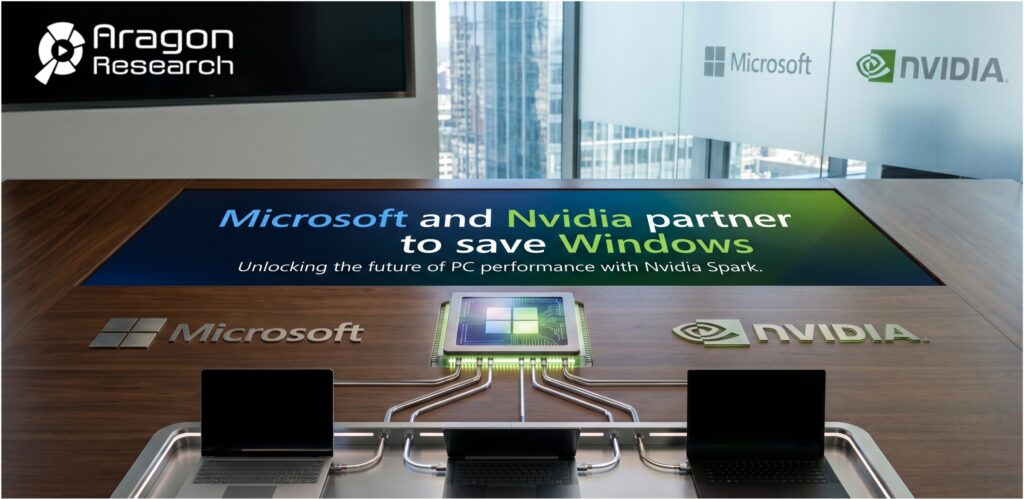
Image design by Aragon, rendered by Gemini.
By Jim Lundy
Microsoft and Nvidia partner to save Windows
The Intel and ARM PC Chip designs were dooming Windows. This week, the enterprise personal computing market experienced a fundamental shift at the NVIDIA GTC conference where Microsoft and NVIDIA announced a deep full stack partnership to pioneer a new class of thin and light Windows personal computers.
Driven by the custom Arm-based NVIDIA RTX Spark superchip, these upcoming computing systems combine a 20-core central processing unit with advanced Blackwell graphics architecture to deliver 1 petaflop of local artificial intelligence performance.
This technical milestone aims to provide developers, creators, and power users with the hardware overhead required to execute complex digital workflows entirely on device. This blog overviews the Microsoft and NVIDIA collaboration and offers our analysis.
Why Did Microsoft Announce Windows on Nvidia RTX Spark
Microsoft announced its deep core optimization of Windows 11 for the NVIDIA RTX Spark platform to establish a secure, localized foundation for the emerging era of autonomous digital agents. While previous enterprise PC architectures were designed around traditional x86 instructions and application delivery, the modern enterprise technology landscape increasingly demands the local processing of massive contextual models and reasoning tasks. Relying solely on cloud data centers to process every routine enterprise agent execution introduces unsustainable network latency and soaring cloud computing expenditures for modern organizations.
By co-engineering specialized operating system modifications with NVIDIA, Microsoft addresses these scaling issues by introducing architectural features like workload profile scheduling to distribute processing tasks efficiently across all 20 processor cores. Furthermore, the operating system vendor redesigned how Windows manages page sizes and memory limits to support up to 128GB of high-speed unified memory, allowing large language models to reside directly on the client device.
This operational pivot ensures that as corporate software workflows shift from standard text input apps to background digital agents, the core platform remains firmly tethered to Windows rather than migrating to alternative cloud runtime environments.
Analysis
This announcement represents a structural shift that effectively minimizes the historic reliance of Microsoft on traditional silicon providers for premium enterprise form factors. For decades, the enterprise desktop ecosystem was defined by predictable hardware iterations from legacy processor manufacturers, but the processing demands of generative AI have exposed the limitations of standard hardware layouts.
By partnering directly with NVIDIA to bring a data center class architecture down to ultra-thin corporate laptops, Microsoft is building a defensible enterprise perimeter that can process models locally with up to 120 billion parameters. Unless something changes, this also signals the end of the Intel era for Windows PCs.
From an industry perspective, this means that foundational AI capabilities will increasingly transition from metered cloud APIs to unmetered on-device processing. Competitors who continue to rely entirely on standard, low-bandwidth neural processing units will face severe pressure to replicate this high-bandwidth coherent unified memory architecture or risk losing complete relevance among corporate developers and technical creators.
Furthermore, this deployment provides original equipment manufacturers with a standardized blueprint to build lightweight workstations that match the structural efficiency of integrated consumer hardware platforms while remaining within the strict compliance boundaries of corporate active directories and management consoles.
The integration of specialized security primitives like Nvidia OpenShell directly into the Windows security subsystem indicates that Microsoft is prioritizing data isolation and containment to alleviate the privacy concerns that slowed down initial corporate adoption of AI-enabled workstations.
What Enterprises Should Do
Enterprises must evaluate this development within the context of their long-term workplace modernization and hardware procurement strategies over the next twelve to eighteen months. Technology leadership should actively investigate how local agentic containment can offset rising cloud consumption expenditures by mapping out which automated reasoning workflows can be shifted to local client devices.
Rather than treating the arrival of these systems as a routine corporate hardware replacement cycle, organizations need to understand how these massive unified memory pools alter the deployment of localized open-source models across corporate networks. IT departments should begin auditing their current internal application portfolios to ensure readiness for optimized Arm-based translation layers like the updated Microsoft Prism emulator.
Bottom Line
The partnership between Microsoft and NVIDIA signals that the future of personal computing belongs to local autonomous agents that require high-bandwidth infrastructure. Organizations should begin assessing their software delivery pipelines for compatibility with this architecture. Investing time now to understand these physical security boundaries will position enterprises to deploy secure on-device automation as hardware arrives this fall.
-
display trackbacks
Comments { 1 }