


Apple: the $4 Trillion Titan that Tim Cook Built
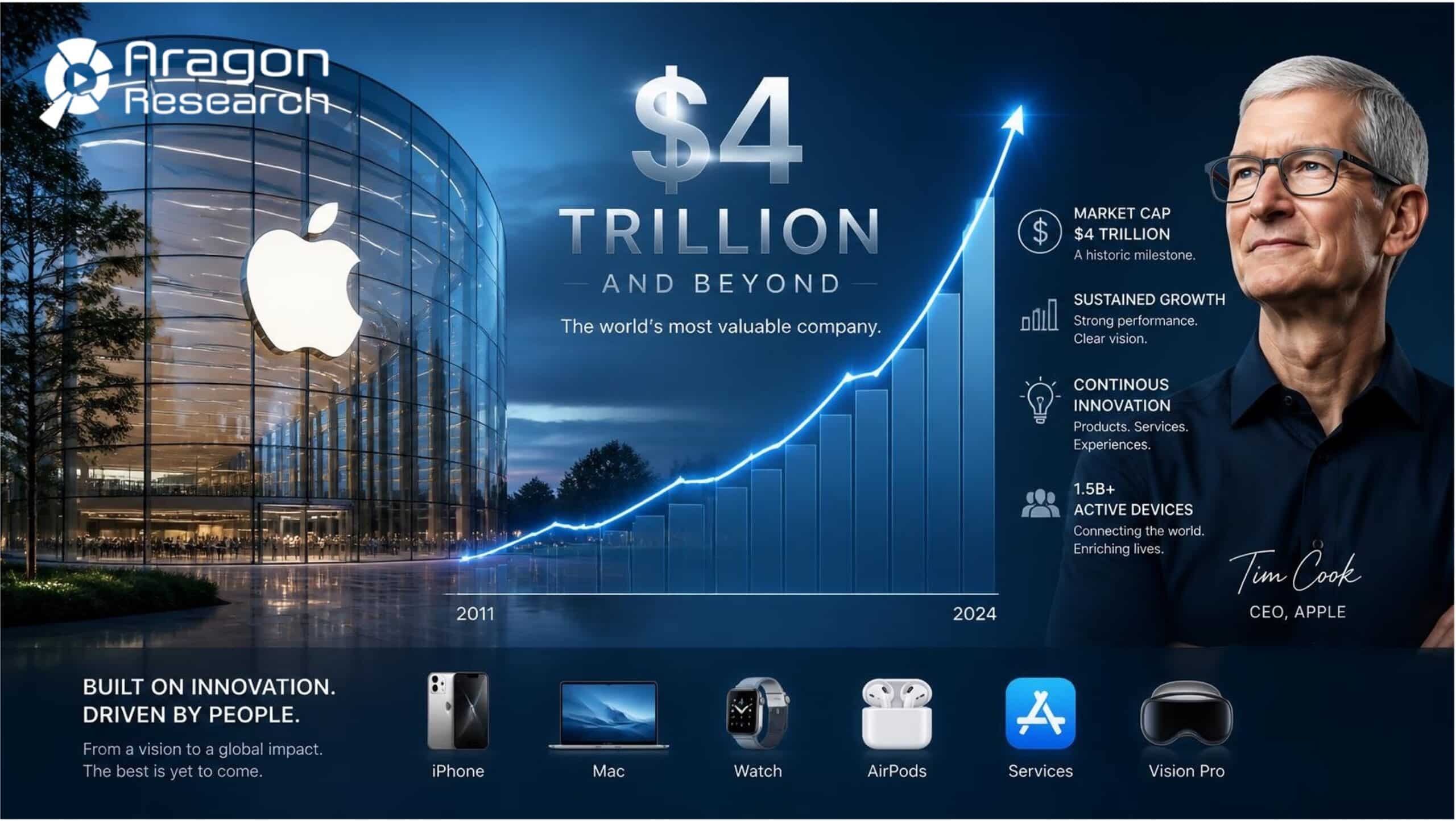
Image design by Aragon, rendered by Canva.
By Jim Lundy
Apple: the $4 Trillion Titan that Tim Cook Built
Managing global technology portfolios requires a balance between rapid innovation and predictable execution. When Tim Cook assumed leadership of Apple, skepticism surrounded whether the organization could maintain momentum beyond its initial smartphone breakthroughs. Over the subsequent decade and a half, methodical supply chain management and targeted hardware development created an enterprise powerhouse. This blog overviews the Apple growth strategy under Tim Cook and offers our analysis.
Why Did Apple Focus On Steady Operational Expansion?
Technology markets frequently reward dramatic product pivots, yet long-term enterprise value stems from architecture stability and operational consistency. Rather than relying on constant market disruption, Apple focused on expanding product categories, securing vertical supply chains, and building silicon platforms.
This strategy transformed single-device buyers into multi-product ecosystem users. The expansion included refining the flagship phone lineup, establishing tablet dominance over competing mobile operating systems, launching wearable health categories, and deploying custom microprocessors across computing platforms.
The consumer technology landscape operates on extreme cycles, yet long-term enterprise valuation requires relentless execution. When Tim Cook assumed control in 2011, the smartphone market was entering a key growth phase and critics questioned whether a operational expert could maintain corporate momentum. Over the subsequent fifteen years, systematic portfolio expansion and component supply control turned a device maker into a four-trillion-dollar enterprise power. This blog overviews the Apple leadership transition and earnings report and offers our analysis.
Apple: Scaling From Billions To Four Trillion Under Tim Cook
Managing global technology markets requires balancing hardware innovation with supply chain discipline. Rather than relying solely on breakthrough product releases, Apple focused on broadening hardware categories, engineering proprietary silicon, and building a high-margin services ecosystem.
During this era, corporate valuation expanded from three hundred fifty billion dollars past the historic one trillion, two trillion, and four trillion dollar milestones. Annual revenue quadrupled past four hundred billion dollars through disciplined share buybacks and global market expansion.
The strategy extended the flagship phone line, established tablet dominance over Android alternatives, created the wearable category with smartwatch and wireless audio products, and moved computing platforms to custom silicon.
| Product Line or Pillar | Strategic Innovation Under Tim Cook | Enterprise and Market Impact |
| iPhone Lineup | Iterative hardware updates, tiering models, and structured upgrade programs | Expanded global active installed base and established predictable revenue cycles |
| iPad Portfolio | Expansion from entry models to M-series Pro devices with digital stylus support | Outpaced competing Android tablets to dominate enterprise and education sectors |
| Apple Watch | Dedicated wearable operating system and continuous health telemetry features | Built a dominant market position in personal health and fitness wearables |
| AirPods Category | Custom wireless audio silicon and integrated ecosystem connectivity | Created an industry-defining audio accessory segment generating massive margin |
| Mac and Apple Silicon | Transition from third-party x86 microprocessors to custom M-series silicon | Delivered superior performance per watt while securing complete component control |
| Mac Ultra and Local AI | High-bandwidth unified memory architecture optimized for edge computing | Positions desktop workstations as premier local processing engines for enterprise AI |
In parallel with hardware growth, the organization shifted its installed base toward recurring digital services. Offerings like cloud storage, digital media, and financial tools grew into an ecosystem generating over one hundred billion dollars annually. This high-margin revenue stream now outpaces the combined financial performance of the traditional tablet and desktop product lines.
Analysis
The long-term impact of this tenure demonstrates that operational precision creates stronger competitive moats than frequent product experimentation. The transition to proprietary microprocessors stands as the most critical hardware decision in modern computing.
By designing in-house silicon, Apple severed its dependencies on external chip roadmaps. This shift forced legacy processor suppliers and competing personal computer vendors to restructure their hardware strategies to match unified memory efficiency.
Furthermore, integrating large amounts of unified memory across workstation hardware like the Mac Ultra changes the dynamics of enterprise artificial intelligence. As organizations seek to run generative models locally to safeguard proprietary data, high-bandwidth integrated memory becomes a primary infrastructure requirement.
Competitors relying on traditional modular hardware face higher latency and cost structures when attempting to replicate this local computing environment.
Incoming chief executive officer John Ternus inherits an operationally refined organization but faces immediate structural hurdles. Sustaining momentum across a four-trillion-dollar valuation requires navigating global semiconductor bottlenecks and rising memory component costs.
Additionally, managing regulatory friction regarding international artificial intelligence rollouts and geopolitical supply chain concentration will test the new executive leadership team.
What Enterprises Should Do
Enterprise technology leaders should evaluate current computing hardware fleets through the lens of device longevity and processing efficiency. Procurement teams ought to analyze total cost of ownership rather than focusing strictly on initial purchase price.
Organizations planning edge artificial intelligence deployments should test unified memory workstations for local model execution. Data security teams can utilize local processing to reduce cloud data transmission risks.
IT departments must adjust procurement schedules to accommodate ongoing advanced semiconductor node supply constraints. Modernizing device management architecture will ensure seamless integration across mixed desktop and mobile deployments.
Bottom Line
Fifteen years of supply chain discipline and custom silicon engineering established Apple as a benchmark for platform stability. Incoming leadership must now navigate rising component costs and complex regulatory environments to protect this foundation. Enterprise technology planners should leverage this hardware reliability and edge processing power to optimize workplace deployments and support emerging local AI workloads.
Related Blogs:
Apple Seeks Injunction to Block OpenAI
Apple Sues OpenAI, alleges theft of AI Tech
Apple Reboots Apple Intelligence
Eyewear Market Evolution: Apple Tests Smart Glasses Styles
Apple M5 Pro MacBook powers Edge AI
Important Research related to this Blog:
Also – Check out all our Podcasts HERE
Have a Comment on this?