

Inside Google’s Silent AI Agent Takeover
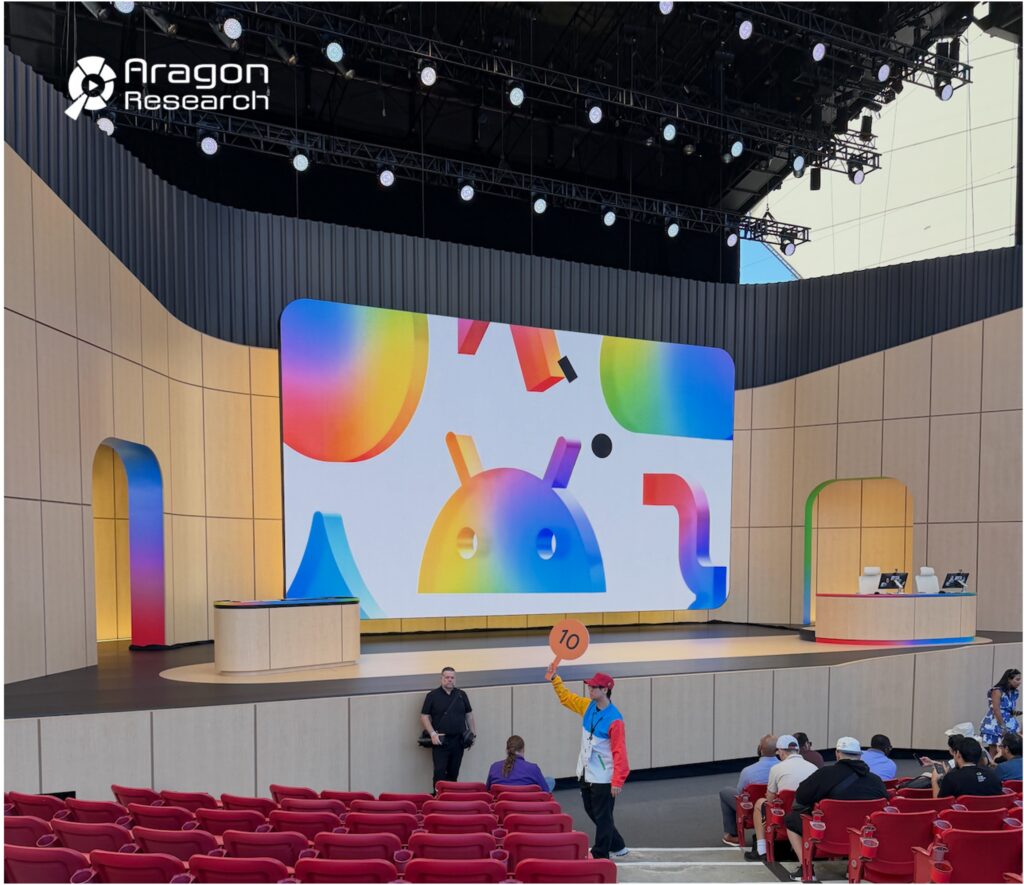
The stage right before the opening at Google I/O 2026.
By Jim Lundy
Inside Google’s Silent AI Agent Takeover
Tech giants rarely declare war out loud; they simply redefine the battlefield. This week at its annual I/O conference, Google unveiled an aggressive array of artificial intelligence updates aimed at cementing its winning strategy in both infrastructure and applications. This blog overviews the Google I/O announcements and offers our analysis.
Why Did Google Announce Gemini 3.5 and Omni?
The announcements center on reclaiming undisputed leadership in speed, multimodal capabilities, and native application integration. Google introduced the Gemini 3.5 Flash model, which achieves frontier intelligence and coding efficiency while operating four times faster than competing frontier engines.
Alongside this, the company debuted Gemini Omni Flash, a video-centric model that pairs real-world kinetic understanding with intuitive media generation. Google also embedded its personal productivity agent, Gemini Spark, directly into the core Google Search infrastructure.
This update fundamentally alters the traditional search engine by adding multi-agent management, a dedicated chatbot follow-up system, and native agentic workflows right below the query box. By weaving personal productivity tools directly into the fabric of web search, Google effectively cuts off third-party application layers before they can establish market share.
| Announcement | Core Capability | Target Impact |
| Gemini 3.5 Flash | Frontier coding and agentic reasoning; 4x faster output token speed | High-velocity enterprise automation and multi-agent systems |
| Gemini Omni Flash | Multimodal generation with video input and output capabilities | Rich media asset creation and contextual video workflows |
| Google Search AI Upgrade | Built-in multi-agent management and chatbot-driven follow-ups | Blurs the line between search engines and personal productivity |
| Gemini Spark Integration | Direct background automation and task execution inside Search | Displaces standalone personal productivity and coding apps |
Analysis
Aragon Research believes these updates reveal a tactical pivot from a defensive posture to a quiet, scorched-earth strategy against rivals. By offering Gemini 3.5 Flash at immense speed and low cost, Google is attempting to make alternative mid-tier foundation models economically non-viable for enterprise builders. The real impact, however, lies in the application layer. By embedding Spark and agentic coding capabilities straight into Google Search and Chrome, Google is executing a replication strategy designed to absorb the market share of independent AI startups.
This aggressive ecosystem expansion forces enterprise software vendors to re-evaluate their roadmap positioning. Organizations will no longer need to stitch together disparate productivity tools, search APIs, and foundational models if Google offers a self-contained, unified agent platform. Google is leveraging its massive distribution advantage to make its ecosystem an unavoidable default, essentially starving competitors of user traction without ever launching a public PR war.
The Competitive Imperative: Rivals Must Respond
Google’s aggressive move to bundle its frontier models directly into its search and productivity suite places immense pressure on its main rivals—primarily Microsoft, OpenAI, and Anthropic. Microsoft, which heavily integrated OpenAI’s GPT models into its Copilot ecosystem (and then added Anthropic Claude), now faces a formidable challenge in both speed and native ubiquity. To maintain their footing, these competitors can no longer rely solely on offering a marginally smarter model.
They must counter by drastically reducing their own API costs and demonstrating superior interoperability across non-Google ecosystems. OpenAI and Anthropic will likely need to double down on developer-friendly open integrations, forming strategic alliances with other tech giants—such as Apple, AWS, or Meta—to ensure their agents have a wide enough distribution channel. If rivals fail to match Google’s frictionless, out-of-the-box agentic workflows, they risk being relegated to niche enterprise use cases rather than acting as the default operating system for the AI era. The next few months will require a rapid, highly visible response from these players to prove they can prevent Google from monopolizing the agentic future.
Enterprise Action Plan
Enterprises must immediately evaluate these offerings and consider their implications on the existing corporate technology stack. Business technology leaders should audit their current investments in standalone AI productivity apps and point solutions to see where Google’s native upgrades render those licenses redundant. Furthermore, development teams should test Gemini 3.5 Flash to determine if its token efficiency can significantly lower the operational costs of production-scale AI initiatives.
Bottom Line
Google I/O 2026 marks the official transition from simple conversational prompts to highly integrated, multi-agent enterprise actions. Google has quietly built an architectural wall around its ecosystem by fusing lightning-fast models with core search and productivity apps. Enterprises should lean heavily into evaluating these native agent platforms to drive down computational costs and streamline workflows, while remaining hyper-aware of vendor lock-in risks as Google aggressively attempts to monopolize the application layer.
Have a Comment on this?