


Microsoft GPU PCs to Challenge Apple
By Jim Lundy
Microsoft GPU PCs to Challenge Apple
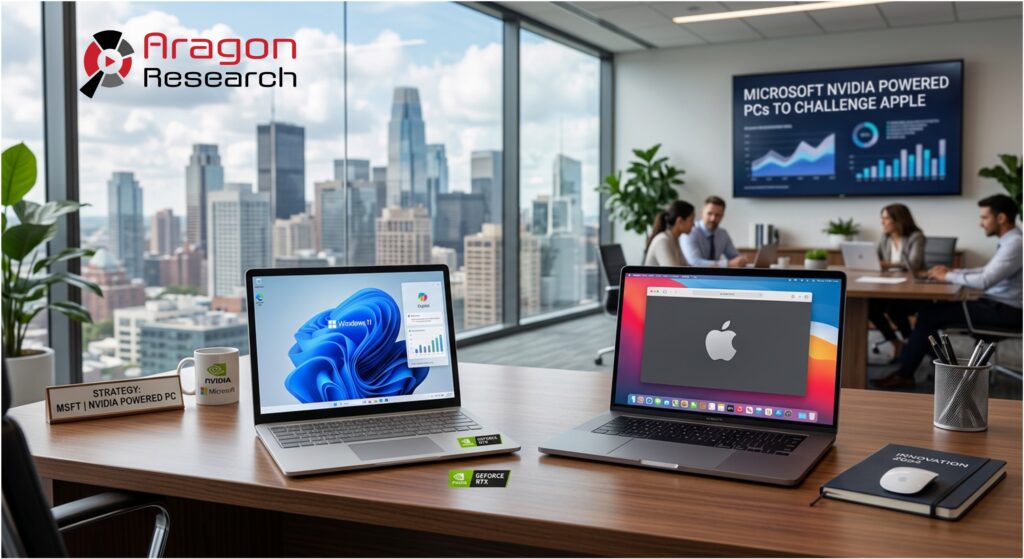
The high-end mobile workstation market encountered a major disruption following the unveiling of the custom Arm-based NVIDIA RTX Spark superchip at the recent GTC event, triggering an immediate shift in the competitive landscape for premium computing hardware. The specialized silicon integrates an advanced Blackwell graphics processing unit with a high-efficiency 20-core central processing unit and up to 128GB of unified system memory designed to process intense multi-step computing tasks locally. This comprehensive hardware release will see initial adoption across flagship systems from major device manufacturers, including the newly introduced Microsoft Surface Laptop Ultra alongside specialized creator laptops from ASUS, Dell, HP, Lenovo, and MSI. This blog overviews the Nvidia Powered Spark PC announcements and offers our analysis.
Why Did Microsoft and Nvidia Launch the RTX Spark PC Platform
NVIDIA and Microsoft designed and launched this integrated ecosystem to directly challenge the dominant position of Apple within the lucrative professional creator, developer, and enterprise design markets. Historically, digital artists, data scientists, and advanced software engineers were forced to choose between the high-bandwidth unified memory efficiency offered by Apple silicon and the industry-standard software ecosystem tied to NVIDIA graphics cards. Microsoft lacked a premium silicon answer that could deliver sustained performance in thin form factors, forcing power users onto macOS.
By delivering a highly efficient 3-nanometer architecture tailored specifically for thin-and-light laptop chassis, NVIDIA provides its hardware partners with the physical blueprints required to eliminate the unique memory bandwidth advantage previously enjoyed by the MacBook Pro line. Microsoft anchors this hardware rollout by optimizing Windows on Arm to guarantee deep compatibility with advanced engineering applications. The platform combines 6,144 Blackwell cores with a shared pool of ultra-fast memory to allow creative applications to handle data sets that previously required desktop workstations or remote server clusters.
Analysis
This massive product rollout completely changes the dynamics of the high-end enterprise PC market by offering a viable alternative to the unified memory playbook that Apple used to dominate premium segments. For several years, Apple successfully captured premium enterprise user margins because traditional x86 laptops lacked the cohesive memory bandwidth required to process ultra-large AI models, complex 12K video timelines, and massive 3D geometries without experiencing severe thermal throttling or rapid battery depletion.
The arrival of these new systems means that original equipment manufacturers can finally deliver identical structural benefits wrapped in a standard Windows enterprise management framework. Consequently, Apple will face intense pressure to accelerate its own hardware development cycles and expand its enterprise developer relationships to prevent high-value creative and engineering teams from migrating back to the Windows ecosystem.
Furthermore, because major software vendors like Adobe are rearchitecting the core rendering engines of flagship applications specifically for the RTX Spark silicon, the traditional software optimization advantage held by macOS is shrinking. This structural equalization allows enterprise procurement departments to standardize their deployment models under a unified operating system environment without forcing specialized departments to operate on isolated hardware platforms that complicate corporate security patching and asset management.
The Anticipated Apple Response: Technology and Price
Apple will likely counter this Windows GPU offensive by leveraging its vertically integrated supply chain to adjust both its architectural roadmap and its pricing structures. On the technology front, expect Apple to accelerate the deployment of its Ultra-class silicon to the MacBook Pro line much faster than its historical release cadences. The vendor will also likely expand the neural engine core count and memory bus width across its baseline chips to maintain a performance lead in on-device AI operations. Additionally, Apple will need to deepen its partnerships with open-source AI communities to ensure that localized large language models run more efficiently on macOS than on competing Windows Arm layers.
From a pricing perspective, Apple will face pressure to adjust its expensive memory upgrade tiers, which have historically served as a high-margin barrier for enterprise buyers. To protect its market share from the influx of affordable RTX Spark laptops, Apple may introduce a more aggressively priced enterprise configuration or bundle entry-level workstation models with corporate support packages. The vendor might also introduce a scaled-down, highly efficient portable workstation, effectively an Apple Nano workstation concept, aimed at price-sensitive enterprise developers who require unified memory but do not need the full thermal capacity or cost of a top-tier MacBook Pro.
What Enterprises Should Do
Procurement and technology officers should closely review their upcoming corporate workstation allocation budgets ahead of the fall release cycle. Organizations that previously standardized on Apple hardware due to local model processing constraints or high-end video rendering demands must thoroughly evaluate the cost-to-performance ratios of these incoming Windows alternatives.
Enterprise infrastructure teams should also initiate pilot testing programs to observe how their existing application portfolios perform under updated emulation layers before committing to large-scale deployment. Technology leaders should leverage this newfound market competition to renegotiate volume pricing agreements with their existing hardware providers.
Bottom Line
The introduction of the NVIDIA RTX Spark platform ends the exclusive hold of Apple on high-bandwidth unified memory laptop architectures. Enterprises now possess a viable path to run advanced generative workflows on a manageable Windows operating system foundation. Decision-makers should leverage this newfound market competition to optimize their hardware acquisition costs during the next procurement cycle.
Have a Comment on this?