

Google Enhances Workspace with Agentic AI Capabilities
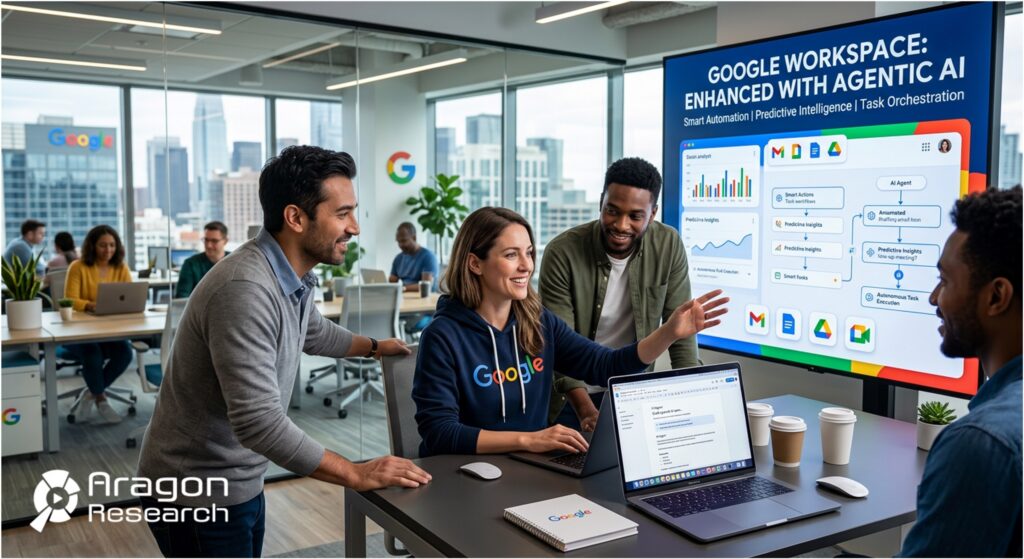
Image design by Aragon, rendered by Gemini.
By Jim Lundy
Google Enhances Workspace with Agentic AI Capabilities
The modern office environment requires significant administrative effort to manage routine communications and coordination. At Google I/O Google introduced several artificial intelligence updates to Google Workspace during its annual developer conference. These enhancements focus on conversational voice features, autonomous email management, and precise digital image editing. This blog overviews the Google Workspace news and offers our analysis.
Why Did Google Announce New AI Workspace Tools
The vendor launched these capabilities to shift its productivity suite from a passive repository of documents into an active collaborative environment. Market demand has rapidly evolved past simple text summarizers toward autonomous software that can execute workflows.
By embedding voice-activated features and background orchestration directly into existing applications, Google aims to minimize the cognitive friction of manual data retrieval. This rollout also serves to justify premium subscription tiers by offering distinct utility that cannot be replicated by standard office tools.
Here is the summary of what was announced:
- Voice Capabilities: Shifts interactions from typing to conversational dictation, allowing real-time information retrieval and note organization across core applications via hands-free voice commands.
- Google Pics: Lowers the barrier for enterprise design by using precise pixel-level object segmentation and multi-user canvases, reducing reliance on complex, third-party creative software.
- AI Inbox Updates: Streamlines daily administration by shifting email from a reading queue to an execution queue through automated draft generation and predictive task management.
- Gemini Spark: Represents the transition to true agentic workflows, moving past transactional queries to a continuous background assistant that coordinates tasks across the entire suite.
Analysis
This announcement signals that the enterprise collaboration market is officially moving into the era of agentic productivity. Google is positioning its virtual assistant as the central connective tissue across enterprise workflows rather than a separate chat interface. This strategy forces competitors to accelerate their own autonomous roadmaps to avoid being viewed as static storage repositories. The emphasis on localized image control and hands-free dictation addresses the common enterprise frustration with the unpredictable outputs of early generative models.
Furthermore, the introduction of background orchestration tools means that the vendor is attempting to capture the workflow automation layer traditionally dominated by specialized software. If an agent can independently monitor communications, manage tasks, and synthesize cross-application data, the need for third-party integration platforms diminishes. The long-term impact will likely be a consolidation of the productivity stack, where the platform vendor controls both the content creation and the operational workflow. Enterprises should look past the convenience of voice commands and evaluate how these deep platform integrations affect data governance and vendor lock-in.
Automating Work with AI Inside of Workspace
The core mechanism of Google’s automation strategy centers on background orchestration that connects fragmented business applications without manual user intervention. Rather than requiring users to open separate tabs to share information, the underlying intelligence reads the contextual data within one application to execute tasks in another. For instance, the system can parse the details of an incoming email, cross-reference data inside a spreadsheet, and automatically update a calendar invite or task log. This represents a significant shift from traditional macro-based automation, which relies on rigid code and predictable triggers, toward intent-based automation that adapts to natural language.
By embedding continuous personal agents directly into the collaboration suite, the vendor is attempting to establish an autonomous workflow layer that runs silently in the background. The software can independently monitor communication queues to draft responses, organize messy notes into formal outlines, and surface relevant files before a user searches for them. This native infrastructure undercuts traditional enterprise integration tools by handling multi-step cross-application processes internally. As a result, daily business operations transition from manual data entry and retrieval to a model where humans primarily review and approve actions pre-arranged by the software.
Enterprise Action Items
Enterprises should closely monitor these updates and evaluate their implications on the existing technology infrastructure. IT leaders need to review data privacy permissions, particularly regarding tools that scan repository files to draft content autonomously. Organizations already committed to this ecosystem should pilot the voice and inbox features within specific departments to assess actual productivity gains before planning a broader corporate rollout.
Bottom Line
Google is aggressively transitioning its productivity suite into an autonomous agent platform to redefine digital workflows. This evolution provides enterprise users with powerful tools for voice-driven document creation and automated administration. Organizations must carefully balance the clear operational efficiencies of agentic assistance against the broader challenges of platform dependency and data security.
Have a Comment on this?