


Apple IOS Fills a Vacuum For Child Safety
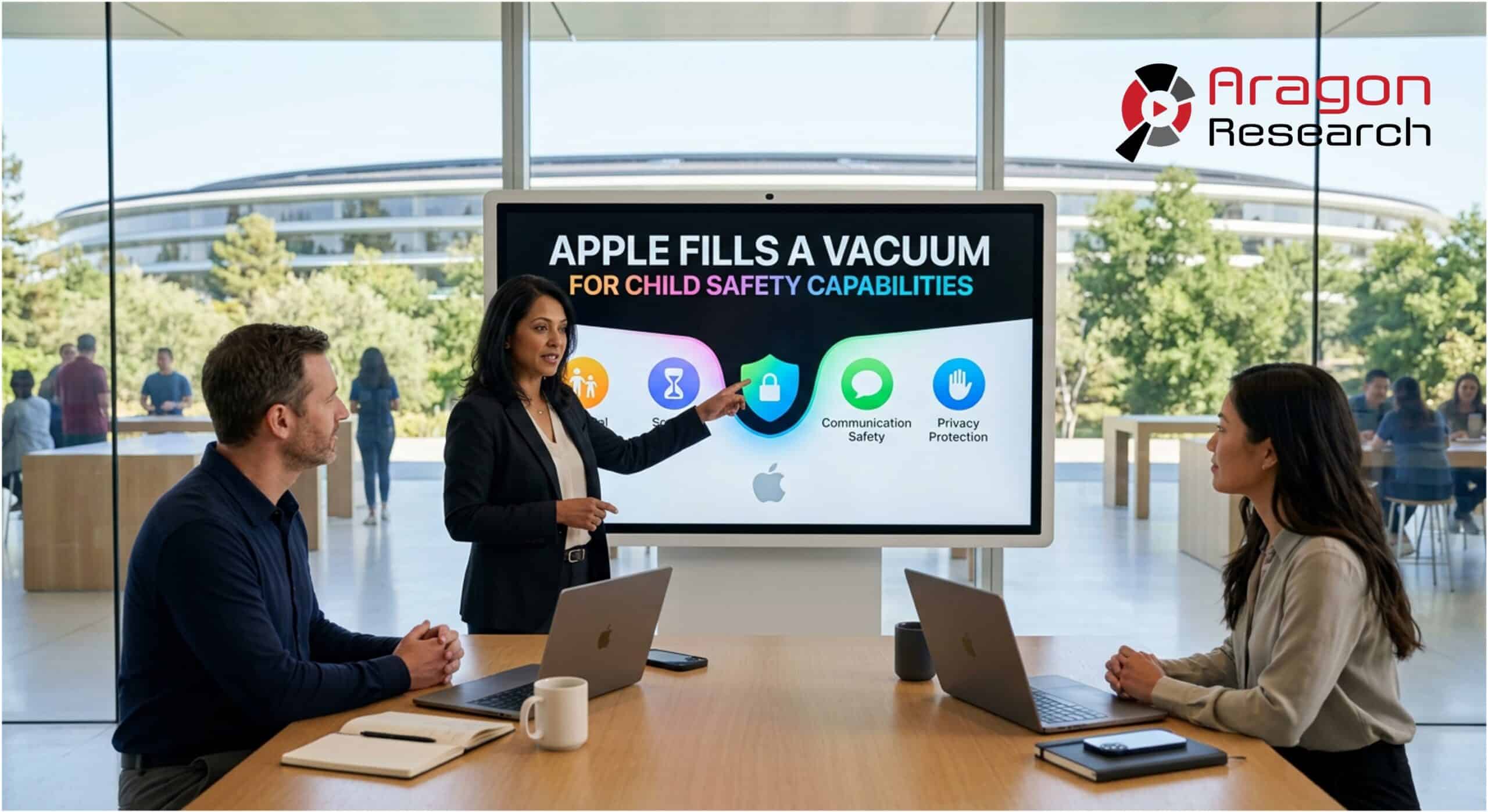
Image design by Aragon, rendered by Gemini.
By Ken Dulaney
Apple ioS Fills a Vacuum For Child Safety
This blog overviews the recent child safety announcements from Apple’s WWDC 2026 conference and offers our analysis on the strategic implications for the consumer and enterprise technology markets.
How did Apple Fill a Vacuum For Child Safety Capabilities
At its WWDC 2026 conference, Apple introduced an extensive and granular suite of child safety and parental control features integrated directly into iOS 27, iPadOS 27, and macOS 27. This move responds directly to increasing global regulatory pressure, where governments are actively initiating smartphone bans in schools and investigating the impact of digital media on minors. Rather than relying on rigid, time-based on/off limitations, Apple’s updated ecosystem introduces a more sophisticated architecture.
The core improvements focus on granular, context-aware management:
- Child Accounts Ecosystem: Automated, age-appropriate safeguards enforced across all Apple hardware, including the restriction of adult websites and age-gated App Store downloads.
- Ask to Browse: A mandatory permission workflow where children must request parental approval to access new web domains via Safari.
- Granular Time Allowances: Recommendations developed with the American Academy of Pediatrics that allow parents to set specific time limits for broad categories—such as Social Media, Gaming, and Entertainment—and construct customized daily schedules around school hours.
- AI-Driven Communication Safety: The expansion of Apple’s on-device AI filtering. Previously limited to blurring nudity, the system now automatically detects and blocks graphic violence and gore in Messages, FaceTime, and Phone interactions, while requiring parental validation for new contacts.
Analysis
Aragon Research believes this release represents a critical pivot in the child safey ecosystem landscape. Apple is positioning its safety architecture to be significantly more comprehensive than competing platforms today. By embedding these capabilities natively and ensuring they function seamlessly across iPhones, iPads, and Macs—while providing APIs for third-party developers via tools like PermissionKit—Apple has eliminated the fragmentation that traditionally plagued parental control software.
The strategy addresses the macro-environmental pressure of hardware bans by offering schools and parents a compromise: a highly restrictive, yet highly functional tool. The integration of on-device AI to mitigate inappropriate contacts and explicit material provides a technical answer to growing compliance and liability concerns. This minimizes the risk of bypasses that frequently compromised older, passcode-only restriction models.
Enterprise Implications
Enterprises should closely monitor and understand this development, particularly organizations deploying corporate-owned, personally enabled (COPE) device strategies or those operating in the education sector. Security and compliance teams must evaluate how these native OS-level restrictions interact with existing Mobile Device Management (MDM) profiles. For enterprises building consumer-facing applications targeting families, developers must immediately integrate Apple’s new Declared Age Range API to ensure compliance with native privacy boundaries without accessing a minor’s exact birth date.
Impact on the Market
The long-term impact on the hardware and software market will be profound. By capturing parental trust through advanced security and granular control, Apple effectively secures the entry point for the youngest demographic of users. Parents driven by safety concerns will default to Apple hardware for their children. Downstream, as these children mature, Apple products will remain the baseline technology foundation upon which these future users build their personal and professional workflows. This locks in long-term platform loyalty and creates a high barrier to entry for competing ecosystems.
Bottom Line
Apple’s WWDC 2026 child safety enhancements represent a strategic response to global regulatory pressures by shifting parental controls from simple time-limits to granular, AI-driven content oversight. Enterprises must understand these shifts to align their device management and application compliance strategies. Ultimately, this framework strengthens Apple’s long-term market position by establishing its ecosystem as the foundational technology platform for the next generation of users.
Have a Comment on this?