


Google jumps ahead with Willow Quantum Chip
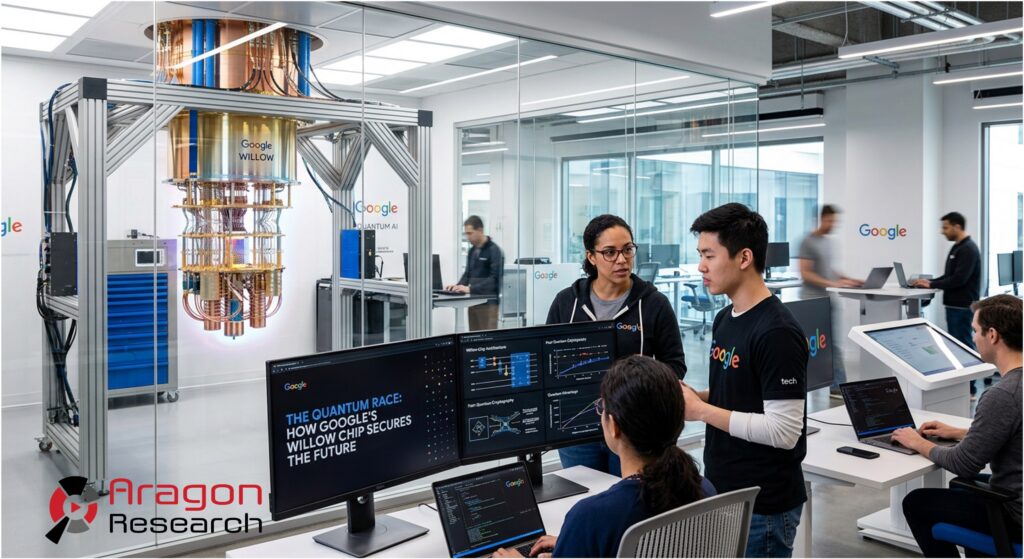
Image design by Aragon, rendered by Gemini.
By Ken Dulaney
Google jumps ahead with Willow Quantum Chip
The Quantum race is not slowing down and it has become a global contest. The US, Canada, China, Germany, Japan and the U.K. are all competing. This blog overviews the recent announcement of Google’s Willow quantum chip and offers our analysis of its implications for the computing market.
Why Google Announced the Willow Quantum Chip
Google recently unveiled “Willow,” its latest superconducting quantum processor, marking a significant technical leap over its predecessor, Sycamore. Willow features 105 physical qubits—roughly double the count of the previous generation—and demonstrates a critical breakthrough in quantum error correction. By scaling a physical qubit lattice from 3×3 to 7×7, Google reduced error rates by a factor of over 2x, effectively doubling the lifespan of logical qubits. The announcement serves as a demonstration of “quantum supremacy,” where a quantum system performs a task impossible for classical supercomputers. In a standard benchmark computation, Willow finished in under five minutes; the same task would take a modern classical supercomputer an estimated 10 septillion years—a duration exceeding the age of the universe.
Analysis
From the Aragon Research perspective, Willow is more than just a hardware iteration; it is a signal that the timeline for “Q-Day”—the point at which quantum computers can crack RSA encryption—is accelerating. Google has moved its own internal “Q-Day” target from 2030 to 2029, reflecting faster-than-expected progress in error correction and hardware stability. While Willow is not yet a “cryptographically relevant” quantum computer, it proves that the path toward one is technically viable.
The impact of this chip extends beyond security into complex simulations. In weather prediction and material science, Willow-class systems can model molecular interactions that are currently approximated or ignored by classical binary logic. For instance, simulating specific chemical catalysts or atmospheric fluid dynamics can be done in hours on a quantum system, whereas classical systems might take years of compute time or fail to reach the required precision. Competitively, Google is positioning itself ahead of both established players like IBM and a growing fleet of startups. While IBM focuses on high qubit counts and modularity, Google is winning the race on error reduction and raw computational “advantage” for specific algorithms.
What Enterprises Should Do About This News
Enterprises should treat this announcement as a trigger to move from “passive observation” to “active preparation.” This is no longer a science project confined to labs. Organizations must prioritize “quantum agility” within their security stacks. This means auditing current encryption protocols and preparing to migrate to post-quantum cryptography (PQC) standards, such as the ML-DSA algorithms being integrated into Android and Chrome. The “harvest now, decrypt later” threat is real; adversaries are likely collecting encrypted data today to decrypt it in 2029.
Impact on the Market
The Willow announcement will likely force a consolidation in the quantum vendor landscape. We expect increased pressure on system builders and fabricators—Google manufactures its own chips in Santa Barbara, California—to provide more transparent roadmaps. Other vendors, such as Quantinuum and Microsoft, are also racing to build complete systems, but Google’s ability to vertically integrate hardware and software (via its Cirq framework) gives it a distinct lead. We anticipate that Google will begin distributing access to Willow-based systems via its Early Access Program and Google Cloud by late 2025 or early 2026, though full-scale dedicated on-premises systems remain years away.
Bottom Line
Google’s Willow chip effectively shortens the runway for the quantum revolution, moving the expected arrival of cryptographically relevant systems to 2029. Enterprises should not wait for “Q-Day” to arrive; the risk to long-lived data is immediate. Start by inventorying high-value cryptographic assets and training R&D teams on quantum programming environments like Cirq or Qiskit to ensure your organization is ready to leverage these systems as they become commercially available through the cloud.
Have a Comment on this?