


Fixing Claude: Anthropic Taps SpaceX for Power
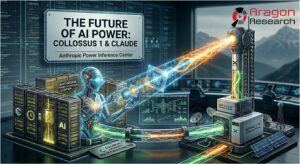
Image design by Aragon, rendered by Gemini.
By Jim Lundy and Adam Pease
Fixing Claude: Anthropic Taps SpaceX for Power
The race for artificial intelligence supremacy is increasingly becoming a battle over infrastructure and energy. Anthropic and SpaceXAI recently announced a joint partnership with where Anthropic will be able access the Colossus 1 supercomputer, signaling a massive expansion in its compute capacity. This news follows a turbulent period for the vendor, which struggled throughout early 2026 to meet the surging demand for its Claude CoWork and Claude Code tools. This blog overviews the Anthropic-SpaceX news and offers an analysis of how it fits into their broader infrastructure rescue.
Why Did Anthropic Announce a Deal for Colossus 1?
Anthropic entered this agreement to secure immediate, high-scale compute for its rapidly growing user base. Colossus 1, now under the SpaceXAI banner, features over 220,000 NVIDIA GPUs and provides 300 megawatts of power. This serves as a vital release valve for the capacity constraints that have frustrated Claude Pro and Claude Max subscribers.
However, the SpaceX deal is only one piece of a much larger “Infrastructure Rescue.” Just last month, Anthropic finalized massive, multi-billion-dollar commitments with its primary cloud partners. Google and Amazon (AWS) have stepped in as both financial backers and primary infrastructure lifelines. While Anthropic’s $100 billion commitment to AWS over ten years serves to tie its scaling capabilities directly to proprietary chips, many of these massive terrestrial projects are still under construction. The SpaceX partnership allows Anthropic to tap into the world’s fastest-deployed supercomputer while these multi-gigawatt facilities remain in development.
Analysis: A Diversified Triple-Threat Strategy
The deal with SpaceX represents a pragmatic shift in the AI industry where even the most dedicated cloud partnerships cannot satisfy the sheer data processing appetite of frontier models. By leveraging Colossus 1, Anthropic is effectively using “bridge compute” to maintain its competitive edge while waiting for its massive commitments with AWS and Google to fully materialize.
This signals that Anthropic is moving away from being a cloud-agnostic player and is instead becoming a core component of the Amazon and Google ecosystems. This strategic capture is underpinned by a decade of foresight in custom silicon. Google’s early bet on TPUs and Amazon’s aggressive development of Trainium and Inferentia chips have created a “full-stack” moat. By offloading massive workloads from supply-constrained GPUs to these proprietary, energy-efficient chips, Anthropic reportedly gains up to 50% savings in some scenarios.
Perhaps the most insightful part of the SpaceX announcement is the long-term interest in orbital AI compute. This suggests that leading AI firms recognize a looming “terrestrial ceiling” where Earth-bound power grids and cooling requirements become the ultimate bottleneck. Moving compute to space is no longer a research concept; it is becoming a strategic necessity to bypass land-use restrictions and energy scarcity on Earth.
Recommendations for Enterprises
Enterprises should view these moves as a signal that compute availability will remain the primary volatility factor in AI service reliability. If your organization relies on Claude for production workloads, you should evaluate how this expanded capacity—including increased rate limits for Claude Code—can accelerate your development timelines.
We recommend that IT leaders diversify their own AI implementations across multiple cloud environments. Because Anthropic’s roadmap is now subject to the hardware cycles of Google and AWS, you must monitor how these funding arrangements influence future service pricing and model availability. It is no longer enough to choose a model based on performance; you must choose based on the stability of the infrastructure behind it.
Bottom Line
Anthropic’s partnership with SpaceX, combined with its massive Google and AWS deals, confirms that the infrastructure war has entered a new phase of extreme scale. By securing Colossus 1 and eyeing orbital capacity, Anthropic is positioning itself to outrun the physical limitations of the traditional data center. For enterprises, this means that the true differentiator for AI providers will be their ability to secure and manage massive amounts of power. The move toward space-based processing highlights a future where AI leadership depends as much on aerospace and energy logistics as it does on algorithmic innovation.
Have a Comment on this?