


Google: Record Revenue and the $185B AI Pivot
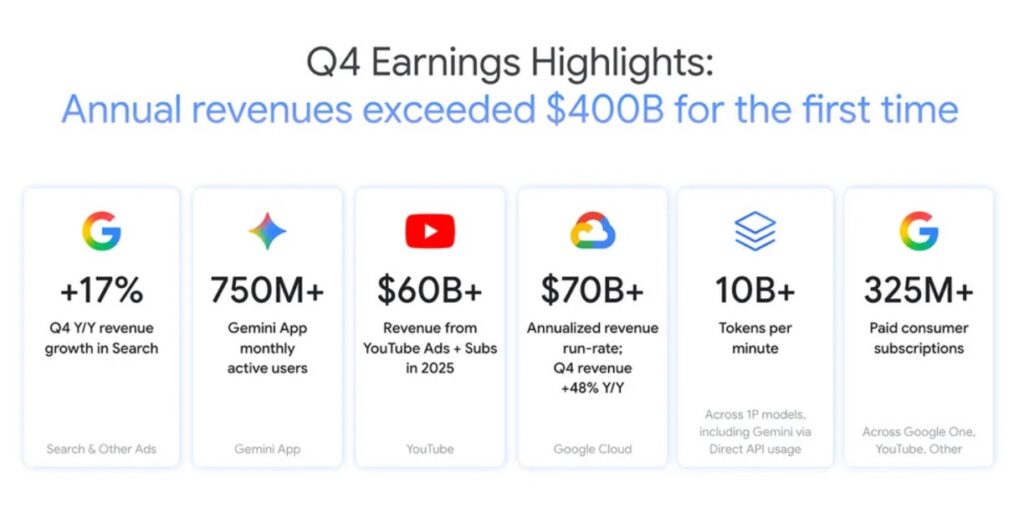
Google highlights of its most recent earnings (Source: Google).
By Jim Lundy
Google: Record Revenue and the $185B AI Pivot
Alphabet recently reported its fourth-quarter and fiscal year 2025 results, marking a historic turning point for the search giant. The company achieved a record $403 billion in annual revenue, the first time it has crossed the $400 billion threshold, while net income for the quarter surged 30% to $34.5 billion. Beyond the top-line numbers, the core of the announcement was a massive escalation in infrastructure spending, with 2026 capital expenditure projected to reach between $175 billion and $185 billion. This blog overviews the Alphabet earnings report and offers our analysis.
Why did Alphabet announce massive infrastructure spending?
The primary driver behind this aggressive spending plan is the rapid acceleration of Google Cloud and the consumer adoption of its Gemini AI platform. Google Cloud revenue grew 48% in the fourth quarter to $17.7 billion, significantly outperforming market expectations and demonstrating that enterprise demand for AI infrastructure is translating into real revenue. To maintain this momentum, Alphabet is effectively doubling its capital investment from the $91 billion spent in 2025. This capital is earmarked for new data centers and the expansion of its custom TPU hardware to support the training and deployment of the Gemini 3 model.
Analysis
The scale of Alphabet’s projected $185 billion investment represents more than just a capacity increase; it is a fundamental shift in the company’s business model from a software-driven services firm to a capital-intensive infrastructure provider. By committing to spend nearly half of its annual revenue on physical assets, Google is attempting to build a barrier to entry that startups and even some legacy hyperscalers will struggle to match. The 55% sequential growth in the Google Cloud backlog to $240 billion suggests that this is not speculative spending, but a response to an unprecedented queue of enterprise customers waiting for compute capacity.
This shift also signifies a move toward vertical integration. Alphabet is increasingly relying on its own silicon and dedicated energy supplies to circumvent the supply chain constraints and power shortages that are currently slowing down the broader AI market. While the market reacted with some volatility to the high costs, the underlying data shows that Google has successfully defended its search moat while simultaneously scaling a world-class cloud business. The risk for Alphabet in 2026 is no longer a lack of demand, but the potential for a “depreciation drag” that could compress margins if the conversion of the backlog into recognized revenue lags behind the pace of construction.
What should enterprises do about this news?
Enterprises should view Alphabet’s massive infrastructure commitment as a signal of long-term stability for the Gemini ecosystem. Technology leaders should evaluate their current cloud and AI roadmaps to ensure they are positioned to take advantage of the increased capacity and specialized hardware Google is bringing online. This is the time to deepen the technical evaluation of Gemini 3 for production workloads, particularly for large-scale multimodal applications where Google’s integrated stack offers a performance-per-dollar advantage. Organizations should also consider the implications of Google’s expanding footprint on their own data residency and sustainability requirements.
Bottom Line
Alphabet has proven that it can monetize artificial intelligence at a massive scale, with both its cloud and advertising units benefiting from the AI transition. The decision to invest up to $185 billion in 2026 is a bold move to secure its dominance in the next decade of computing. Enterprises must recognize that the AI race has moved from the experimental phase to the industrial phase. Moving forward, the focus for organizations should be on execution and leveraging this vast new infrastructure to drive business value.
Have a Comment on this?