

What SpaceX’s $60B Cursor Deal Means for AI
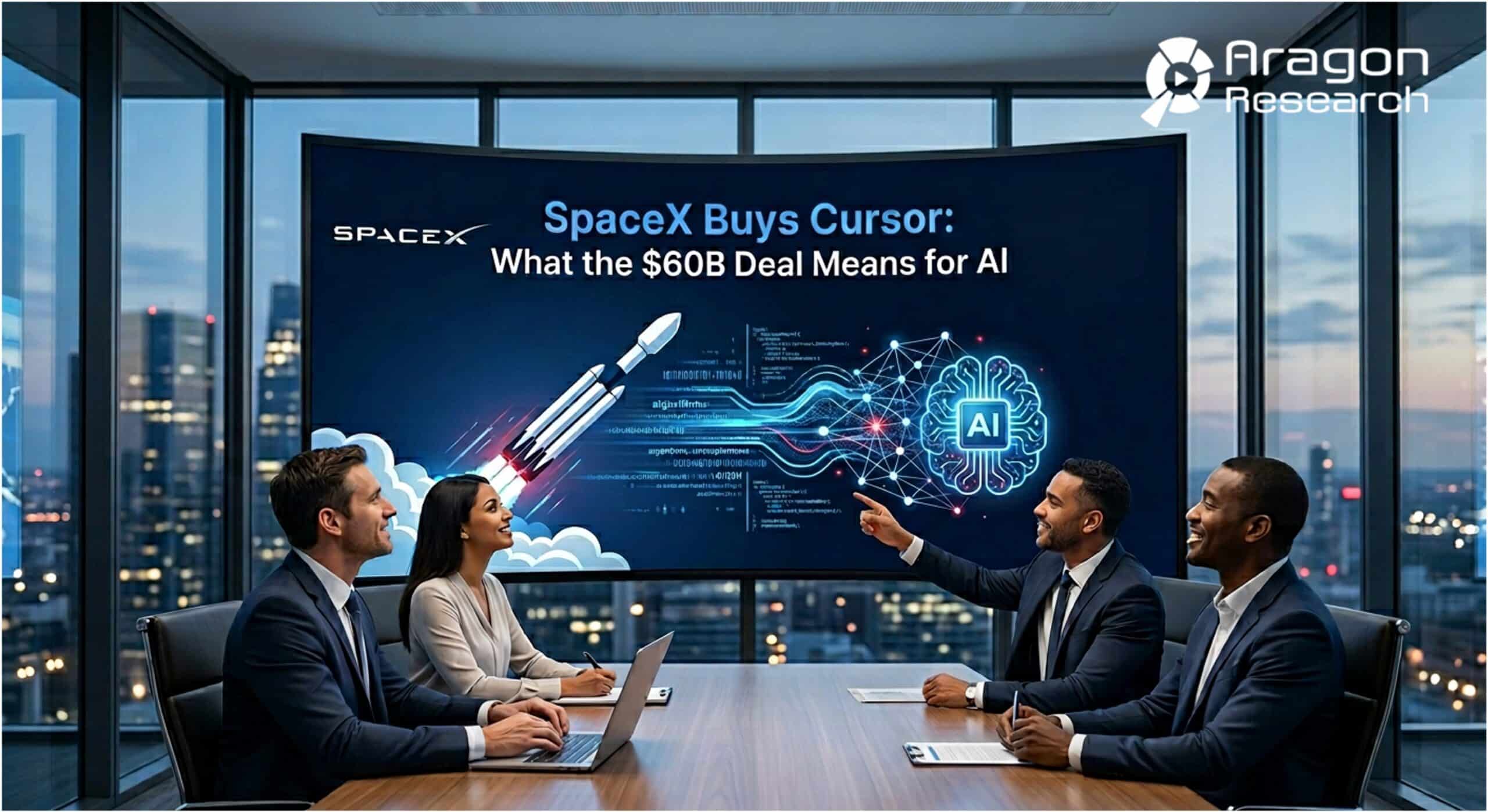
Image design by Aragon, rendered by Gemini.
By Jim Lundy
What SpaceX’s $60B Cursor Deal Means for AI
The tech market just experienced a massive structural shift as aerospace capital directly absorbed one of the fastest growing software platforms. SpaceX has entered into a formal agreement to purchase the artificial intelligence coding startup Cursor for sixty billion dollars in stock. This transaction occurred just days after the rocket manufacturer made its public debut on the Nasdaq in the largest initial public offering in history. The deal represents a significant deployment of newly public equity to secure critical intellectual property in the developer tools space. This blog overviews the SpaceX acquisition of Cursor and offers our analysis.
Why Did SpaceX Announce the Cursor Acquisition
SpaceX is aggressively building out an end to end technology conglomerate that stretches far beyond space exploration and satellite internet. By purchasing Cursor, the enterprise secures a highly popular artificial intelligence platform that recently reported over two billion dollars in annualized business to business revenue. This move follows the earlier structural merger of SpaceX with xAI, an entity that has struggled to match the coding capabilities of rival frontier models.
The acquisition allows the combined organization to immediately integrate Cursor advanced agentic software capabilities with the massive computational infrastructure of the Colossus data center complex. SpaceX expects the transaction to close during the third quarter of this year to help scale its internal aerospace software pipelines while capturing a massive footprint among enterprise software engineers.
Analysis
This transaction underscores a critical market inflection point: independent AI tools can no longer survive without hyperscale infrastructure backing. While Cursor achieved massive popularity and fueled the rise of automated software development, recent data indicated its market share dropped from forty-one percent to twenty-six percent under intense pressure from Anthropic. The reality is that the financial burden of training foundation models has become too immense for standalone startups to sustain.
By pulling Cursor under a public giant valued at over two trillion dollars, the platform gains the infinite compute resources required to survive. Aragon Research believes this consolidation indicates that the standalone developer assistant market is effectively closing. Specialized artificial intelligence vendors will increasingly be forced to merge into mega cap technology stacks or face obsolescence as computing costs rise.
Did SpaceX Overpay, or is This the New AI Valuation Benchmark?
This staggering $60 billion all-stock transaction naturally prompts the question of whether SpaceX drastically overpaid to subsidize xAI’s coding gap, or if this represents a permanent valuation reset for premier application-layer AI firms. At roughly 23x its $2.6 billion annualized revenue run rate, the price is undeniably premium—especially given the recent market share erosion under Anthropic’s assault. However, viewing this through a traditional software valuation lens misses the point.
SpaceX isn’t just buying current cash flow; it is securing a heavily captured enterprise developer ecosystem of over 7 million users to vertically integrate its compute, model, and application tiers. For top-tier AI applications that have successfully achieved massive user scale and crossed the $1 billion to $2 billion ARR threshold, the valuation math has shifted: price tags are no longer determined by isolated margins, but by their strategic value as terminal “front-ends” for tech conglomerates racing to own the developer pipeline.
Enterprise Implications
Technology leaders must carefully evaluate how this massive consolidation impacts their current software development lifecycles and vendor strategies. If your engineering organization currently depends on Cursor for application development, you must anticipate that its future product roadmap and data privacy terms will align with proprietary ecosystem goals. Enterprises should expect a tighter integration with specific infrastructure which could limit previous multi cloud flexibility. It is highly recommended to audit your development tools stack and evaluate alternative platform agnostic coding assistants to prevent total vendor lock in. Organizations must understand that developer infrastructure is becoming highly centralized and maintaining architectural flexibility is the best defense against sudden ecosystem shifts.
Bottom Line
The sixty billion dollar acquisition proves that automated developer infrastructure has become a tier one strategic asset for tech conglomerates. Enterprises should treat this event as a clear sign that independent artificial intelligence productivity tools are rapidly consolidating into larger proprietary clouds. Technology leaders must evaluate their current software dependencies, actively consider alternative coding assistants, and ensure their long term IT roadmaps emphasize multi vendor diversification.
Have a Comment on this?