


CrowdStrike Unveils SafeMind for Agentic Cyber
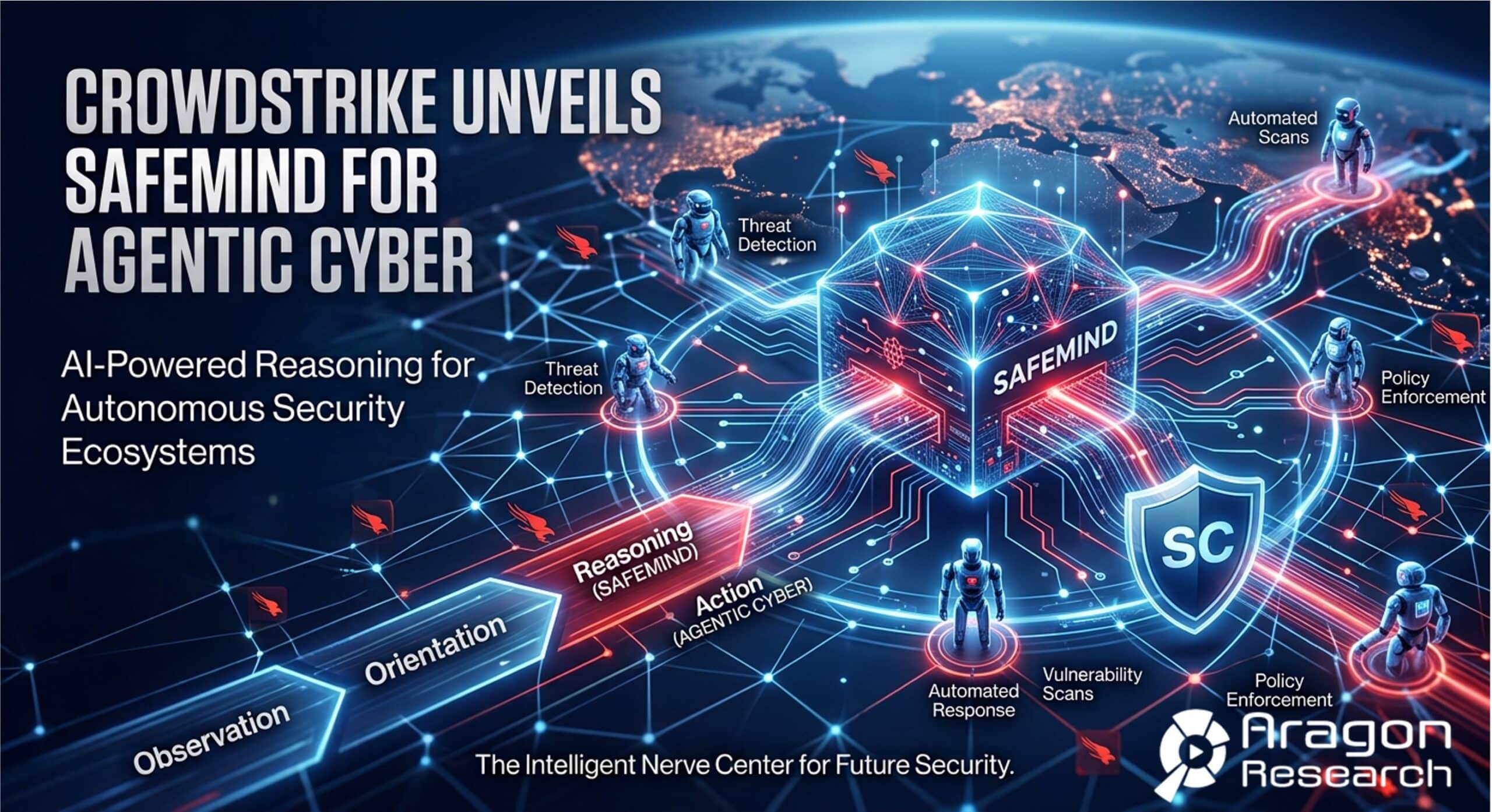
Image design by Aragon, rendered by Gemini.
By Jim Lundy
CrowdStrike Unveils SafeMind for Agentic Cyber
The speed of modern cyber attacks has outpaced the ability of human defenders to respond manually. At Fal.Con 2026, CrowdStrike introduced SafeMind, an agentic security architecture developed in collaboration with NVIDIA and CoreWeave. Built on NVIDIA Nemotron open models and trained on Falcon sensor telemetry, the platform couples an offensive emulation model with an automated defensive model. This dual architecture operates in a unified closed-loop harness designed to execute remediation at machine speed. This blog overviews the CrowdStrike SafeMind announcement and offers our analysis.
Why Did CrowdStrike Announce SafeMind?
Security operations centers face an unsustainable surge in sophisticated adversary tactics and alert volumes. Standard frontier artificial intelligence models can identify security anomalies, but they lack the operational context and execution frameworks needed to resolve incidents safely. Furthermore, running massive general models across petabytes of enterprise telemetry creates unacceptable latency and budget inflation.
CrowdStrike developed SafeMind to provide defenders with purpose-built agentic capabilities tailored to combat machine-speed intrusions. The system deploys two distinct models: Red Tempest to discover attack paths and Blue Solano to deploy defensive countermeasures. By pairing these models within an autonomous harness powered by CoreWeave infrastructure, CrowdStrike aims to deliver significantly faster remediation while drastically reducing operational compute costs.
Analysis
Cybersecurity architecture is reaching a defining pivot point where passive detection gives way to autonomous response. Generic large language models trained on public internet data cannot solve mission-critical security challenges because they lack authoritative endpoint telemetry and real-world incident response grounding. CrowdStrike is attempting to establish an architectural benchmark by deploying paired adversarial and defensive models inside a single operational loop.
This development places substantial competitive pressure on the broader security market. Vendors that built simple conversational interfaces over third-party frontier models will find their offerings commoditized. Competitors must now develop or acquire specialized model weights trained on proprietary telemetry rather than relying on generalized reasoning engines. We expect endpoint and extended detection and response rivals to initiate partnerships with semiconductor and specialized cloud providers to build similar co-evolving architectures.
The collaboration with NVIDIA highlights a critical trend where domain-specific models challenge general frontier models in enterprise production. For high-stakes security operations, compact models trained on specialized threat intelligence deliver superior precision at a fraction of the inference cost. The true enterprise differentiation going forward will reside in autonomous harnesses that execute verified remediation, rather than basic conversational assistance.
CrowdStrike SafeMind vs. Microsoft Perception
The introduction of SafeMind directly challenges Microsoft’s recent rollout of its Perception platform and MAI-Cyber-1-Flash model. While Microsoft uses autonomous red, blue, and green agents beneath Security Copilot to focus heavily on software codebases and bug remediation, CrowdStrike focuses its Red Tempest and Blue Solano models on live endpoint telemetry and active adversary emulation
The primary battleground between these two agentic approaches will be operational cost. Microsoft’s multi-agent model architecture relies on Security Compute Units, where enterprise costs can rapidly scale past ninety thousand dollars per month for moderate deployments
CrowdStrike aims squarely at this vulnerability by leveraging NVIDIA Nemotron open models and CoreWeave infrastructure to promise ninety-nine percent cost savings over generic frontier architectures. While Microsoft offers deep integration across enterprise developer tools, CrowdStrike delivers a native sensor harness optimized for real-time endpoint containment.
What Enterprises Should Do
Enterprise security leaders should evaluate how closed-loop agentic architectures can relieve operational strain within their security operations centers. Organizations should assess SafeMind and similar emerging agentic platforms by testing automated remediation in controlled environments to validate precision and safeguard governance.
Technology executives must examine total cost of ownership across agentic offerings. Before expanding investments in multi-agent security suites, teams should calculate their consumption models, whether based on compute units or endpoint sensor licensing
Security teams should audit vendor roadmaps, demanding evidence of domain-specific model training and deterministic safeguards rather than unconstrained conversational copilots.
Bottom Line
CrowdStrike has advanced the cybersecurity market by delivering an agentic architecture purpose-built for defenders. As automated threats accelerate, enterprises must prioritize specialized, closed-loop systems that remediate incidents autonomously over generic artificial intelligence tools.
Related Blogs:
AgentExchange: Salesforce Unifies Apps & Agents
Salesforce Headless 360 and the Agentic UI
How Anthropic won the PR Narrative but Google kept the Volume
Important Research related to this Blog:
Also – Check out all our Podcasts HERE
Have a Comment on this?