


Salesforce Headless 360 and the Agentic UI
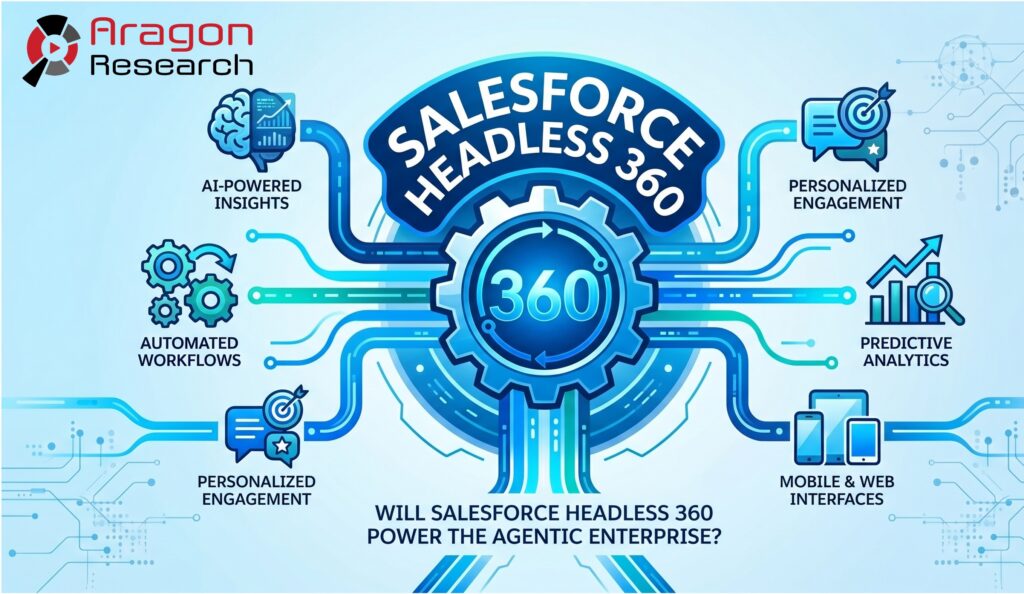
Image design by Aragon, rendered by Gemini.
By Jim Lundy
Salesforce Headless 360 and the Agentic UI
The software industry is witnessing a fundamental shift in how enterprise applications are accessed and utilized. This week Salesforce announced a pivot from its traditional browser-based console toward a more programmable, automated architecture. This blog overviews the “Salesforce Headless 360” news and offers our analysis.
Why did Salesforce announce Headless 360?
Salesforce introduced Headless 360 to address the rise of the agentic enterprise, where autonomous AI agents perform tasks that previously required human navigation. For over two decades, the platform was designed around a human user clicking through a graphical interface to update records or manage cases.
By exposing its core capabilities as APIs, Model Context Protocol tools, and command-line interfaces, Salesforce is making its entire stack accessible to AI agents and developers. This move ensures that the business logic, data, and workflows residing in Salesforce can be triggered from external environments like Slack, WhatsApp, or specialized coding tools without requiring a human to log into the main platform.
Analysis
This announcement represents a strategic admission that the traditional software-as-a-service model, which relies on seat-based human interaction, is no longer the sole primary driver of enterprise value. Salesforce is effectively decoupling its back-end power from its front-end interface to prevent becoming a legacy silo in an AI-first world. By launching Headless 360, the firm is attempting to become the invisible operating system for business processes rather than just a destination website for employees.
The impact on the market will be significant, as it forces competitors in the CRM and ERP spaces to prioritize API-first architectures over UI enhancements. We expect this to trigger a wave of “headless” re-architecting across the industry, as vendors realize that if their tools cannot be easily navigated by an agent, they will be bypassed in favor of more programmable alternatives.
Why did Salesforce announce Agent Exchange?
On top of the Headless design experience for making Salesforce Agent first, Salesforce introduced AgentExchange to unify its disparate marketplaces—AppExchange, Slack Marketplace, and the Agentforce ecosystem—into a single storefront. In the emerging agentic enterprise, a single business process often spans multiple environments, such as a sales agent requiring a data connector in CRM and a workflow trigger in Slack. By consolidating over 10,000 apps and 1,000 pre-built agents into one interface, Salesforce aims to eliminate the friction of navigating different platforms to find AI solutions.
What should enterprises do about this news
Enterprises should evaluate the Headless 360 offering as a cornerstone for their long-term automation and AI strategy. It is important to spend time with Salesforce to decide the right approach to leveraging Salesforce in an Agentic way. Pricing may be a barrier.
Additionally, it is time to audit existing manual workflows within the CRM to identify which processes can be transitioned to autonomous agents using these new programmatic tools. Organizations should consider the implications on their current technology stack, specifically how their development teams can use the new Model Context Protocol tools to streamline DevOps and customer service. This is not just a feature update but a structural change that requires technical leaders to rethink how they integrate Salesforce data into the broader corporate ecosystem.
Bottom Line
Salesforce is successfully pivoting from a human-centric platform to an agent-ready infrastructure with the launch of Headless 360. This transition allows companies to leverage decades of accumulated business logic and data through automated agents rather than manual data entry.
Enterprises must move beyond viewing Salesforce as a mere system of record and start treating it as a programmable engine for the agentic era. Failing to adopt a headless approach will likely lead to increased operational friction and slower technical velocity compared to competitors who embrace these autonomous capabilities.
-
display trackbacks
display trackbacks
display trackbacks
display trackbacks
Comments { 4 }