


Adobe Agent Redefines Document Workflows
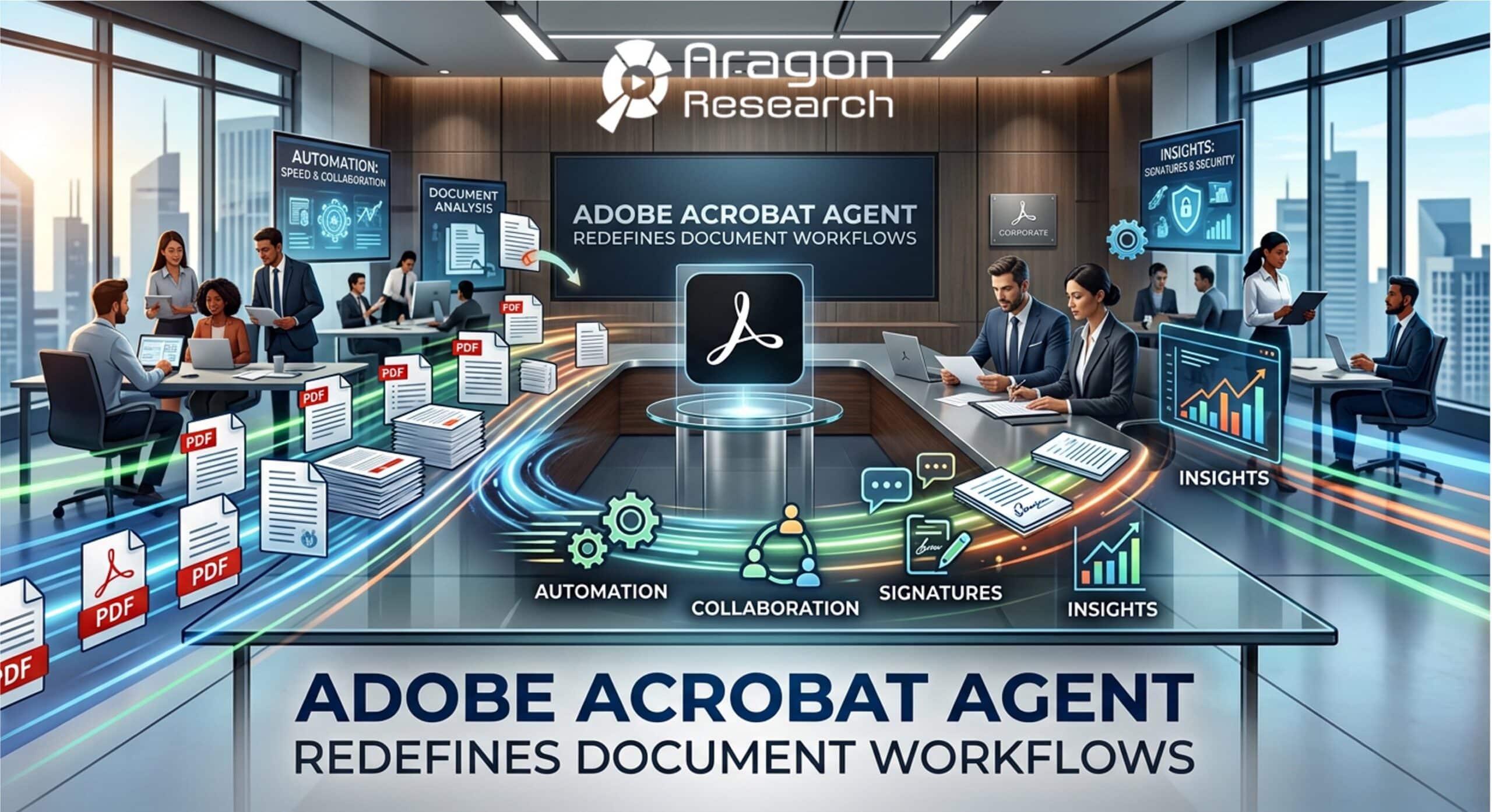
Image design by Aragon, rendered by Gemini.
By Jim Lundy
Adobe Acrobat Agent Redefines Document Workflows
Static enterprise documents have long served as stagnant repositories of corporate memory, forcing workers to spend countless hours manually extracting data. Adobe recently unveiled major updates to Acrobat driven by the Adobe Productivity Agent, designed to transform static files into interactive reports, summary slides, and custom audio podcasts. The release introduces critical enterprise capabilities, including Analyzer and Knowledge Base, which connect to SharePoint and Google Drive to surface structured insights from thousands of files. This blog overviews the Adobe Acrobat AI agent announcement and offers our analysis.
Why Did Adobe Announce Acrobat Productivity Agent Capabilities?
Adobe released these capabilities to defend its dominant position in document software as generative AI assistants reshape daily productivity routines. While workers open hundreds of billions of PDFs in Acrobat annually, users increasingly favor conversational interfaces for rapid synthesis and content generation.
By embedding agentic workflows, audio generation, and structural layout extraction directly into Acrobat, Adobe seeks to prevent users from offloading document tasks to third-party language models. Connecting these capabilities to shared cloud repositories targets the growing enterprise market for unified knowledge discovery.
Analysis
This announcement marks a critical transition from simple conversational summarization to full agentic document orchestration. Adobe is attempting to redefine the PDF from a passive viewing container into an active workspace for insight generation, automated styling, and multimedia output.
Aragon Research views this expansion as a direct challenge to standalone enterprise search vendors and specialized AI document startups. By turning unstructured PDF content into structured data tables, interactive slides, and audio summaries within a single interface, Adobe reduces the necessity for disparate point solutions.
The inclusion of automated styling through Adobe Express integration further encroaches on traditional presentation and design software markets. This allows non-technical workers to bypass complex design workflows entirely for standard business deliverables.
However, this strategy creates new competitive pressure across the enterprise software landscape. Office suite providers and knowledge management vendors will be forced to accelerate their own deep repository integrations or risk losing daily user engagement. Enterprise buyers must recognize that consolidating these workflows into Adobe will inevitably influence licensing structures and storage strategies.
What Should Enterprises Do About This News?
Enterprise technology leaders should evaluate these new Acrobat features against their existing enterprise search, document management, and design stacks. Procurement teams should audit current software subscriptions to identify potential redundancies in audio conversion, document extraction, and template design tools.
Organizations must also update their data security and governance frameworks regarding repository connectors. Linking automated agents to shared environments like SharePoint or Google Drive requires strict permissions management to prevent unauthorized access to sensitive corporate information across business units.
IT leaders should conduct pilot programs with high-volume document teams, such as legal, procurement, and sales operations. These trials will help quantify actual time savings against the operational costs of deploying agentic capabilities.
Bottom Line
Adobe is attempting to lock down the enterprise document productivity layer by shifting Acrobat from a passive viewing tool into an active agentic platform. Enterprises should assess how these expanded capabilities fit into their broader AI and knowledge management architectures while auditing potential point-solution redundancies. IT leaders must balance the immediate productivity gains of centralized document workflows against the long-term strategic risks of deepening vendor dependence.
Related Blogs:
AgentExchange: Salesforce Unifies Apps & Agents
Salesforce Headless 360 and the Agentic UI
How Anthropic won the PR Narrative but Google kept the Volume
Important Research related to this Blog:
Also – Check out all our Podcasts HERE
Have a Comment on this?