


Microsoft Ignite: The 5 Copilot Updates
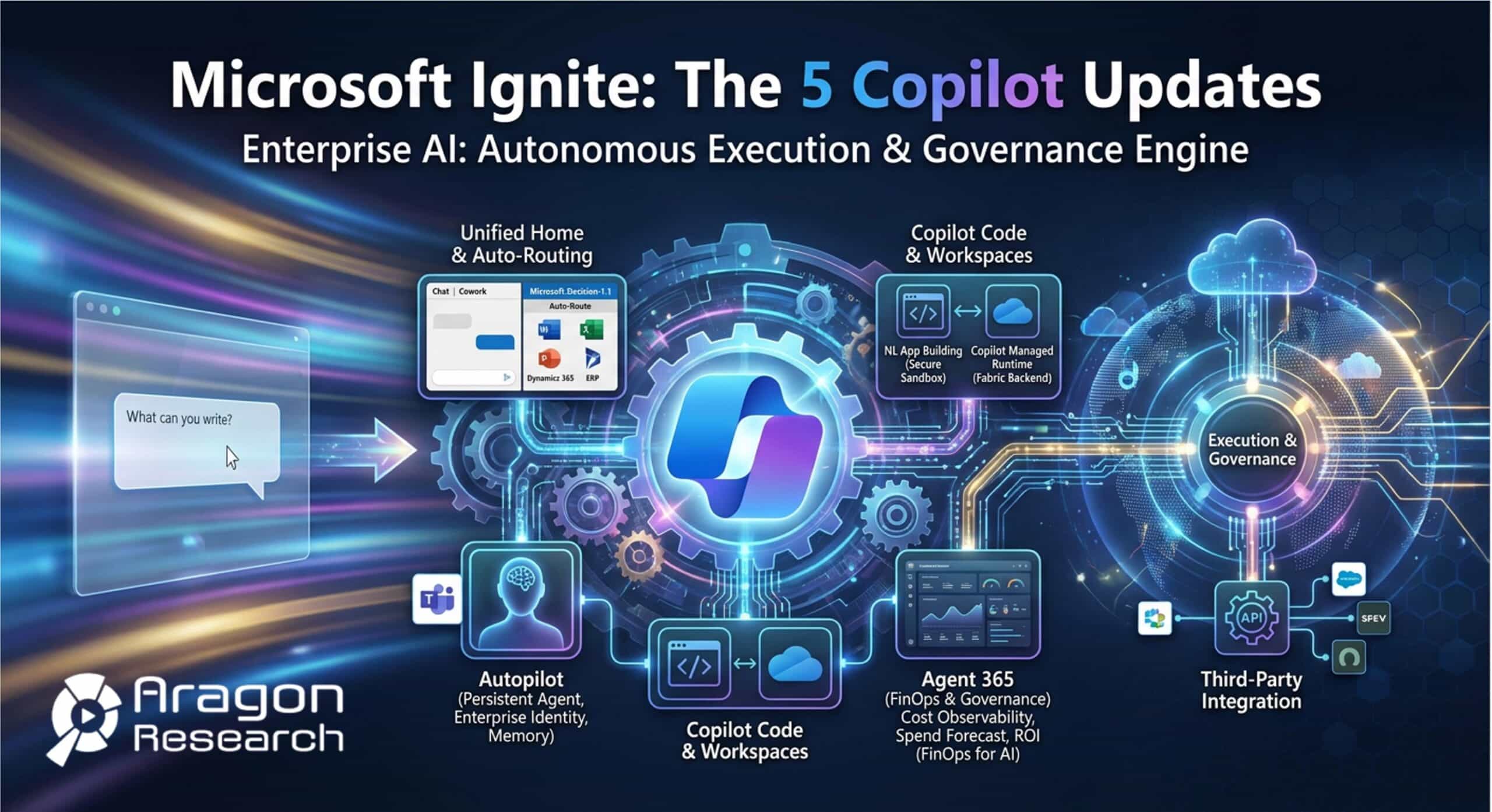
Image design by Aragon, rendered by Gemini.
By Jim Lundy
Microsoft Ignite: The 5 Copilot Updates
Enterprise artificial intelligence has moved past basic chat interfaces into the era of autonomous execution. Organizations no longer ask what generative models can write; they demand to know what agents can complete and how much those runs cost. Microsoft just answered this market shift with a broad set of platform updates that turn its productivity assistant into an execution and governance engine. This blog overviews the Microsoft Copilot announcements and offers our analysis.
Why Did Microsoft Announce the New Copilot Capabilities
Microsoft needed to close the gap between personal productivity prompts and enterprise-wide agent governance. By introducing Home as a unified entry point for Chat and Cowork, along with Auto routing powered by the Microsoft-Decision-1.1 model, the vendor simplifies how workers switch between quick queries and complex workflows. Word, Excel, and PowerPoint now run directly inside the Copilot application, while Dynamics 365 Sales and ERP plugins embed core business transactions into the same workspace.
Beyond interface updates, Microsoft launched an infrastructure and governance layer led by Autopilot, Copilot Code, Copilot Workspaces, Copilot Managed Runtime, and Agent 365. Autopilot acts as a persistent, long-running agent with its own enterprise identity and memory that teams can mention in Teams channels. Copilot Code enables natural language app building in secure sandboxes, while Copilot Managed Runtime hosts those applications with an optional Microsoft Fabric data backend. Agent 365 introduces FinOps for AI, giving administrators and business leaders cost observability, spend forecasting, and return on investment metrics across Microsoft and third-party agents.
| Announcement | Core Capability | Availability |
| Agent 365 | FinOps observability, cost management, and ROI analytics | Frontier program; expands in December |
| Autopilot | Persistent personal agent with tenant identity and memory | Rolling out to Frontier customers |
| Copilot Managed Runtime | Managed hosting and governance with Fabric data backend | Generally available |
| Copilot Workspaces | Shared team space evolving from Copilot Notebooks | Frontier program |
| Dynamics 365 Plugins | Native Sales CRM and ERP actions inside Copilot | Generally available |
| Copilot Code | Natural language app creation inside secure sandboxes | Frontier now; GA in December |
| Copilot Home and Auto | Unified Chat and Cowork entry with smart model routing | Rolling out worldwide; Office in Copilot GA |
Analysis
These announcements signal that the standalone chat assistant market is effectively over. Microsoft is repositioning Copilot as an enterprise agent operating system where creation, hosting, collaboration, and financial governance live under one control plane. The most strategic piece of this release is not the user interface refresh, but the combination of Agent 365 and Copilot Managed Runtime. Chief information officers have hesitated to scale autonomous agents because usage-based token consumption creates unpredictable budget spikes and shadow IT sprawl. By delivering native FinOps for AI alongside a managed runtime connected to Microsoft Fabric, Microsoft gives technology leaders the financial guardrails required to approve production deployments.
This move forces competing enterprise software vendors and pure-play AI startups to replicate full-stack observability and runtime hosting or risk being relegated to narrow plug-ins. Independent citizen-development tools also face direct pressure from Copilot Code, which pairs natural language application generation with enterprise tenant security. Rivals can no longer compete strictly on model quality because Microsoft’s Auto router abstracts the underlying model away from the user, optimizing dynamically for speed, accuracy, and expense. Vendors lacking an integrated data foundation and cost governance dashboard will struggle to justify separate enterprise licensing.
What Should Enterprises Do About This News
Enterprise architecture and IT leadership teams should immediately evaluate Agent 365 and Copilot Managed Runtime against their current artificial intelligence governance frameworks. Organizations already participating in the Frontier program should pilot Autopilot and Copilot Workspaces with a single cross-functional department to observe how persistent agents interact with corporate memory and security boundaries.
Technology leaders must also review their low-code and application development portfolios before Copilot Code reaches general availability in December. Since Copilot Code and Managed Runtime use Microsoft Fabric as an optional data backend, data architects should examine how citizen-built agentic applications will impact existing Fabric capacity and data governance policies. Procurement teams should work with IT to test Agent 365 chargeback models before expanding usage-based agent consumption across business units. Be aware that Microsoft is looking for lock-in with this approach. Having a vendor neutral AI architecture is an assignment for IT and the business together.
Bottom Line
Microsoft has transformed Copilot from a conversational helper into a full-stack enterprise platform for building, hosting, and governing autonomous agents. The addition of Agent 365 FinOps and Copilot Managed Runtime directly addresses the cost transparency and security barriers that have slowed enterprise AI adoption. Enterprises should audit their overlapping low-code and agent orchestration tools now and establish clear FinOps guardrails before rolling out persistent agents like Autopilot at scale.
Related Blogs:
Microsoft Cloud Up 27% on Copilot Demand
Microsoft Copilot Cyber updates will be costly
How Anthropic won the PR Narrative but Google kept the Volume
Important Research related to this Blog:
Also – Check out all our Podcasts HERE
Have a Comment on this?