


AI Governance: Focus on Empowerment Not Control
By Betsy Burton
In many organizations, and particularly among some vendors and IT professionals, the term “governance” still carries the connotation of a rigid control function—a set of technologies designed primarily to restrict action and ensure compliance with minimum standards. And most recently, I have seen a number of AI database and platform providers position their data management capabilities as “governance.”
This perspective often frames governance as an obstacle to innovation, focusing heavily on preventing misuse rather than enabling effective, responsible use.
Viewing governance as a control mechanism will not work – especially with today’s technically savvy business environment.
The core issue is about business, people, processes, information and technology. It is not a technology first issue; it is a business first issue. Adding to this issue, many business and IT leaders lack the training and focus required to address the business, performance management, investment, ethical and data quality dilemmas that AI introduces.
Decisions about AI are rarely obvious business, people, ethical or investment quandaries considered in isolation; they are often a series of small, isolated choices in an grey area that collectively lead to a significant impact. Furthermore, executives are generally rewarded based on revenue generation or cost-savings, which may actively discourage questioning decisions related to business strategy and governance.
Elevating Governance to a Strategic Discipline
AI Governance must be recognized as a discipline, not just an afterthought. It is the process of defining, tracking, and measuring critical business operational components to reduce risks and increase business outcomes. This holistic approach is critical for ensuring a business makes appropriate ethical use and reuse decisions, enforces privacy policies, and appropriately engages with its entire ecosystem of partners, suppliers, and customers.
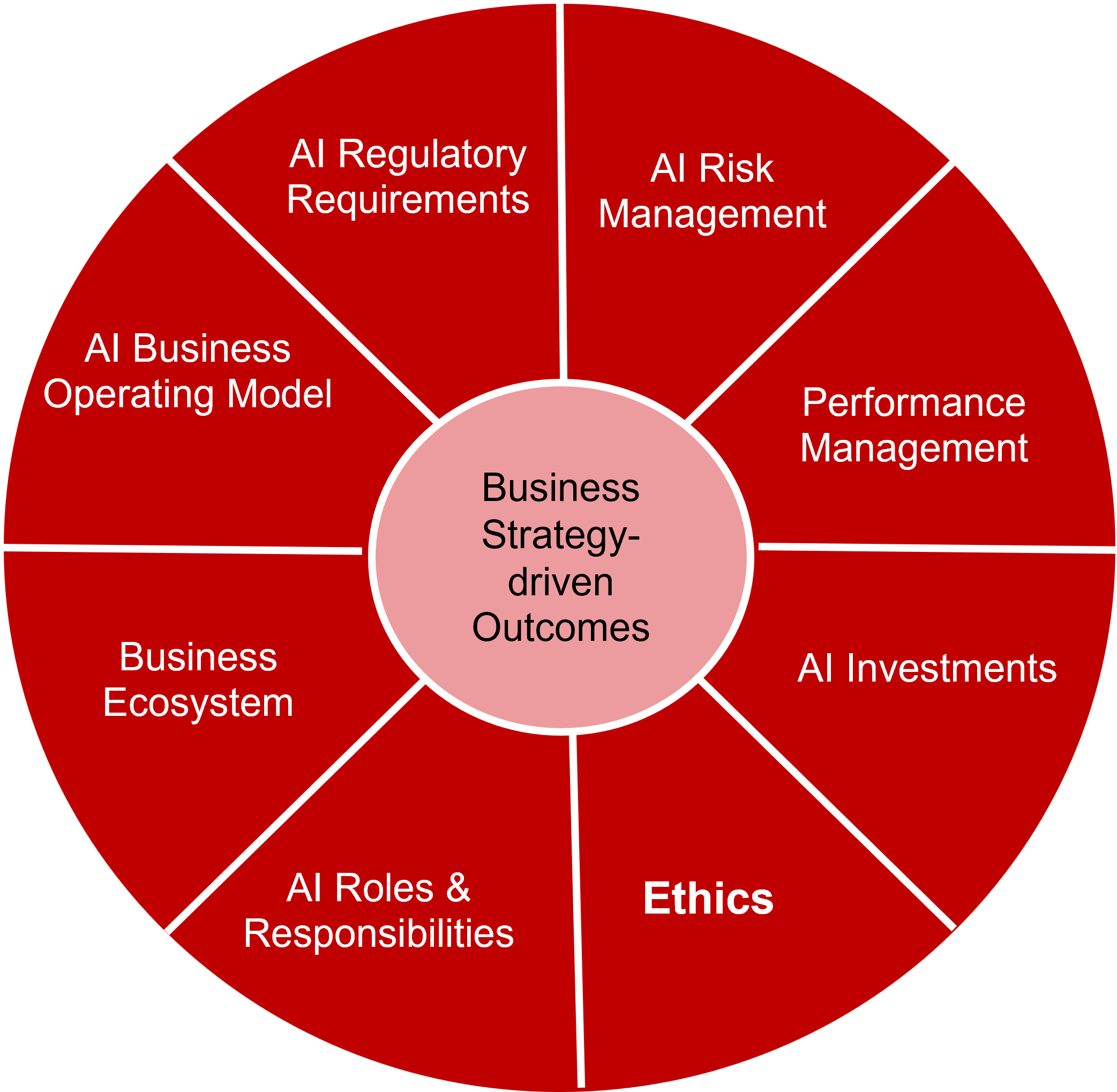
Aragon Research AI Governance Framework
This strategic discipline encompasses a broad framework of interconnected components, extending far beyond simple compliance:
- Roles & Responsibilities: Governance must clearly define roles for humans in the continuous training and management of AI, as well as the responsibilities of digital labor (assistants/copilots) within the increasingly digital workforce.
- Investments: Governance must guide how and when to invest in AI technologies, especially since many organizations are adopting AI organically through end-users or embedded within applications like Google Gemini and Salesforce Einstein.
- Performance Management: Establishing clear metrics for AI technologies and AI-enabled processes is critical, ensuring a clear line of sight between specific metrics and the overall business strategy and outcomes.
- Business Operating Model and Ecosystem: AI will challenge organizations to rethink or revise their current operating model, which includes revising their business strategy, competitive model, and core aspects like resources and value proposition. Furthermore, effective AI governance must consider the external business ecosystem and help prioritize which partners are critical to integrate with or avoid on new AI projects.
- Ethics: Proactively defining and managing an ethical framework to ensure conscious decisions align with and enhance the business culture and goals. This is increasingly vital due to the impact of technology decisions on people, businesses, and society.
- Regulatory Requirements: Applying all existing (industry, regional) and new statutory mandates to technology usage.
- Risk Management: Quantifying the risks—including security and privacy concerns—and assessing the probability of unexpected, unfortunate events. Because AI is so new, many are just now beginning to understand its additional risks.
How to Apply the Aragon Research Governance Framework
Applying the Aragon Research Governance Framework is a foundational step in establishing a robust governance discipline, not just an afterthought.
- Gain Executive Buy-in and Education: Immediately educate senior executives on the value of AI governance and gain their support. Clarify how governance should be supported given the organization’s culture, commitment, and business strategy.
- Establish Metrics and Tracking: Define specific Performance Management metrics that tie the use of AI technologies directly to overall business outcomes and strategy. Use these metrics to continuously track and measure the impact of AI initiatives.
- Integrate with Business Functions: Ensure the governance strategy works collaboratively with departments like Legal, Architecture, HR, and IT. For example, HR must be involved in defining the roles and responsibilities of the digital workforce.
- Foster a Culture of Governance: The ultimate goal is to move beyond relying on isolated executive decisions and create a culture where governance is embedded into all decision-making, ensuring the responsible, effective, and ethical use of AI technologies.
Bottom Line
By adopting a comprehensive AI Governance framework—one that is focused on enabling strategic, measurable, and ethical use rather than just control—organizations can not only mitigate risks but also build trust with their stakeholders. This approach requires organizations to educate their senior executives immediately regarding the value of AI governance and gain their support.
Investing in AI governance and creating a culture of governance-driven decision-making is essential for navigating the increasingly complex business and IT landscape. It is the critical step to ensuring a more effective, measurable, ethical, and responsible use of these new technologies.
Have a Comment on this?