


Canva AI 2.0 will challenge Adobe
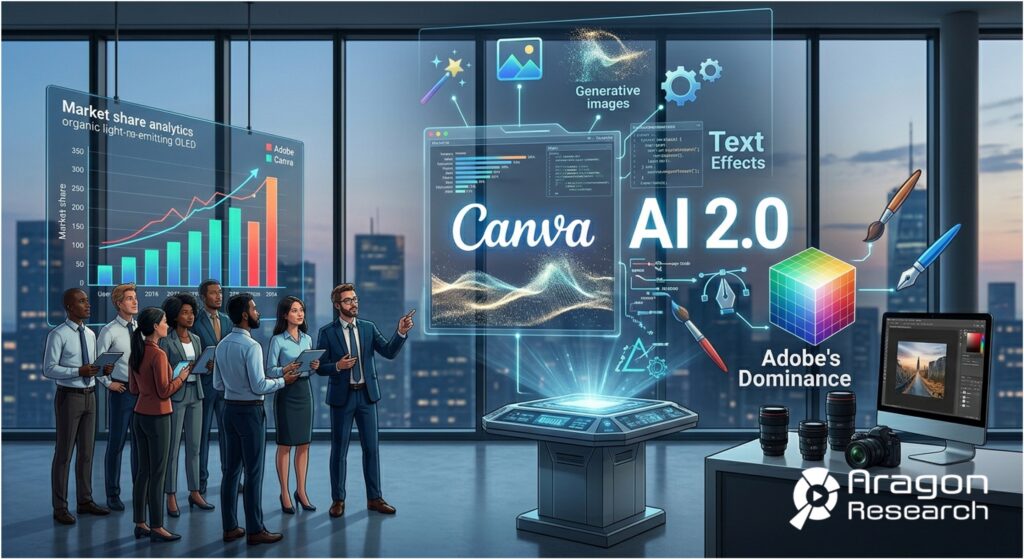
Image design by Aragon, rendered by Gemini.
By Jim Lundy
Canva AI 2.0 will challenge Adobe
The competitive landscape for digital design is undergoing a massive realignment as the boundary between casual and professional tools dissolves. Organizations are increasingly looking for ways to democratize content creation without sacrificing brand consistency or professional quality. Canva recently announced Canva AI 2.0 at its 2026 product launch, introducing a foundational design model that transforms the platform into an agentic creative partner. This blog overviews the Canva AI 2.0 news and offers our analysis.
Why did Canva announce Canva AI 2.0?
Canva launched AI 2.0 to transition from a template-driven editor to a conversational design ecosystem that handles end-to-end production. By introducing the proprietary Canva Design Model, the firm is providing users with the ability to generate fully layered, editable designs from simple prompts rather than flat, static images. The vendor is aiming to solve the modern enterprise dilemma of scaling content creation while facing limited design resources.
The addition of Agentic Orchestration and Connectors allows the platform to pull live data from enterprise tools like Slack, Salesforce, and Gmail to automate the creation of marketing assets and corporate reports. This shift is designed to capture the entire enterprise creative workflow, moving Canva beyond simple social media graphics and into complex, multi-channel campaign management. By embedding these autonomous capabilities, the vendor intends to embed itself deeply into daily operational workflows, making design a frictionless byproduct of data analysis and communication.
Why Canva is Challenging Adobe
The core of Canva’s challenge to Adobe lies in a strategic trifecta: disruptive pricing, advanced AI partnerships, and an aggressive push into the high-end corporate market. Historically, Adobe has maintained a lock on creative departments through complex, premium-priced software tailored to specialists. Canva is attacking this position by offering an enterprise alternative at a significantly lower price point, forcing procurement officers to question the necessity of seat-heavy Adobe Creative Cloud licenses for non-designers.
Furthermore, Canva is matching Adobe’s technical capabilities by embedding sophisticated models like Google’s Nano Banana directly into its ecosystem. This integration powers tools like Magic Layers, which breaks down AI-generated images into separate, movable elements to give users true composition control. Most importantly, Canva is moving up-market to challenge Adobe on process and workflow optimization. By connecting its brand intelligence layer with major corporate productivity hubs, Canva allows entire enterprise teams to generate compliant visual assets where their business data lives, bypassing traditional creative bottlenecks.
Analysis
The rollout of Canva AI 2.0 indicates that Canva is no longer content being the lite alternative to professional suites; it is moving directly into territory long held by Adobe. While Adobe has focused on integrating Firefly AI into its existing professional workflows to assist trained designers, Canva is rebuilding the creative process around the AI agent itself. The strategy bypasses traditional asset creation entirely by allowing non-technical employees to generate complex visual assets that previously required specialized training.
The most significant move is the introduction of Layered Object Intelligence, which mirrors the granular control of Adobe Illustrator but replaces the steep learning curve with a conversational interface. By adding autonomous web research, data synthesis, and automated scheduling, Canva is positioning its platform as a productivity hub that competes as much with Microsoft 365 and Google Workspace as it does with Creative Cloud. This news means Adobe will be forced to simplify its user experience further or risk losing the massive prosumer and enterprise marketing segments to Canva’s increasingly sophisticated automation. Furthermore, it signals an industry trend where the value of creative software is shifting from pixel manipulation to workflow orchestration.
Why did Canva announce Canva AI 2.0?
Canva launched AI 2.0 to transition from a template-driven editor to a conversational design ecosystem that handles end-to-end production. By introducing the proprietary Canva Design Model, the firm is providing users with the ability to generate fully layered, editable designs from simple prompts rather than flat, static images. The vendor is aiming to solve the modern enterprise dilemma of scaling content creation while facing limited design resources.
The addition of Agentic Orchestration and Connectors allows the platform to pull live data from enterprise tools like Slack, Salesforce, and Gmail to automate the creation of marketing assets and corporate reports. This shift is designed to capture the entire enterprise creative workflow, moving Canva beyond simple social media graphics and into complex, multi-channel campaign management. By embedding these autonomous capabilities, the vendor intends to embed itself deeply into daily operational workflows, making design a frictionless byproduct of data analysis and communication.
Analysis
The rollout of Canva AI 2.0 indicates that Canva is no longer content being the lite alternative to professional suites; it is moving directly into territory long held by Adobe. While Adobe has focused on integrating Firefly AI into its existing professional workflows to assist trained designers, Canva is rebuilding the creative process around the AI agent itself. The strategy bypasses traditional asset creation entirely by allowing non-technical employees to generate complex visual assets that previously required specialized training.
The most significant move is the introduction of Layered Object Intelligence, which mirrors the granular control of Adobe Illustrator but replaces the steep learning curve with a conversational interface. By adding autonomous web research, data synthesis, and automated scheduling, Canva is positioning its platform as a productivity hub that competes as much with Microsoft 365 and Google Workspace as it does with Creative Cloud. This news means Adobe will be forced to simplify its user experience further or risk losing the massive prosumer and enterprise marketing segments to Canva’s increasingly sophisticated automation. Furthermore, it signals an industry trend where the value of creative software is shifting from pixel manipulation to workflow orchestration.
Recommendations for Enterprises
Enterprises should evaluate Canva AI 2.0 as a potential replacement for fragmented creative and productivity tools. If your marketing and communications teams are currently struggling with the bottleneck of professional design requests, you should consider the implications of Canva’s new Brand Intelligence for maintaining governed, on-brand output at scale. IT and business leaders need to audit their existing design spend to identify where conversational AI can reduce software licensing costs.
We recommend evaluating the new Connectors and Sheets AI features to see if they can streamline your internal reporting and content distribution workflows. It is important to assess whether the conversational design model provides enough precision for your high-end creative needs before committing to a full platform migration. Businesses must also examine the data privacy frameworks of the Canva Design Model to ensure that corporate data ingested via connectors remains secure and compliant with internal governance policies.
Bottom Line
The launch of Canva AI 2.0 represents a fundamental shift toward agent-led creativity that directly challenges the dominance of traditional professional design software. By making complex workflows conversational and automated, Canva is lowering the barrier to high-fidelity production for every employee in the enterprise. Enterprises should closely monitor how these agentic features integrate with their existing tech stack to realize potential productivity gains in content creation. This move solidifies Canva’s status as a top-tier enterprise vendor that is successfully redefining the future of digital work.
Have a Comment on this?