

Google Cloud and Agentic AI Growth Surge
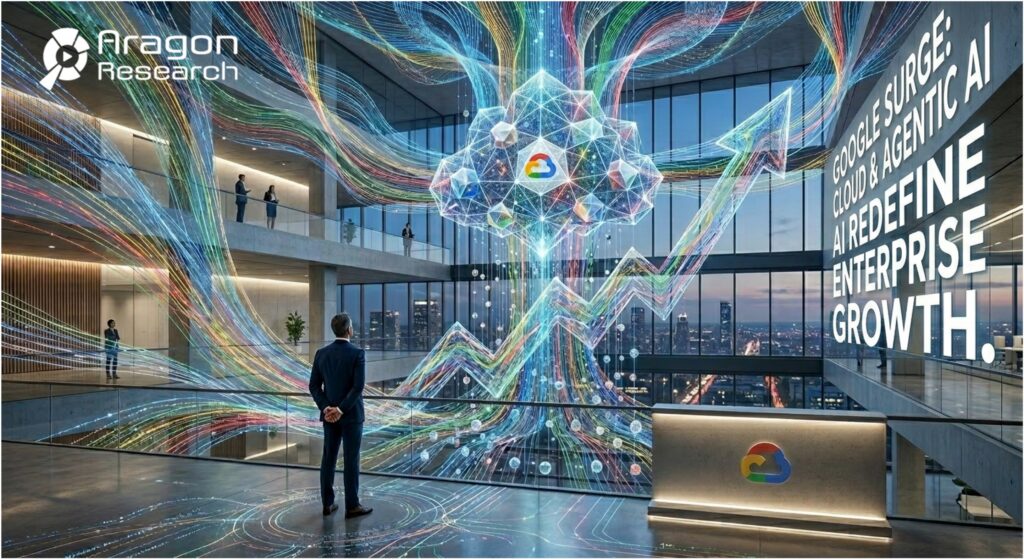
Image design by Aragon, rendered by Gemini.
By Jim Lundy
Google Cloud and Agentic AI Growth Surge
Alphabet, the parent company of Google, kicked off 2026 with a demonstration of financial strength, signaling that its long-term investments in artificial intelligence are now translating into primary revenue drivers. The company reported a landmark quarter, with Google Cloud surpassing the $20 billion revenue milestone for the first time. This blog overviews the Alphabet Q1 2026 earnings and offers our analysis.
Why Did Alphabet Announce These Record Results
The surge in performance was led by a 63% year-over-year increase in Google Cloud revenue, fueled by the rapid enterprise adoption of Gemini Enterprise and the Vertex AI platform. Alphabet CEO Sundar Pichai highlighted that the company’s “full-stack” approach—integrating custom silicon like the TPU 8t with advanced foundation models—is driving efficiency and attracting high-value contracts. Notably, the cloud backlog nearly doubled to over $460 billion, and the company closed its acquisition of Wiz to bolster its agentic security offerings. These results were paired with a 19% growth in Search advertising, proving that AI Overviews and the new “AI Mode” are increasing user engagement rather than cannibalizing traditional search traffic.
Analysis
The defining takeaway from this quarter is the shift from experimental AI to “agentic” production at scale. While competitors are still focusing on chatbots, Google is successfully pivoting toward autonomous digital task forces and agentic workflows. The 800% year-over-year growth in revenue from generative AI products within the Cloud division suggests that Google has successfully decoupled its growth from traditional seat-based licensing. By providing the underlying infrastructure—specifically the eighth-generation TPUs—Google is becoming the indispensable utility for the AI economy.
The integration of Gemini 3.1 across the stack has also allowed Google to solve the “cost of inference” problem that plagues many AI firms. Reducing the cost of core AI responses by 30% while decreasing latency by 35% is a significant engineering feat that provides a massive competitive moat. Furthermore, the acquisition of Wiz and the subsequent launch of “agentic defense” tools indicate that Google is positioning itself as the leader in AI-native security.
This is a direct challenge to legacy security vendors, as Google can now offer a self-healing, autonomous security perimeter that operates at a velocity humans cannot match. For the market, this news means that the “hyperscaler gap” is widening; firms without a vertically integrated hardware and software stack will find it increasingly difficult to compete on price or performance.
Strategic Recommendations for Enterprises
Enterprises should evaluate their current cloud and AI roadmap through the lens of agentic automation. With Google Cloud now delivering mature agent orchestration platforms like Gemini Enterprise, organizations should consider moving beyond simple LLM integration and toward building autonomous agents for specific business functions like procurement, network planning, or cybersecurity. Specifically, firms heavily invested in data should explore the new Agentic Data Cloud to leverage BigQuery’s 30x growth in Gemini-powered workflows.
It is also time to consider the implications of Google’s custom silicon. As Google begins delivering TPUs directly to select customer data centers, high-performance computing (HPC) and AI labs should evaluate the cost-per-dollar advantage of TPU 8i for inference over standard GPU clusters.
Enterprises currently using Meta or other open platforms should note the 50 million downloads of Gemma 4, suggesting that Google’s open-model strategy provides a viable, low-friction path for internal development that remains compatible with the broader Google Cloud ecosystem.
Bottom Line
Alphabet has successfully transitioned from an advertising company with an AI problem to an AI company with a massive advertising and cloud engine. The Q1 2026 results confirm that the “AI winter” was avoided through disciplined infrastructure investment and a focus on enterprise-grade agentic tools. For the enterprise, the message is clear: the era of the passive chatbot is over, and the era of the autonomous agent has arrived. Decision-makers should prioritize the evaluation of Google’s vertically optimized stack to ensure they are not overpaying for less efficient, non-integrated AI solutions.
Have a Comment on this?