


OpenAI Prism Accelerates Scientific Discovery Through Workflow Integration
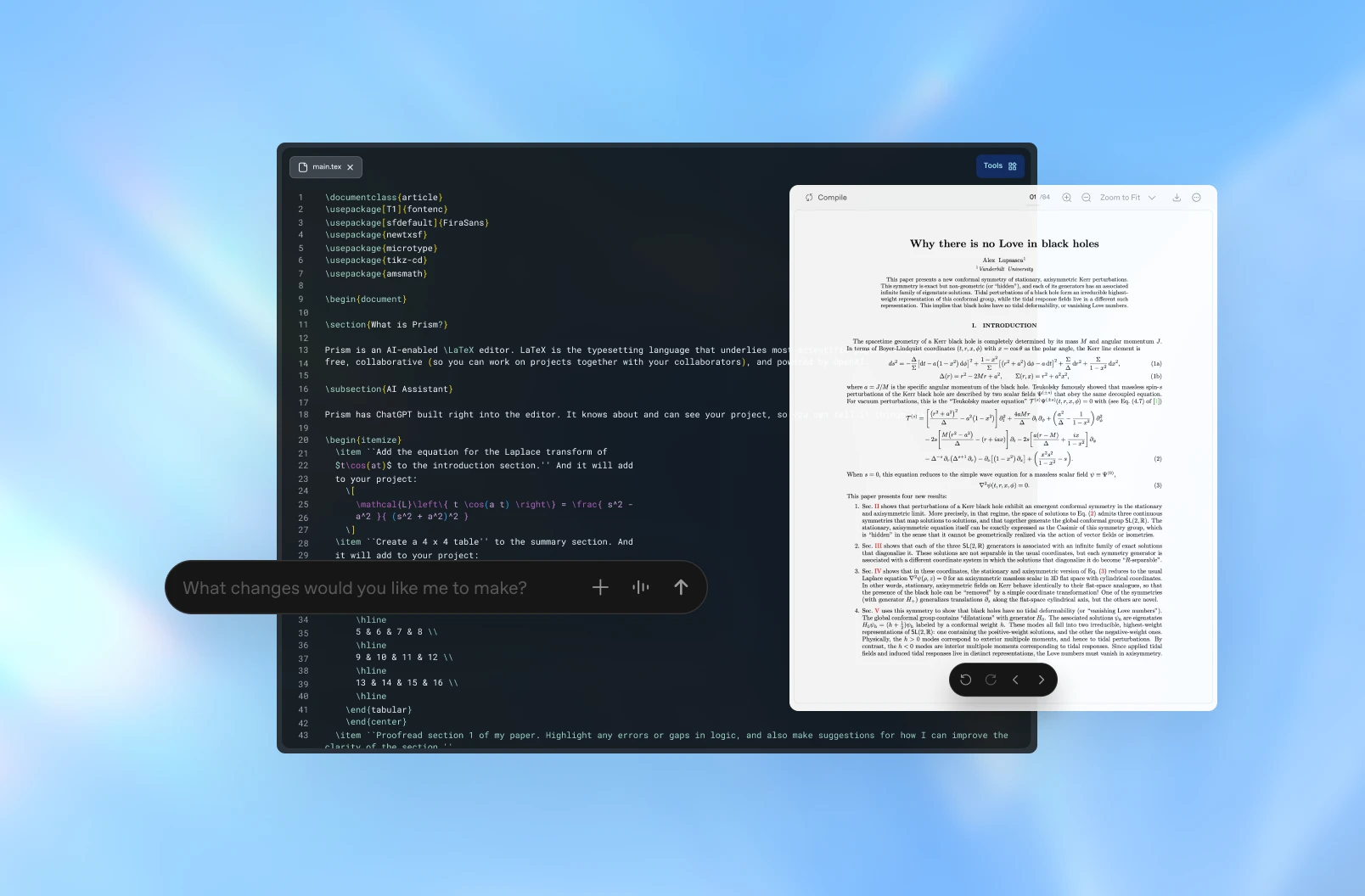
On Tuesday, January 27, 2026, OpenAI announced the launch of OpenAI Prism, a dedicated scientific workspace designed to bridge the gap between generative AI and rigorous academic research. Revealed during a press briefing, Prism arrives as a free web-based application for all ChatGPT account holders. The tool represents a strategic pivot toward domain-specific interfaces, aiming to replicate the success seen in AI-assisted software engineering by providing researchers with a specialized environment for paper composition and data synthesis. You can find the full details in OpenAI’s official announcement.
What Was Announced
Prism is a new product release that functions as an AI-enhanced word processor and research hub. It is built atop the GPT-5.2 architecture, leveraging the model’s advanced reasoning to assess scientific claims, revise technical prose, and perform deep literature reviews. Key capabilities include:
LaTeX Integration: Native support for the standard typesetting system used in academia, streamlining the move from draft to publication-ready document.
Visual Synthesis: The ability to convert whiteboard sketches or informal drawings into structured, publication-quality diagrams using GPT-5.2’s vision capabilities.
Context-Aware Research: A “Research Window” that maintains the full context of a project, ensuring that AI suggestions are grounded in the specific data and history of the user’s current study.
Why did OpenAI announce Prism?
OpenAI is capitalizing on a massive surge in scientific engagement; the company reports that ChatGPT now processes 8.4 million weekly messages related to hard sciences. By launching Prism, OpenAI is attempting to formalize this usage. The goal is to move the AI from a “chatbot” role into a “workflow” role, much like how specialized editors transformed coding. By providing a structured environment, OpenAI seeks to reduce the friction of formal verification and technical formatting, encouraging professional researchers to adopt GPT-5.2 as their primary investigative interface.
Analysis: Strengths and Challenges
Strengths
Technology & Efficiency: By integrating LaTeX and automated diagramming, Prism eliminates significant “grunt work” in scientific publishing. The deep context management also mitigates the “forgetfulness” often found in standard chat interfaces.
Business Positioning: Offering a free tier creates a massive top-of-funnel for OpenAI’s Pro and Enterprise subscriptions, securing the academic pipeline early in the research lifecycle.
Societal Impact: Early successes in proving Erdos problems and statistical axioms suggest that AI-human collaboration can significantly shorten the time-to-discovery for complex theoretical breakthroughs.
Challenges
Veracity and Hallucination: Despite GPT-5.2’s advancements, the “black box” nature of LLMs remains a hurdle for peer review. There is a persistent risk of the model generating plausible-sounding but mathematically incorrect proofs.
Academic Integrity: The ease of prose revision may lead to debates regarding authorship and the potential for “paper mills” to flood journals with AI-generated research.
Economic Barrier: While Prism is free, the heavy lifting—such as GPT-5.2 Pro’s advanced proofing—may eventually create a “compute divide” between well-funded institutions and independent researchers.
Impact on the market
Prism signals a shift in the AI market from “general purpose” tools to “verticalized” workspaces. We expect to see immediate pressure on traditional reference management software and LaTeX editors to integrate similar LLM capabilities. Furthermore, the focus on formal verification suggests that the next frontier for AI competition will not just be “creativity,” but mathematical accuracy and reproducibility.
Bottom Line
OpenAI’s Prism is a sophisticated attempt to turn ChatGPT from a conversational assistant into a professional research staple. By focusing on workflow integration rather than just raw model power, OpenAI is making a play for the “operating system” of the lab. Recommended Action: Enterprises and academic institutions should begin establishing guidelines for AI-assisted research now. While Prism offers immense productivity gains, the responsibility for verification remains firmly with the human researcher.
-
display trackbacks
Comments { 1 }