


Zoom pushes Knowledge with New Context Layer
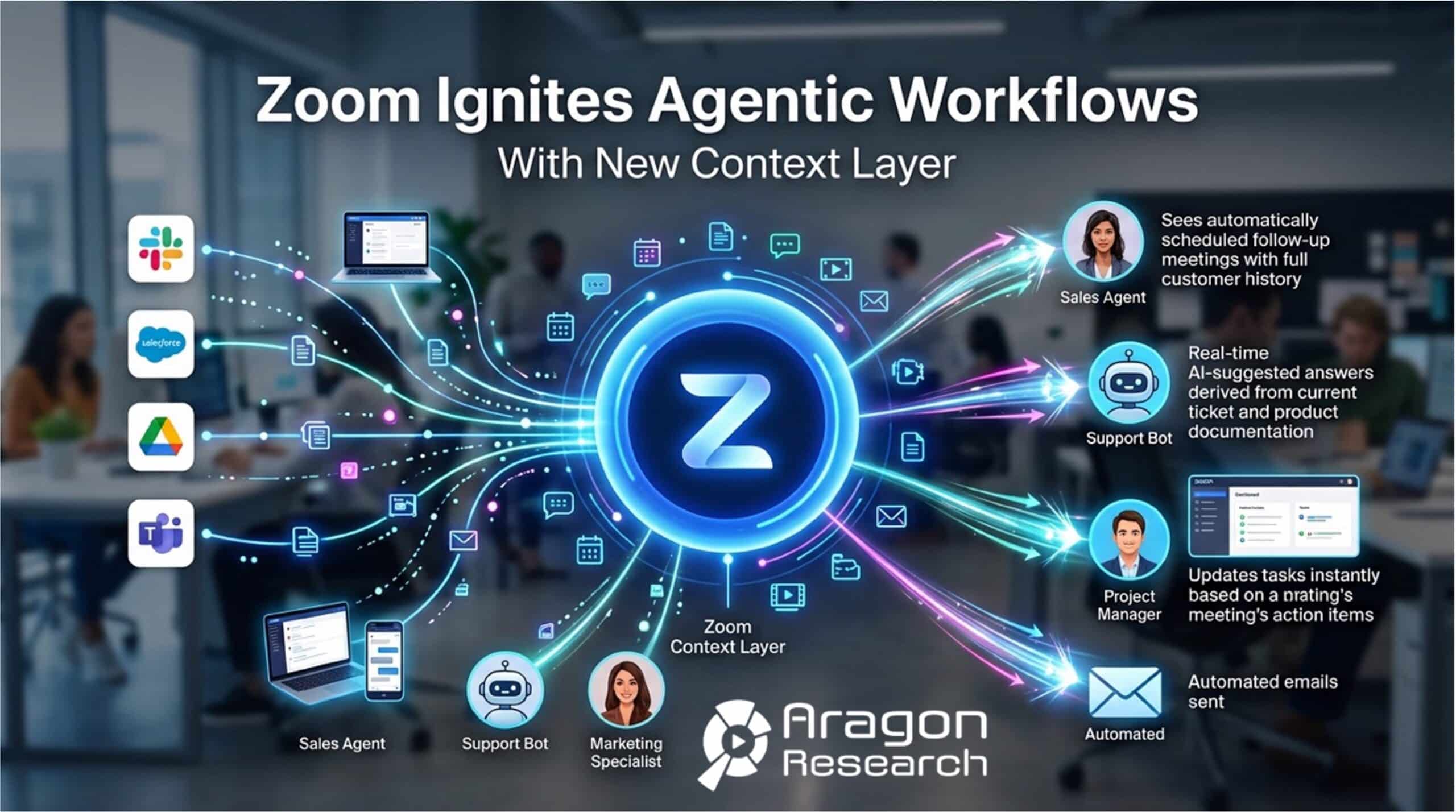
Image design by Aragon, rendered by Gemini.
By Jim Lundy
Zoom pushes Knowledge with New Context Layer
Conversations are the lifeblood of modern enterprise operations, yet most spoken insights evaporate the moment a meeting ends. Fragmented interactions across video, phone, and chat leave both human workers and software agents guessing about past decisions. At its annual Zoomtopia conference, Zoom introduced a Unified Context Layer alongside specialized agent teams and cross-platform data protocols. These capabilities transform scattered communication histories into structured enterprise memory. This blog overviews the Zoom Unified Context Layer announcement and offers our analysis.
Why Did Zoom Announce the Unified Context Layer?
Zoom announced the Unified Context Layer to eliminate the data silos that stall daily enterprise execution. When customer and internal conversations jump between video meetings, phone calls, and chat threads, critical business context gets lost. The Unified Context Layer solves this by linking conversation histories directly with relevant documents and real-time activity across third-party software.
To turn this context into action, Zoom also launched ZoomMate Agent Teams and new Model Context Protocol servers. These releases allow external assistants like Claude, Microsoft Copilot, Gemini, and Slackbot to query Zoom data directly. Furthermore, Zoom introduced natural language workflow automation in My Notes, dynamic customer profiles for Zoom CX, and centralized administration controls. New governance features include deepfake risk detection and integration with Microsoft Purview sensitivity labels.
Analysis
At Aragon Research, we view enterprise information through the lens of knowledge lakes that serve as foundational sources for digital skills and agentic processes. Historically, collaboration platforms acted as transient pipes for voice and video. Transcripts sat in isolated folders rather than feeding the broader organizational memory. With the Unified Context Layer, Zoom is converting unstructured conversational exhaust into a living knowledge lake. This repository directly powers autonomous skills and multi-agent workflows.
The true market differentiator here is architectural openness. By deploying Model Context Protocol servers and open search interfaces, Zoom allows external assistants from Microsoft, Google, OpenAI, and Anthropic to draw directly from its conversational data. Zoom recognizes that enterprises will not standardize on a single vendor for artificial intelligence. Instead of trapping data inside its own user interface, Zoom is positioning itself as the indispensable context engine for third-party agentic processes.
This strategy shifts the competitive landscape for the entire unified communications and contact center markets. Rivals that keep meeting data locked inside proprietary silos will find their platforms bypassed by enterprise architects building cross-functional agent teams. Competing collaboration vendors must now replicate this open context-sharing architecture. Those that fail to feed enterprise knowledge lakes will be relegated to commodity transport layers.
Additionally, embedding deepfake detection and sensitivity labels directly into this context layer addresses the primary bottleneck in agentic adoption. Automated processes cannot function safely if the underlying knowledge lake is polluted by synthetic media or unauthorized data exposure. Zoom is securing the data pipeline before the agents ever take action.
What Should Enterprises Do About This News?
Enterprises must evaluate Zoom’s new architecture as they design their roadmaps for digital skills and agentic processes. Chief Information Officers and enterprise architects should examine how the Unified Context Layer can feed their existing corporate knowledge lakes. Because Zoom now connects directly to platforms like Salesforce and external assistants via Model Context Protocol servers, technology leaders should audit their current integration middleware. You can eliminate custom data pipelines that are now natively supported.
Security and governance teams also need to test Zoom’s new Centralized AI Management controls, compliance archiving, and deepfake detection tools. Establishing strict data classification rules within Zoom will be essential before allowing autonomous agents to query meeting histories and execute cross-platform workflows.
Bottom Line
Zoom has evolved from a video conferencing utility into a core provider of conversational intelligence for enterprise knowledge lakes. By exposing its Unified Context Layer to third-party platforms, the company ensures that spoken business context can drive digital skills and agentic processes across the entire technology stack. Enterprises should evaluate these new capabilities immediately, test the Model Context Protocol integrations, and update their data governance policies to safely turn daily conversations into automated work outcomes.
Related Blogs:
Zoom Q2: Enterprise Wins and AI Pressure
Zoom dives deeper into AI Agents & On-Prem Tech
Important Research related to this Blog:
Also – Check out all our Podcasts HERE
Have a Comment on this?